Quick answer: A wedding venue sourcing brief is a client-approved document setting out the dates, location, guest count, budget scope, venue requirements and decision process for your search. It gives every venue the same basis for confirming suitability and price, and it gives you a shortlist the client can actually evaluate.
Settle what the venue has to deliver, and who can approve the choice, before you book a single tour. A beautiful property can still sit outside the approved spend, exclude the caterer the client has already hired, or have no workable indoor alternative when it rains.
Use the template below to turn a discovery conversation into a brief. Keep the internal approval details in your agency’s working copy, and send venues a shorter version carrying only what they need to respond.
A questionnaire and a sourcing brief are different documents
A questionnaire collects information. A sourcing brief records the requirements you have already resolved with the client. An RFP, where you need one, asks suppliers to propose and price a solution against those requirements.
The brief earns its keep whether you book directly, compare published options, or request a custom proposal. Not every project needs a formal RFP process, and treating every project that way is how planners lose a week.
Professional tools already handle the structured collection. Aisle Planner’s venue template guidance covers questionnaires, room layouts, vendor timing and venue-specific operating notes. [1] The client approval workflow below is an editorial recommendation for planning businesses rather than a feature of any particular platform.
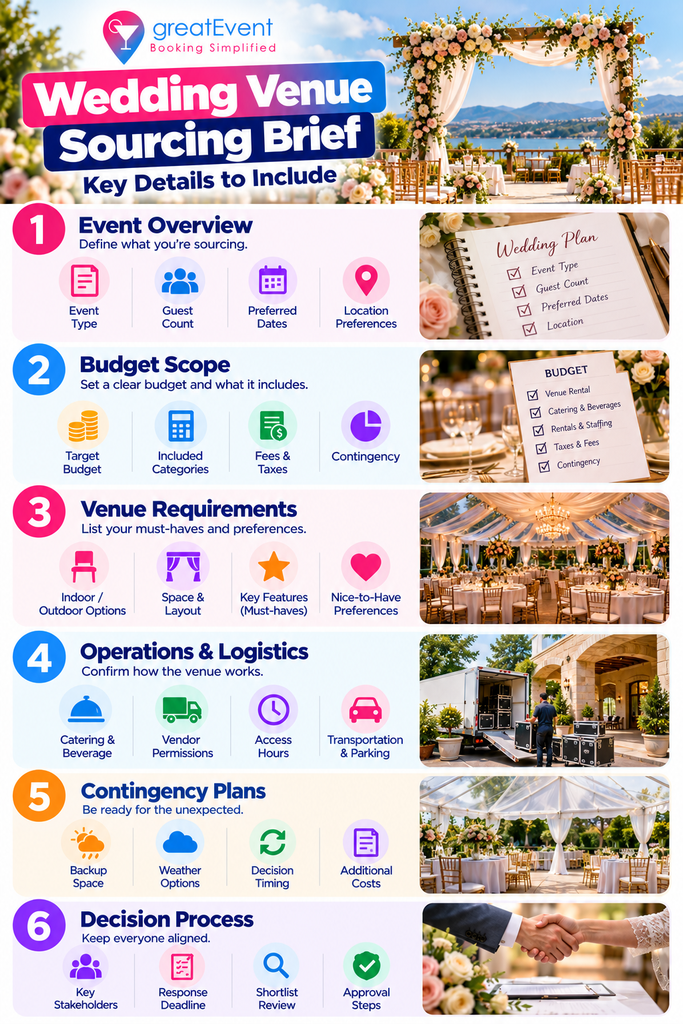
What a professional venue sourcing brief should include
| Brief section | Decisions to record | Why the planner needs it |
|---|---|---|
| Scope and authority | Included functions, decision maker, payer, authorized signer | Clarifies what you are sourcing and who can approve it |
| Dates and location | Preferred dates, acceptable alternatives, geographic limits | Prevents irrelevant availability checks |
| Attendance and layout | Expected and maximum guests, seating and event spaces | Tests fit against the intended setup |
| Budget scope | Target, ceiling, included categories, contingency treatment | Makes supplier prices comparable |
| Required features | Nonnegotiables, preferences, acceptable alternatives | Separates feasibility from subjective appeal |
| Operations | Catering, vendor permissions, access hours, transport | Identifies restrictions before tours |
| Contingency | Backup space, decision timing, additional costs | Tests whether the alternative is workable |
| Decision process | Response deadline, shortlist review, approval steps | Keeps the project and venue holds coordinated |
Write “unconfirmed” in any field you have not resolved. A blank reads as flexibility to whoever picks the document up next, and an unconfirmed requirement reads as a follow-up task. That distinction saves arguments later.
Define the budget before you request prices
Write down what the sourcing allowance actually covers. “Venue budget” can mean room rental alone, or a combined allowance spanning venue, catering, beverages, required rentals, staffing, fees and taxes. Two planners using the same phrase routinely mean different numbers.
Get the client to approve the categories before you compare properties. Record whether planning fees, transport, guest lodging and contingency sit inside or outside the allowance. Keep the client’s internal ceiling separate from the spending guidance they authorize you to share with suppliers, because those are rarely the same figure. Wedding venue costs and the 2026 venue cost guide are useful for setting that expectation before the client commits to a number.
For each venue, request the rental charge, minimum spending commitments, mandatory supplier costs and known additional fees. Ask how service charges and taxes are calculated. Do not assume a service charge is a gratuity, or that it counts toward a food and beverage minimum. Get the property’s written explanation.
The deposit schedule shapes the decision too. Capture when funds are needed and who approves payment. The Henry Ford’s published FAQ names date, location, minimum expenditures and deposit schedule as elements of its booking agreement. [2] That is one property’s arrangement, not a template for the market.
Translate client preferences into things venues can confirm
A mood board describes style. It does not establish capacity or permissions. Pair every important preference with an operational question.
| Client preference | Useful sourcing requirement |
|---|---|
| An outdoor ceremony | Outdoor space plus a named backup that supports the planned attendance and access needs |
| A preferred caterer | Written confirmation that the caterer is permitted, with any conditions or additional fees |
| Space for dinner and dancing | A proposed layout showing tables, dance floor, entertainment, service areas and circulation |
| A private experience | Named exclusive spaces, reserved hours, shared areas, and any other events on site |
| Convenient guest access | Verified arrival routes, parking or shuttle arrangements, and access to the actual event spaces |
Supplier rules vary by service and sometimes by room. The Chesapeake Bay Foundation’s Annapolis venue requires an approved caterer while describing an exception process for cultural or religious needs. The Henry Ford permits certain outside specialty vendors but sets approved access times and other restrictions. [2][3] Confirm the exact requirement rather than accepting a general “outside vendors welcome.”
Ask about cultural, religious, dietary and accessibility requirements in terms of the services the event needs. Share what the provider has to know, and keep unnecessary personal or medical detail out of a document that will circulate among several venues.
Where the ceremony and reception are separate bookings, the ceremony versus reception comparison covers how the two differ in cost and staffing.
Make the rain plan a shortlist criterion, not a footnote
For any outdoor component, ask the venue to name the backup space and show how the planned event fits inside it. Confirm whether that space is reserved for your client, whether it needs a room changeover, and how guests and vendors move between the two.
Record who makes the weather call, by when, and what additional rental, staffing or setup costs follow. The client should understand the alternative before they choose the property, not on the morning it starts raining.
The Henry Ford describes reserving an additional indoor venue for certain outdoor functions and sets its own decision timing. [2] Other venues handle it differently. Read that as a reason to ask for a written plan, not as a policy you can assume elsewhere.
Include the access hours your vendors actually need
The guest-facing schedule is a fraction of the venue booking. Ask for vendor arrival, installation, preparation, rehearsal, guest access, event end, breakdown and final collection times.
If a florist needs a long installation window, or a band needs a sound check, establish that before you ask about availability. Clarify delivery routes, storage, restrictions on installations, and who supplies setup labor.
Jacob’s Pillow publishes additional-charge provisions for extended access and work beyond the agreed scope. [4] Treat that as a prompt to price access and labor explicitly. Assuming they come included is a common and expensive habit.
A copyable wedding venue sourcing brief
Create one approved version per client project. Replace the bracketed fields, delete what does not apply, and date every revision. This is a planning template, not contract language.
Part A: internal client approval record
Project: [Client or project reference]
Planner: [Name and agency]
Brief version and date: [Enter]
Services being sourced: [Ceremony, reception, rehearsal, other]

Decision authority: [Who approves the shortlist]
Final venue approver: [Enter]
Authorized contract signer: [Enter]
Payer and payment approver: [Enter]

Budget approval: [Target and maximum authorized spend]
Included categories: [List]
Excluded categories: [List]
Contingency: [Amount or method; inside or outside the allowance]

Priorities: [Nonnegotiables]
Preferences: [Ranked list]
Acceptable compromises: [Enter]
Excluded properties or features: [Enter]
Unresolved client decisions: [Enter]

Approval record: [Client approver, date, version approved, reference]
Next review date: [Enter]
Any change affecting budget, date, attendance or essential
requirements requires a reissued brief.
Part B: the venue-facing brief
Project and contact: [Project reference, planner name, agency,
business email, phone]
Route sourcing responses through: [Lead planner]
Response deadline: [Date and time zone]

Dates and destination: [Preferred date]
Alternatives: [List or state none]
Geographic limits: [City, area, or maximum travel time from a
named point]

Attendance and layout: [Expected attendance and upper planning limit]
Counts by function: [Enter]
Required spaces: [Ceremony, dinner, entertainment, support]

Spending guidance: [Approved target or range]
This amount covers: [Categories]
Please state all exclusions, required minimums, mandatory supplier
costs, service charges and taxes.

Required features: [Nonnegotiables]
Preferred features: [List]
Existing or proposed vendors: [Only those relevant to permissions]

Weather alternative: [Required indoor or covered arrangement]
Please identify the backup location, layout, reservation status,
activation deadline, decision maker and any additional cost.

Guest logistics: [Parking, shuttle loading, arrival routes,
accommodation needs]
Room blocks: [Required / not required / to be confirmed]

Please return: available dates and named spaces; proposed layout;
itemized estimate; inclusion and restriction list; vendor
requirements; backup plan; hold status and expiry.
Part C: planner verification and next action
Venue and response date: [Enter]
Brief version answered: [Enter]
Essential requirements: [Confirmed / unresolved / not met, with
supporting evidence]
Site inspection required to verify: [List]
Open questions, owner and due date: [Enter]
Availability or hold status and expiry: [Enter]
Client approval needed by: [Enter]
If the venue is not a hotel, the room-block line needs its own answer early. Blocking hotel rooms for a wedding covers the general case, and room blocks when the wedding is not at the hotel covers the harder one.
Turning venue responses into a client shortlist
Check the nonnegotiables first. A property with a confirmed conflict belongs in an exception discussion. A property with an unanswered essential question is still pending verification, which is a different status and should not be presented as a finalist.
Then compare like with like: the same attendance, the same functions, the same access hours, the same cost categories. Call out any substitution a venue has proposed, such as a different ceremony space or a restricted setup window. Left unflagged, those vanish inside an attractive package price and resurface in week six.
Here is the shape of the problem, using invented numbers. A project expects 140 guests with an upper planning limit of 160, and the client requires an indoor ceremony alternative. A venue confirms dinner seating for 160 but indoor ceremony seating for only 120. It has not met the brief. The larger headline capacity does not resolve the mismatch, and no amount of enthusiasm about the grounds will seat the other 40 people. Either the client approves a workable change, or the venue comes off the list.
Present each finalist with the reason it fits, its expected cost for the defined scope, what remains unknown, and the next approval needed. Keep client preferences visibly separate from facts you verified with the property.
Start your next venue search with an approved brief
Take your approved date, location, attendance and essential requirements into a venue search on greatEvent. [5] Keep unresolved points visible in the brief rather than settling them in your head. If you are earlier in the process, how to choose a wedding venue and whether to hire a planner before choosing the venue cover the stage before this one. [6][7]
Research and sources
Public sources reviewed October 7, 2026. The numbered references identify supporting sources. The template, the client approval workflow and the shortlist method are editorial recommendations. Venue documentation describes that property’s own arrangements, so do not generalize any venue’s deposit percentage, access window, catering rule, capacity or weather policy across the US market. No market averages or savings figures are claimed anywhere.
[1] Aisle Planner, The Venue Expert’s Guide to Aisle Planner Templates. Documents professional venue questionnaires, layouts and operating notes.
[2] The Henry Ford, Wedding Venue FAQs and Planning. Property-specific booking agreement elements, outside-vendor rules and indoor backup arrangements.
[3] Chesapeake Bay Foundation, Wedding and Event FAQ. Approved-caterer requirement with an exception process for cultural or religious needs.
[4] Jacob’s Pillow, Hosted Event Guidelines and Policies. Additional-charge provisions for extended access and out-of-scope work.
[5] greatEvent, How It Works.
[6] greatEvent, How to Choose the Perfect Wedding Venue.
[7] greatEvent, Should You Hire a Wedding Planner Before Choosing a Venue.
Frequently Asked Questions
Who completes a wedding venue sourcing brief? ▾
The planner prepares it from the discovery conversation, checks for requirements that contradict each other, and gets client approval. The venue then responds to the brief rather than to a conversation nobody wrote down.
Should you share the full client budget with every venue? ▾
Share the spending guidance the client has authorized, and define exactly what it covers. The total project budget, the internal ceiling and any private negotiating position stay in your working copy.
Can you source venues before the guest count is final? ▾
Yes. Use an expected attendance and an upper planning limit. Ask venues to confirm layout suitability at both numbers, and to explain how pricing or minimum commitments change between them.
Does a sourcing brief replace a venue contract? ▾
No. It records requirements and supports comparison. Final scope, pricing, permissions and commitments get confirmed through the applicable booking documents.
What should you do when client requirements change? ▾
Issue a revised, dated brief, mark the changed fields, and send it to every affected supplier. Reconfirm availability, pricing and feasibility before anyone treats an earlier response as still valid.
Compare vendors for your next event
Search caterers, photographers, florists, planners, and rentals — then send one request to several vendors at once.