Quick answer: Event marketing means two related things. It is the work of promoting an event so the right people register and show up, and it is the use of events as a marketing channel for a brand. For planners and agencies, it usually means the first: a written plan that names the audience, the offer, the channels, the timeline, the budget, and the numbers you will report. Most event marketing strategies rely on a few owned channels (the event page, the email list, the client’s social accounts), backed by partners, sponsors, speakers, and paid ads where the budget allows, with a final push before registration closes and follow-up after the event.
Example scenario (fictional): A two-person agency in Columbus lands a client’s first regional conference. Registration opens with one email and a LinkedIn post. Six weeks out, sign-ups are slow, the client asks why, and the agency realizes no one agreed on who the event is for, what would make them register, or which channel was supposed to do the heavy lifting. The venue and program were fine. Nobody had written a marketing plan.
This is for professional US event planners and agencies who market events on behalf of clients: conferences, product launches, fundraisers, sports tournaments, and public social events. It covers what event marketing is, how to build an event marketing plan, the channels that work, a promotion timeline, event marketing ideas and examples by event type, the US email and endorsement rules that apply, how to measure results, and a short section on marketing your own event management company. The compliance notes are general information, not legal advice.
In this guide:
- What is event marketing?
- Event marketing strategy vs event marketing plan
- How to build an event marketing plan for a client event
- Marketing strategies for events: the main channels
- An event promotion timeline
- Event marketing ideas and examples by event type
- Email, endorsement, and search rules to know
- How to measure event marketing
- Marketing strategy for an event management company
- An event marketing plan template you can copy
What is event marketing?
The phrase gets used in two ways, and clients often mean different things by it, so settle which one you are being hired for. Promotion is one piece of the larger job, and our guide to what event management covers walks through the rest, from the client brief to the post-event report.
| Meaning | What it covers | Who usually asks for it |
|---|---|---|
| Marketing an event | Promoting a specific event to fill seats, sell tickets, or reach a registration target | Associations, event organizers, nonprofits, tournament hosts, and companies running their own conferences |
| Events as marketing | Using an event to build a brand, launch a product, or meet buyers in person | Brand and marketing teams planning launches, roadshows, customer events, and trade show presence |
Many projects involve both. A product launch is an event used as marketing, and it still needs its own promotion plan to get the right press, partners, and customers in the room. When a client says “we need help with event marketing,” ask which outcome they will judge you on: attendance, leads, sales, donations, press coverage, or something else.
Event marketing strategy vs event marketing plan
The two terms often get used as if they mean the same thing, but splitting them helps when you scope work with a client.
- The event marketing strategy is the set of choices: who the event is for, why they should come, what the client wants to get out of it, and which few channels will carry the message.
- The event marketing plan is the schedule that puts those choices into action: tasks, owners, dates, budget lines, and the targets you will report against.
A strategy can fit on one page. The plan changes every week as registrations come in and you move budget toward whatever is working.
How to build an event marketing plan for a client event
Start the marketing plan from the event brief, because the audience, budget, and goals are already there. If you do not have a brief yet, the event brief template has intake questions you can reuse. Then work through these seven parts.

1. Goal and target
Agree on one main goal and one number. For a paid conference, that might be registrations by a set date. For a product launch, it might be qualified buyers who attend. For a fundraiser, it might be tickets sold plus donations. Write down who reports the number and how often.
2. Audience
Describe the people you want in the room as specifically as you can: job roles, industries, locations, members versus nonmembers, past attendees versus first-timers. Each group may need a different message. Past attendees already trust the event; first-timers need a reason to try it.
3. Offer and message
Write down why someone should register, in the attendee’s words. That might be the speakers, the people they will meet, a skill they will learn, a cause they support, or simply a good time. Add the practical facts people check before they commit: date, city, venue, price, and any hotel block or travel details.
4. Channels
Pick a short list of channels and decide what each one is for. Most events lean on the client’s own email list and website, then add partners, sponsors, speakers, social media, and paid ads in proportion to the budget and the audience. The channel table in the next section covers the options.
5. Timeline
Work backward from the event date and any pricing deadlines, such as an early registration rate or a hotel block cutoff. Deadlines give people a reason to act now, so build the calendar around them.
6. Budget
List every marketing cost: ad spend, design, printing, email and registration tools, photography, and any promotional codes or free passes. Agree in writing on who pays for what and who approves spending changes.
7. Measures and reporting
Decide what you will track and set up the tracking before launch: tagged links for each channel, promo codes by partner, and registration source questions. Agree on a reporting rhythm with the client, such as a weekly update that shows registrations by channel against the target.
Marketing strategies for events: the main channels
When you work out how to market an event, no single channel does the whole job. The right mix depends on the audience, the budget, and how much the client already owns. These are the channels planners use most often, and what each one does well.
| Channel | Best used for | What to watch |
|---|---|---|
| Event website or registration page | The place every other channel points to: dates, program, price, venue, and the register button | Keep it current; old dates or prices cost registrations |
| Email to the client’s list | Announcements, deadline reminders, and personal invitations to past attendees | US commercial email rules apply (see below); segment past attendees from new contacts |
| Social media | Speaker news, behind-the-scenes posts, countdowns, and live coverage | Use the client’s accounts and brand voice; plan posts ahead in a calendar |
| Speakers and partners | Reaching audiences the client does not already have | Give them ready-made posts, images, and a tracked link or code |
| Sponsors | Shared promotion to the sponsor’s customers and followers | Write promotion duties into the sponsorship agreement |
| Paid search and social ads | Reaching new people quickly when organic reach is not enough | Set a budget cap and watch cost per registration by channel |
| Search and listings | Being found by people already looking for this kind of event | Public events may qualify for Google event results with correct markup |
| Direct outreach | High-value invitees such as buyers, VIPs, and major donors | Personal emails or calls from the client’s team often work better than mass sends |
If your client is selling sponsorships, write promotion duties into each package so sponsors share the event with their own audience. Event sponsorship for planners covers how to build packages and agreements. If you are comparing registration, email, and attendee tools for client events, the guide to event management software explains what those platforms do.
An event promotion timeline
Lead times vary a lot. A large conference may need many months; a local fundraiser may need a few weeks. The phases below stay roughly the same, so stretch or shrink each one to fit the event.
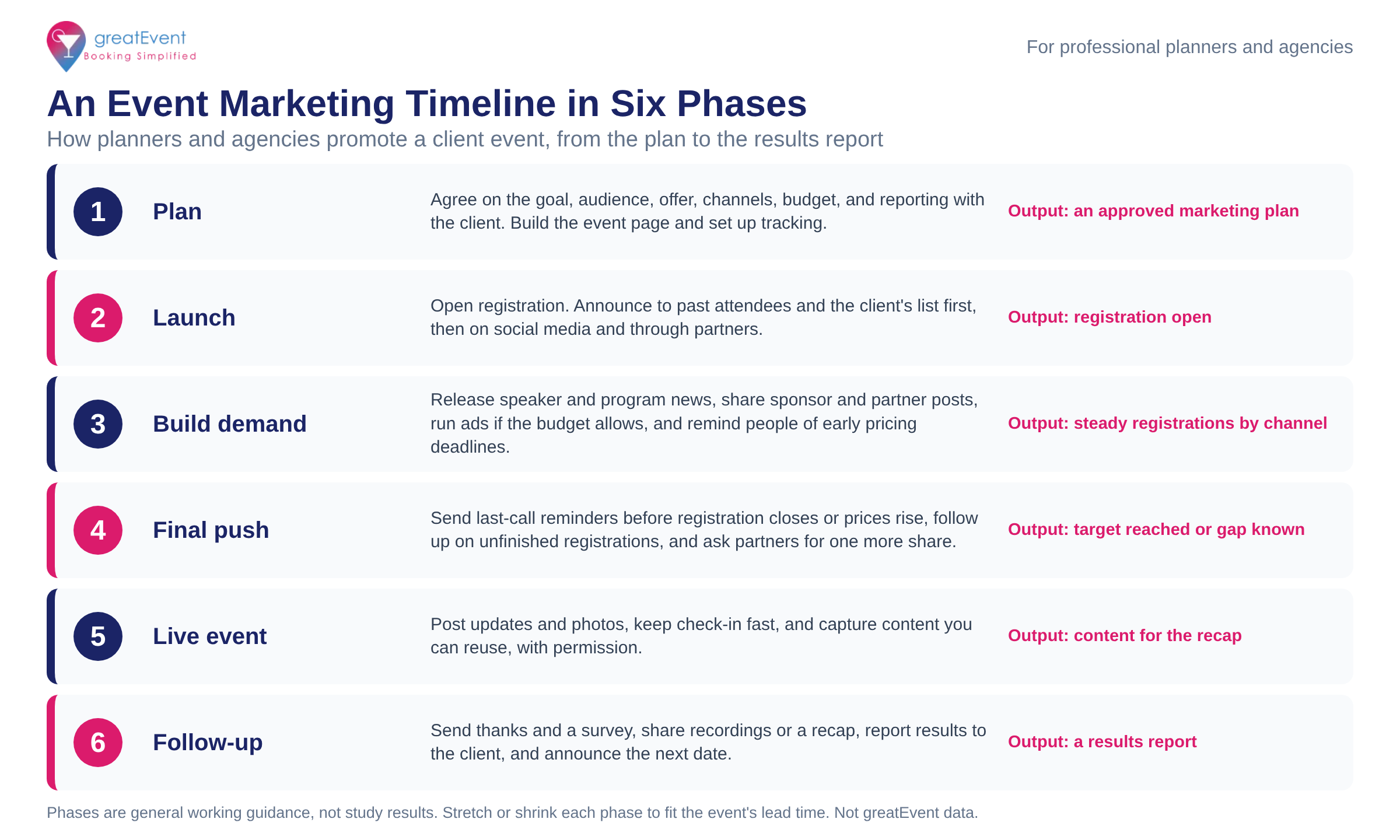
Text version of the infographic:
- Plan. Agree on the goal, audience, offer, channels, budget, and reporting with the client. Build the event page and set up tracking.
- Launch. Open registration and announce the event to past attendees and the client’s list first, then on social media and through partners.
- Build demand. Release speaker and program news, share sponsor and partner posts, and run ads if the budget allows. Remind people about early pricing deadlines.
- Final push. Send last-call reminders before registration closes or prices rise, follow up with people who started but did not finish registering, and ask speakers and partners for one more share.
- Live event. Post updates and photos, make check-in fast, and capture content you can reuse, such as session clips, quotes, and attendee photos taken with permission.
- Follow-up. Send thank-you emails and a survey, share recordings or a recap, report results to the client, and announce next year’s date if there is one.
Event marketing ideas and examples by event type
The best way to promote an event depends on who it is for. These event marketing examples are starting points by event type, not case studies. Pick the ones that fit the client’s audience and budget.
Conferences and association meetings
- Announce speakers one or two at a time to give the campaign a steady stream of news.
- Give each speaker a short kit with a graphic, suggested post text, and a tracked registration link.
- Offer group registration for teams from the same company.
- Email past attendees first, before the public launch, with a personal note.
- Publish the agenda early, even as a draft, since many attendees need it to get approval to attend.
Product launches and brand events
- Build the guest list by name with the client’s sales and PR teams, then invite by personal email or call.
- Offer press and partners an early preview or a separate briefing slot.
- Plan one moment on site that guests will want to photograph and share.
- Follow up with attendees within days, while the launch is still fresh.
The product launch event venue guide covers how the venue choice affects the guest experience and the photos people take.
Fundraisers and galas
- Ask board members and table hosts to invite their own networks, with a simple invitation they can forward.
- Tell the story of what the money will do, in the organization’s own words and with its approval.
- Promote sponsor tables and auction items as news in their own right.
- Send a thank-you after the event that reports what was raised, if the client wants to share it.
Sports tournaments and team events
- Reach coaches, club directors, and team managers directly, since they decide which events their teams enter.
- Publish the schedule, venues, and hotel details early, because families plan travel around them.
- If the event has a hotel policy, explain it clearly on the event page. The guide to the stay-to-play tournament requirement explains how those policies work for teams and families.
- Share results, photos, and highlights during the event to build interest in next year’s edition.
Public social and community events
- List the event on local event calendars and community sites where people look for things to do.
- Work with local businesses, groups, or creators who already reach the audience, and make sure any paid or gifted relationship is disclosed.
- Design a few spaces people will want to photograph; the guide to Instagrammable events has ideas for photo spots and decor.

Email, endorsement, and search rules to know
When you promote a client’s event, you are sending their marketing, so the same US rules apply to you. Three come up on almost every event.
Commercial email and the CAN-SPAM Act
The CAN-SPAM Act defines a commercial email as one whose primary purpose is to advertise or promote a commercial product or service. A promotional email that sells tickets or registrations fits that definition. Transactional messages, such as a confirmation for a registration someone already completed, are treated separately. Under the law, a commercial email must:
- have accurate header and sender information, and a subject line that does not mislead about the content;
- clearly identify the message as an advertisement or solicitation, unless the recipient gave prior affirmative consent;
- give a clear way to opt out, which must keep working for at least 30 days after the message is sent;
- include a valid physical postal address for the sender.
Opt-out requests must be honored within 10 business days. The law also counts anyone who pays or induces another person to send a message on their behalf as someone who initiated it, so the client and the agency can both be responsible for a campaign. Agree in writing on who owns the list, who handles unsubscribes, and whose address goes in the footer.
Influencers, speakers, and paid partners
The FTC’s Endorsement Guides say that when there is a connection between an endorser and the seller that might affect how much weight people give the endorsement, and the audience would not expect it, the connection must be disclosed clearly and conspicuously. The guides list business, family, and personal relationships, payment, and free or discounted products as examples of material connections. For events, that can include creators, speakers, or partners who promote the event in exchange for payment, free passes, or perks. Ask anyone you compensate to disclose the relationship in each post.
Google event results
Google can show public events in its search results when the event page uses Event structured data. Its documentation sets out a few rules that matter for planners:
- Each event needs its own page with a unique URL and markup on that page. The required properties are the event name, start date, and location.
- Only events the general public can attend are eligible. Invitation-only and members-only events are not.
- Virtual events with no real-world component are not supported; the event has to take place at a physical location.
- If an event is canceled or postponed, change the event status and leave the original start date and location in place. If it is rescheduled, update the start and end dates to the new ones.
- Don’t put promotional text such as ticket discounts in the event name.
If the event is listed on a ticketing or social platform, check whether that platform already takes part in Google’s event search experience before you add markup yourself. On WordPress, Google suggests checking for a plugin that adds the structured data. Google does not guarantee that an event will appear in its results.
How to measure event marketing
Report against the goal you agreed on in the plan. Most clients want to see:
| Measure | How to track it | What it tells you |
|---|---|---|
| Registrations by channel | Tagged links, promo codes, and a “how did you hear about us” question | Which channels are worth more budget next time |
| Cost per registration | Channel spend divided by registrations from that channel | Whether paid channels are paying off |
| Attendance against registrations | Check-in data compared with the registration list | Whether reminders and the offer held people’s interest |
| Leads, sales, or donations | The client’s CRM or fundraising records, matched to attendees | Whether the event did its business job |
| Attendee feedback | Post-event survey | What to keep, cut, or promote differently next year |
The post-event survey questions guide has question sets you can adapt, and the guide on how to measure event ROI shows how to turn these numbers into a return figure for the client.
Marketing strategy for an event management company
Your own agency needs a marketing plan too, and the same steps apply: a clear audience, an offer, a few channels, and a way to measure what brings in work.
- Pick a niche you can describe in one sentence, such as association conferences, product launches, or youth sports tournaments.
- Build a portfolio page for each event type, with photos you have permission to use, the client’s brief, and what you delivered.
- Ask happy clients for referrals and testimonials soon after a successful event.
- Stay in touch with venues, hotels, and your vendors and suppliers, since they often hear about events before planners do.
- Publish useful planning content for your niche and share it with past and prospective clients.
- Track where every new inquiry came from so you know which channel to invest in.
Your pricing is part of your marketing, because it tells clients what kind of work you do. The guide on how to price event planning services covers fee models and packages, and what event planners charge, and how roles and budgets compare gives you context when clients ask about cost.
An event marketing plan template you can copy
Copy this outline for each client event. Fill in the brackets, get the client’s approval, and update it weekly once registration opens.
EVENT MARKETING PLAN: [Event name]
Client: [Company]   Approver: [Name, title]   Marketing lead: [Name]
Event date: [Date]   City and venue: [City, venue]

1. GOAL
Main goal: [Registrations, tickets, leads, donations, press]
Target number and date: [Number by date]
Who reports it and how often: [Name, weekly/biweekly]

2. AUDIENCE
Primary group: [Roles, industries, locations]
Secondary group: [Past attendees, members, local community]

3. OFFER AND MESSAGE
Why register: [Speakers, people, learning, cause, experience]
Practical facts: [Price, deadlines, hotel block, travel]

4. CHANNELS (owner / purpose)
Event page: [Owner] / [Purpose]
Email: [Owner] / [List, segments, send dates]
Social: [Owner] / [Accounts, post plan]
Speakers and partners: [Owner] / [Kits, tracked links]
Sponsors: [Owner] / [Promotion duties in agreements]
Paid ads: [Owner] / [Budget cap, platforms]

5. TIMELINE
Launch: [Date]
Early pricing deadline: [Date]
Hotel block cutoff: [Date]
Final push starts: [Date]
Registration closes: [Date]
Follow-up sent: [Date]

6. BUDGET
Ad spend: [Amount]   Design and print: [Amount]   Tools: [Amount]
Free passes or promo codes: [Number, who gets them]
Spending approvals by: [Name]

7. COMPLIANCE
Email list owner and unsubscribe handling: [Name]
Postal address in email footer: [Address]
Disclosure required for paid or gifted partners: [Yes/No, who]

8. REPORTING
Tracked links and codes set up: [Yes/No]
Weekly report: registrations by channel vs target
Post-event report due: [Date]
Source venues and room blocks for the events you market on greatEvent
A strong campaign still needs the right venue and hotel details to promote. On greatEvent, planners can search venues for corporate meetings, conferences, trade shows, weddings, and social events, filter by event type, location, date, capacity, and distance, and compare meeting room capacities side by side. You can send one detailed inquiry to multiple venues and get quotes back, then add services and a hotel room block and finalize the details with your event specialist, so the facts on your event page match what is booked. For tournaments and team travel, use greatEvent Sports.
There are no fees for planners. We pay you commission on any qualifying booking you make on greatEvent.
Register as a professional planner
Frequently asked questions
What is event marketing?
▾
Event marketing is the work of promoting an event so the right people register and attend. The term also describes using events, such as launches and customer events, as a marketing channel for a brand.
What should an event marketing plan include?
▾
A plan should cover the goal and target number, the audience, the offer and message, the channels and who owns each one, a timeline built around deadlines, the budget, and how results will be tracked and reported.
What is the best way to promote an event?
▾
There is no single best channel. Most events start with the organizer’s own email list and event page, then add speakers, partners, sponsors, social media, and paid ads based on the audience and budget.
Do US email rules apply to event promotion emails?
▾
Yes. Under the CAN-SPAM Act, promotional emails need accurate sender details, an honest subject line, a working opt-out, and a valid postal address, and opt-outs must be honored within 10 business days.
Can a private event appear in Google event results?
▾
No. Google’s event results are for events the general public can attend. Invitation-only and members-only events are not eligible, and online-only events are not supported.
Research and sources
Sources were checked on November 2, 2026. The opening scenario is fictional. The event marketing ideas and timeline are general working guidance, not results from a study. The email and endorsement notes summarize the law and FTC guidance and are not legal advice.
- Google Search Central, Event (Event) structured data, developers.google.com.
- 15 U.S.C. 7702, CAN-SPAM Act definitions, via Legal Information Institute, law.cornell.edu.
- 15 U.S.C. 7704, Other protections for users of commercial electronic mail, via Legal Information Institute, law.cornell.edu.
- 16 CFR 255.5, FTC Guides Concerning the Use of Endorsements and Testimonials in Advertising: Disclosure of material connections, via Legal Information Institute, law.cornell.edu.
Compare vendors for your next event
Search caterers, photographers, florists, planners, and rentals — then send one request to several vendors at once.