Quick answer: To find event sponsors for a client event, agree on who sells and who delivers, list what the venue and hotel contracts allow you to sell, and price each package from its cost to deliver plus the client’s revenue target. Pitch past sponsors, the client’s vendors and suppliers, and companies that sell to the attendees. Put every benefit in writing, track delivery on site, and send each sponsor a recap within a few weeks. For a nonprofit client, have its tax adviser review the benefits first.
A client calls six months out from its annual conference and says the board wants sponsors to cover the welcome reception and the coffee breaks this year. Someone has to decide what a sponsor gets, whether the hotel allows a branded charging station in the foyer, and whether the reception sponsor can have its logo on the room keycards, and on most client events that job falls to you.
This guide is for professional planners and agencies who plan client events such as corporate conferences, association meetings, galas, golf and sports tournaments, and nonprofit fundraisers. It covers event sponsorship levels, prospecting, pitches, activations, IRS basics for nonprofit clients, and the sponsor recap. It doesn’t repeat the basic sponsor tiers in our guides to planning a fundraising event in Maryland and hosting a corporate 5K. Nothing here is tax or legal advice.
In this guide:
- Decide who sells and who delivers
- List what you can actually sell
- Build sponsorship levels from deliverables
- How to find sponsors for a client event
- Write the sponsorship proposal
- Event sponsorship activation ideas by event type
- Nonprofit clients: acknowledgment vs. advertising
- Contracts and on-site fulfillment
- The sponsor recap and renewal
- Common mistakes
Decide who sells and who delivers
Event sponsorship work splits into two jobs: selling the packages and delivering them. Many planners only deliver, turning the client’s signed sponsors into signage, food and beverage orders, booth space, and run-of-show cues. Others run the whole program. Say in your proposal which one you’re signed up for, because selling usually takes more hours than fulfilling.
| Model | What you do | What to write into your agreement with the client |
|---|---|---|
| Client sells, you deliver | Build the asset list, give cost-to-deliver numbers, fulfill on site | Deadline for the final sponsor list and logos, and who approves requests that touch the venue contract |
| You run the program | Build the prospectus, pitch, negotiate, fulfill, and report | A price for sales work, who signs and invoices (usually the client), and what happens if sales fall short |
| Shared | The client brings warm contacts; you package, prospect, and deliver | A named owner for each prospect and one shared tracker |
Price the sales work like any other service line, using the models in our guide to how much event planners charge. In most cases the sponsor contracts with and pays the client.
List what you can actually sell
Before anyone drafts a tier, list every asset the event can offer and check each one against the venue and hotel contracts. Sponsor problems often start here: foyer branding the hotel won’t allow on its walls, or a reception time that conflicts with the banquet event order (BEO).
| Asset | Where it lives | What to confirm with the venue or hotel |
|---|---|---|
| Sponsored reception, meal, or coffee break | Food and beverage orders and BEOs | Per-person price, service charge and tax, timing, and whether it counts toward your food and beverage minimum |
| Exhibit or activation space | Meeting space agreement and floor plan | Square footage, power, load-in times, and whether it is in your contracted space |
| Signage, banners, and digital screens | Venue rules and AV order | Where signs may go, rigging rules, approved installers, and charges |
| Session, stage, or keynote sponsor | Program agenda and AV order | Stage time allowed and what can show on screens |
| Hospitality suite or private dinner | Meeting space agreement or room block | Availability, catering rules, and whether it sits in your room block |
| Hotel room perks (keycards, door drops, welcome amenities) | Room block agreement | Whether the hotel offers them, the cost, and lead time |
| Wi-Fi, charging stations, water stations | Venue AV and internet order | Custom network names, power, and who supplies equipment |
| Digital and printed items | Your client’s app, website, emails, and program | Ad sizes, deadlines, and mentions per email |

Walk the list with the venue’s event manager at your site visit and mark each item confirmed, conditional, or not allowed. Only confirmed items go into the prospectus. If you are still sourcing, add sponsor needs to the RFP, such as prefunction space with power and the hotel’s policy on branded room items.
Build sponsorship levels from deliverables
Sponsorship tiers for events are often copied from another prospectus, and gold, silver, and bronze levels with round prices tell a sponsor very little. Start with the asset list instead, group benefits into packages for each budget range, and check that the event can deliver every package at the number you plan to sell.
Price each package from cost to deliver
Add the cost to deliver and the client’s revenue target, then check the result against what the audience is worth to the sponsor. Illustrative example with fictional numbers for a welcome reception sponsor at a 300-person conference:
| Line | Calculation | Running total |
|---|---|---|
| Reception food and beverage | 300 attendees x $45 | $13,500 |
| Service charge and tax (fictional 25%) | $13,500 x 25% = $3,375 | $16,875 |
| Signage and production | $1,625 | $18,500 |
| Planner time to fulfill | 20 hours x $100 | $20,500 cost to deliver |
| Client’s revenue target for this package | $9,500 | $30,000 asking price |
Use your venue’s actual prices, service charge, and tax rate. If the reception was already budgeted, the client would have paid the $16,875 anyway, so only signage and your time ($3,625) are new costs and the sponsorship improves the budget by $26,375. Show the client both views.
Sponsorship level template
Copy this table and fill it in from your confirmed asset list. Leave prices blank until each package has a cost-to-deliver number.
| Benefit | Presenting (1) | Level 2 (2 to 3) | Level 3 (4 to 6) | Supporter (open) |
|---|---|---|---|---|
| Price | $______ | $______ | $______ | $______ |
| Category exclusivity | Yes, by industry | No | No | No |
| Named element (reception, breaks, Wi-Fi, keynote) | Main named element | One named element | Shared element | None |
| Stage or screen recognition | Opening remarks, up to ___ minutes | Logo on session slides | Logo on sponsor slide | Name on sponsor slide |
| Exhibit or activation space | Premium space, ___ sq. ft. | Standard table | Shared area | None |
| Registrations included | ___ | ___ | ___ | ___ |
| Hotel room perk | Keycard or room drop (if the hotel allows) | None | None | None |
| Digital (app, website, emails) | Logo, link, and ___ mentions | Logo and link | Logo | Name |
| Post-event recap and attendee list terms | Full recap | Full recap | Summary recap | Summary recap |
Set a hard limit per level. If you sell three reception sponsors, none of them owns the reception. Define exclusivity per package as “only sponsor in its industry” or “only sponsor of this element.” For nonprofit clients it has tax consequences, covered below.
How to find sponsors for a client event
The best prospects already want to reach the people in the room. Start with warm lists, then work outward.
- Pull the client’s sponsor and exhibitor lists from the last two or three years, and ask lapsed sponsors why they left.
- Ask the client for its vendors and suppliers. Banks, insurers, software providers, and law and accounting firms often sponsor a client’s events to protect the relationship.
- Sort the attendee list by job title and industry and list the companies that sell to those people. For an association, check who advertises in its publications.
- For galas, start with companies whose leaders sit on the board. For tournaments and community fundraisers, try local banks, car dealers, hospitals, and restaurants.
Qualify each prospect before you pitch: does it sell to this audience, does it sponsor similar events, and does anyone know someone there? Pitch the warm, well-matched ones first, and ask when each sets its sponsorship budget.
Expect sponsors to ask how you will measure results. In a 2025 survey of 41 global brand owners by the World Federation of Advertisers (WFA) and Lumency, 76% of the 38 who answered the question named measuring and demonstrating ROI as one of their top three sponsorship challenges. Brand awareness was the most used measure, cited by 84% of the 31 who answered that question. Those are large global brands, and local sponsors may differ, but plan to answer the measurement question early.
Write the sponsorship proposal
A sponsorship proposal should show who will be there, what the sponsor gets in front of them, and how results will be reported. Tailor the deck for top prospects and send a generic prospectus to everyone else.
Sponsor pitch deck outline
SPONSOR PITCH DECK: [Event name], [dates], [city / venue]

1. Cover: event name, dates, venue, client logo
2. The event in one slide: purpose, format, years running
3. The audience: expected attendance, job titles or donor profile,
   industries, regions (use registration data from past years,
   and say where the numbers come from)
4. Why this sponsor: 2 or 3 lines on how the audience fits
   [Company]'s customers or goals
5. Packages: the level table, with prices and limits
   (sold-out packages marked)
6. Named opportunities: reception, breaks, Wi-Fi, keynote, golf hole,
   with a photo or rendering of the space
7. Activation options: what a sponsor can run on site, with venue rules
8. What we report afterward: recap contents and when it arrives
9. Timeline: commitment deadline, logo and artwork deadline,
   activation plan deadline
10. Next step: contact name, email, phone, and a date to talk
Keep the first outreach email to a few sentences and send the deck after the first call, revised for what you learned.
Subject: [Event name] [year]: reaching [audience] in [city]

Hi [Name],

I'm planning [Event name] for [Client], [date] at [venue]. We expect
[number] [job titles / guests], many of whom [buy from / work with]
companies like [Company].

The [named package] would put [Company] in front of every attendee at
[moment]. Do you have 20 minutes next week to see if it fits your
plans for [year]?

[Your name], [title], [agency]
[phone]
Event sponsorship activation ideas by event type
Activation is what the sponsor does with the rights it bought, such as hosting the coffee bar or running a putting contest. The WFA and Lumency survey found brands spent about $0.76 on activation for every $1 spent on sponsorship rights in 2025, down from $0.81 in 2023. Tell sponsors early what they can run on site so they can budget for it.
| Event type | Activation ideas | Check with the venue |
|---|---|---|
| Conference or association meeting | Coffee bar, charging lounge, headshot station, named Wi-Fi | Power, prefunction space |
| Gala or awards dinner | Welcome toast, signature drink, photo backdrop | Bar rules, timing in the BEO |
| Golf or sports tournament | Hole sponsors, closest-to-the-pin contest, beverage cart | Signage rules, contest insurance |
| Nonprofit fundraiser | Paddle raise match, program sponsor, in-kind decor | Gift acceptance policy, tax review |
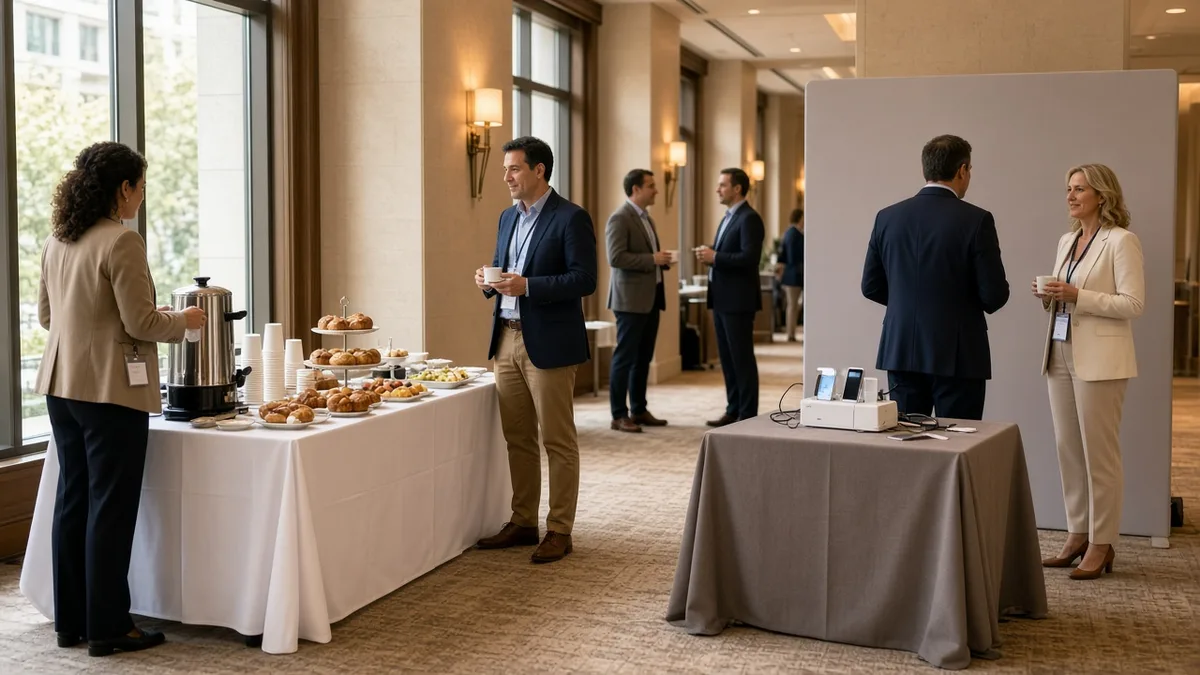
Match the activation to when attendees have time: a charging lounge suits a conference, where people wait between sessions, more than a seated gala.
Nonprofit clients: acknowledgment vs. advertising
This section is general information. If your client is tax-exempt, the benefits you package affect how the IRS treats the sponsor’s payment. A qualified sponsorship payment generally isn’t taxable income to the nonprofit. IRS Publication 598 describes it as a payment from a business that receives “no substantial benefit other than the use or acknowledgment of the business name, logo, or product lines in connection with the organization’s activities.” Payments that buy advertising or other substantial benefits can be unrelated business income. The client’s tax adviser should confirm how each package is treated.
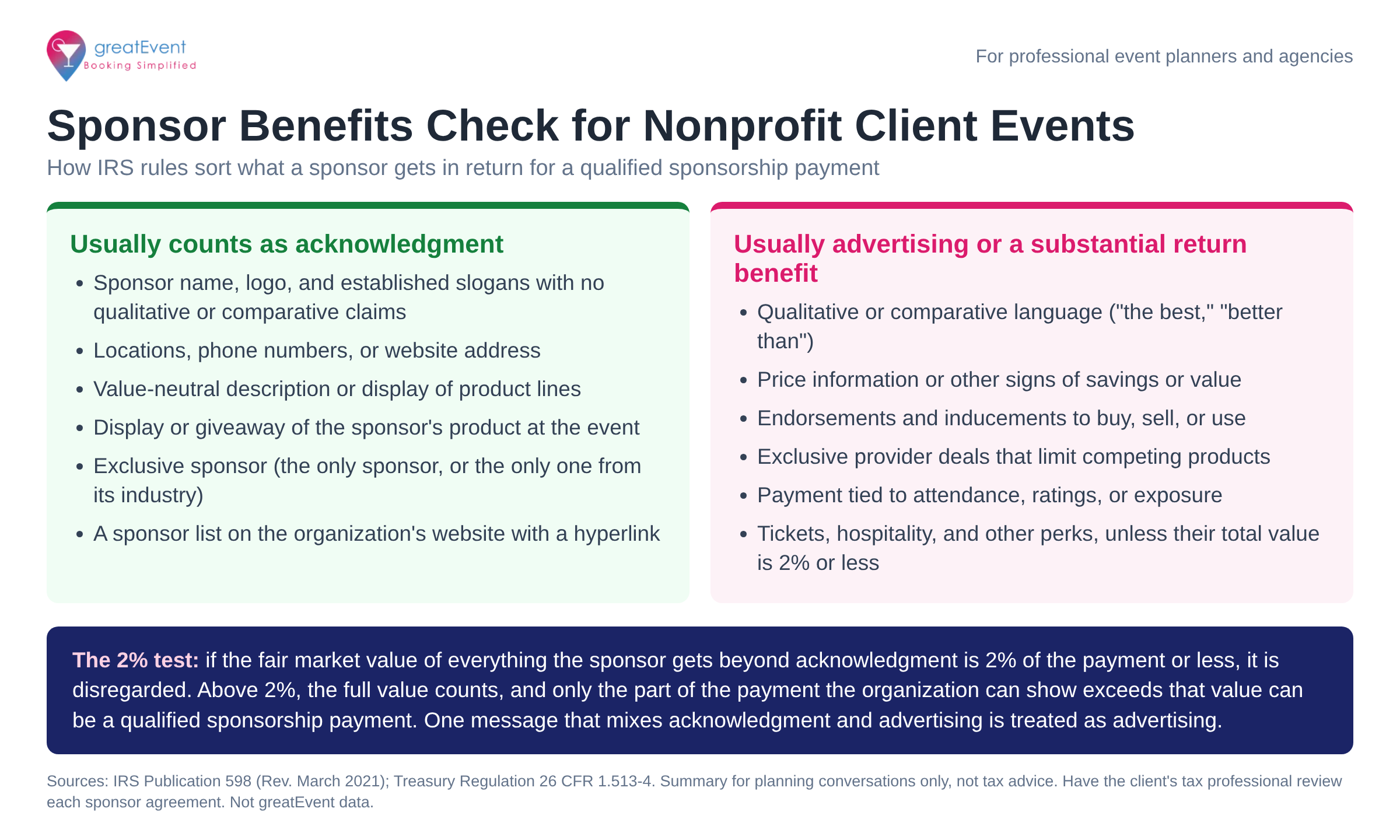
Text version of the infographic: Sponsor Benefits Check for Nonprofit Client Events. Usually counts as acknowledgment: the sponsor’s name, logo, and established slogans with no qualitative or comparative claims; its locations, phone numbers, or website address; value-neutral descriptions or displays of its product lines; display or giveaway of its product at the event; being the exclusive sponsor, or the only sponsor from its industry; and a sponsor list on the organization’s website with a hyperlink. Usually advertising or a substantial return benefit: qualitative or comparative language; price information or other signs of savings or value; endorsements and inducements to buy, sell, or use; exclusive provider deals that limit competing products; payment tied to attendance, ratings, or exposure; and tickets, hospitality, and other perks unless their total value is 2% of the payment or less. The 2% test: if the fair market value of everything beyond acknowledgment is 2% of the payment or less, it is disregarded. Above 2%, the full value counts, and only the part of the payment the organization can show exceeds that value can be a qualified sponsorship payment. One message that mixes acknowledgment and advertising is treated as advertising. Sources: IRS Publication 598 and 26 CFR 1.513-4. Not tax advice.
What this means for your packages
- “The welcome reception is sponsored by [Company]” with its logo is acknowledgment. Adding “the region’s best bank” makes it advertising.
- Being the only bank sponsor is generally fine. Selling only the sponsor’s beverages is an exclusive provider deal.
- Program book ads and trade show activity have their own rules, so flag them for the tax adviser.
Illustrative 2% check with fictional numbers: a $30,000 package includes 10 gala seats worth $250 each. 2% of $30,000 is $600, and the seats are worth $2,500, so the full $2,500 counts and at most $27,500 can be a qualified sponsorship payment. If the client can’t show that split, none of the payment qualifies.
Individual ticket buyers fall under different rules. IRS Publication 1771 requires a written disclosure with a good-faith value estimate when a donor pays more than $75 partly for goods or services. Its example: a $100 payment for a concert ticket worth $40 allows a deduction of no more than $60. Give the client per-person costs from your BEOs, and ask its counsel whether your sales work triggers state charitable solicitation registration.
Contracts and on-site fulfillment
Every benefit you sell becomes a task on site, so put the deliverables in the sponsor agreement and copy them into a fulfillment tracker.
What the sponsor agreement should cover
- The exact benefits, with sizes, quantities, times, and locations, and any exclusivity in plain words.
- Deadlines for payment, logos, artwork, and activation plans, with a fallback if logos arrive late.
- Approval rights over sponsor copy and signage.
- Venue rules and insurance requirements the sponsor must follow.
- What happens if the event is canceled or moved, lined up with the venue contract.
- Attendee data terms and privacy rules.
Have the client’s attorney review the template once. Under the IRS regulation, fair market value is generally set when a binding written contract is signed, and a renewal counts as a new contract, so send nonprofit renewals back through tax review.
Fulfillment tracker template
| Sponsor | Level | Benefit | Due from sponsor | Venue or vendor owner | Delivered (date, time) | Proof (photo, count, link) |
|---|---|---|---|---|---|---|
| [Company] | [Level] | Logo on reception signage | Vector logo by [date] | Sign printer | ||
| [Company] | [Level] | Branded coffee break, day 2 | Cup sleeves by [date] | Hotel catering (BEO #__) | ||
| [Company] | [Level] | Two-minute welcome remarks | Speaker name by [date] | Run of show / AV | ||
| [Company] | [Level] | Keycard branding | Artwork by [date] | Hotel front office |
Photograph every delivered benefit. The photos become most of the sponsor recap.
The sponsor recap and renewal
A sponsor recap shows each sponsor what it got and opens the renewal conversation. Send it within two to four weeks of the event. In the WFA and Lumency survey, 59% of the 32 brands that answered said they spend less than 1% of their sponsorship budget on measuring return. A clear recap from you gives sponsors evidence they may not be paying to collect themselves.
Sponsor recap template
SPONSOR RECAP: [Company] at [Event name], [dates]

1. Thank you and summary (3 lines)
2. What you bought: level and list of contracted benefits
3. What we delivered: each benefit, with date, time, and photo
4. Audience reached: final attendance, by job title or donor
   profile as agreed in the contract (no personal data beyond
   what the contract allows)
5. Activation results: visits, scans, demo counts, contest entries,
   leads collected by the sponsor's own team (say who counted)
6. Digital: email mentions sent, app or web impressions if
   the client's platforms report them
7. Feedback: sponsor survey results and any attendee comments
   about the sponsor's activation
8. What we'd change next year
9. Renewal: first-look offer for [next year's package],
   hold date for the decision
Survey sponsors before you write it. Our list of post-event survey questions includes a set for sponsors and exhibitors. Our guide to measuring event ROI covers the client’s post-event report, and our guide to corporate event costs per attendee helps you check next year’s prices against your cost model.
Give current sponsors first right of refusal on their package for a set period, then open it to new prospects.
Common mistakes
- Selling assets the venue contract doesn’t allow.
- Pricing a package below its cost to deliver.
- Leaving “exclusive” undefined.
- Sending a recap without photos or counts.
Plan your next client event on greatEvent
Sponsor packages depend on the right venue: prefunction space for activations, rooms for hospitality suites, and a hotel that can work with sponsor perks in the room block. Planners can book venues, meeting space, and hotel room blocks for their clients’ events, and find event vendors such as caterers, photographers, and entertainment. You can send one detailed inquiry to multiple venues and get quotes back, then add services and a hotel room block and finalize the details with your event specialist. A member of the greatEvent team can help you source venues that match the requirements of your sponsor program, from exhibit space to reception rooms. There are no fees for planners. We pay you commission on any qualifying booking you make on greatEvent.
Register as a professional planner
Frequently Asked Questions
How do event planners find sponsors for a client event?
▾
Start with warm prospects: past sponsors and exhibitors, the client’s vendors and suppliers, companies that sell to the attendees, and attendees’ own employers. Qualify each one by audience fit, past sponsorship of similar events, and whether you or the client know someone there, then pitch the best matches first.
What are typical event sponsorship levels?
▾
Most events use three to five levels, from a single presenting sponsor down to an open supporter level. Build each level from confirmed deliverables, set a limit on how many you sell at each level, and price each package from its cost to deliver plus the client’s revenue target.
How much should a sponsorship package cost?
▾
Add up what the package costs to deliver, including food and beverage, service charge and tax, signage, production, and fulfillment time, then add the client’s revenue target. Check the total against what reaching that audience is worth to the sponsor.
What should a sponsorship proposal include?
▾
Include the event and its purpose, the audience with real attendance data, why the audience fits the sponsor, the packages and prices, named opportunities, activation options, what you will report afterward, deadlines, and a contact for next steps.
What is a qualified sponsorship payment?
▾
It is a payment from a business to a tax-exempt organization where the business gets no substantial benefit beyond the use or acknowledgment of its name, logo, or product lines. Advertising and other substantial benefits can make part of the payment taxable, so the client’s tax adviser should confirm how each package is treated.
When should sponsors get a recap?
▾
Send the sponsor recap within two to four weeks after the event. Include what the sponsor bought, proof of what you delivered, audience and activation results, survey feedback, and a first-look renewal offer.
Research and sources
Sources were checked on October 28, 2026. Example figures in this article, including the reception pricing and the 2% check, are fictional and labeled as such. They are not greatEvent data. This article is general information, not tax or legal advice. Ask the client’s tax adviser and attorney to review sponsor packages and agreements.
- Internal Revenue Service, “Publication 598: Tax on Unrelated Business Income of Exempt Organizations” (Rev. March 2021), irs.gov. Qualified sponsorship payments, use or acknowledgment, advertising, contingent payments, and the exclusions for periodicals and trade shows.
- Electronic Code of Federal Regulations, “26 CFR 1.513-4, Certain sponsorship not unrelated trade or business,” ecfr.gov. The 2% test, exclusive sponsor and exclusive provider arrangements, allocation of payments, valuation at the date of the written contract, and Examples 4, 11, and 12.
- Internal Revenue Service, “Publication 1771: Charitable Contributions, Substantiation and Disclosure Requirements” (Rev. 11-2023), irs.gov. Written disclosure for quid pro quo contributions over $75 and the $100 ticket example.
- World Federation of Advertisers and Lumency, “Global Sponsorships and Partnerships: The evolution of client practices” (November 2025), wfanet.org. Survey of 41 brand owners: activation spend per $1 of rights, top sponsorship challenges, measurement spend, and metrics used.
Compare vendors for your next event
Search caterers, photographers, florists, planners, and rentals — then send one request to several vendors at once.