TL;DR
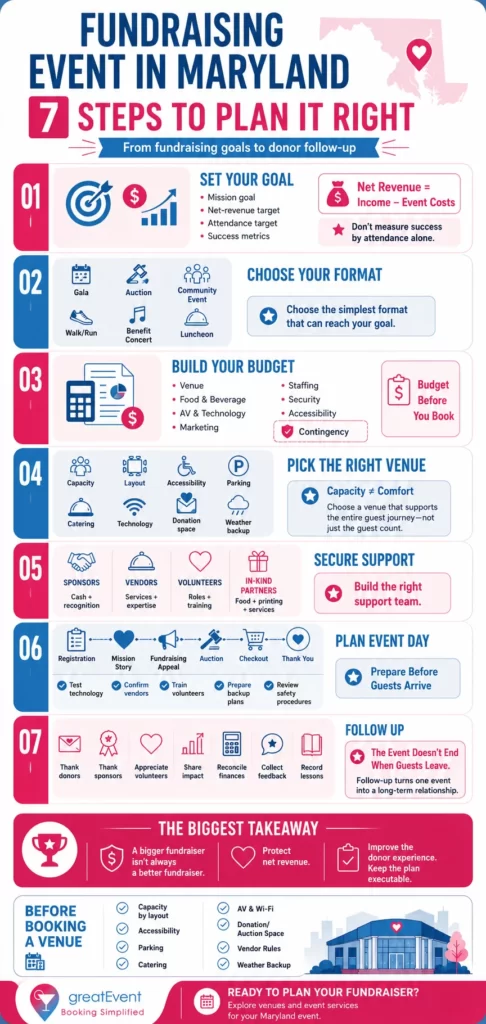
A successful fundraising event in Maryland starts with a measurable financial and mission goal, followed by the right event format, a realistic budget, and a venue that supports registration, donations, food, accessibility, technology, and guest flow. From there, organizers need to secure sponsors and vendors, recruit and train volunteers, promote the mission clearly, prepare a detailed run of show, manage safety and accessibility, and follow up with donors after the event. The strongest fundraiser is not necessarily the biggest one—it is the event that generates meaningful net revenue while creating a positive experience for supporters.
How to Plan a Fundraising Event in Maryland: A Practical Guide
A fundraiser has two audiences to satisfy: the people the organization serves and the people being asked to support the mission.
That makes event planning more than choosing a room, selling tickets, and putting a microphone on a stage. A successful fundraising event in Maryland needs a clear financial objective, a guest experience that makes participation easy, and an operational plan that keeps costs under control.
The venue matters, too. A beautiful space that cannot handle registration, donation activity, accessibility needs, catering, technology, or guest movement can quickly become an operational problem.
If you’re still estimating your venue budget, reviewing current event space costs can help establish a realistic starting point before you commit to a location. event space cost guide
This guide walks through the complete process—from setting the fundraising goal to thanking donors after the event—so you can build a fundraiser that supports both the mission and the bottom line.
What Makes a Fundraising Event Successful?
A successful fundraiser is not simply an event with a high attendance number.
The better question is:
Did the event generate meaningful net revenue, strengthen supporter relationships, and communicate the organization’s mission effectively?
The source planning framework identifies four connected objectives:
| Goal | What it means in practice |
|---|---|
| Raise funds | Generate donations, ticket revenue, sponsorships, auction proceeds, or a combination |
| Build relationships | Give supporters a meaningful opportunity to connect with the organization |
| Increase awareness | Explain the problem, mission, and impact |
| Create future support | Build appropriate, consent-based relationships for future communication |
Your organization may prioritize one objective more heavily than another. A major-donor dinner, for example, may focus heavily on stewardship and relationship building, while a community walk may prioritize participation and peer-to-peer fundraising.
The important point is to define the objective before selecting the venue, ticket price, format, or staffing plan.
Start With Net Revenue, Not Attendance
A useful planning formula is:
Net Revenue = Tickets + Donations + Sponsorships + Auction Revenue + Other Income − Total Event Costs
This changes how you evaluate decisions.
Adding 100 guests does not automatically make a fundraiser better if those guests require expensive catering, additional staffing, a larger room, more rentals, and additional technology.
A smaller event with strong sponsorship support and controlled costs can potentially create a healthier financial result.
Pro Tip: Set the net-revenue target before setting the attendance target. Attendance is an input; net revenue is the outcome.
Step 1: Set the Fundraising Goal and Success Measures
Before looking at venues, define what success means.
Your goal could be:
- Raise a specific net amount
- Fund a particular program
- Acquire new donors
- Increase recurring donations
- Strengthen relationships with existing supporters
- Increase awareness in a local community
Write the target in measurable terms.
For example:
Primary financial goal: Generate a specific amount of net revenue.
Secondary goals: Increase donor engagement, secure new sponsors, and create opportunities for future support.
Then determine which metrics you will track.
Fundraising Event Metrics to Monitor
| Metric | Why it matters |
| Registrations | Shows initial demand |
| Attendance | Measures actual participation |
| Ticket revenue | Tracks event-generated income |
| Donations | Measures direct giving |
| Sponsorship revenue | Shows business/community support |
| Auction revenue | Measures fundraising activity |
| Total expenses | Protects financial discipline |
| Net revenue | Shows the event’s actual financial result |
| Average gift | Helps evaluate donor behavior |
| Donor follow-up | Supports future relationship building |
| Volunteer participation | Measures operational support |
Do not treat staff and volunteer time as invisible.
If an event requires months of preparation, extensive volunteer coordination, or substantial staff hours, that operational reality should be part of the planning conversation.
Step 2: Choose the Right Fundraising Event Format
The best fundraising format depends on your mission, audience, fundraising mechanism, budget, and team capacity.
A gala may be appropriate for major donors and sponsors. A community celebration may be better for broad participation. An auction needs display and checkout infrastructure. A walk or run needs outdoor logistics and a weather plan.
Fundraising Event Formats to Consider
| Format | Best suited for | Key venue requirements |
| Gala or dinner | Major donors, stewardship, speeches | Dining, stage, auction/paddle raise, registration |
| Silent/live auction | Interactive fundraising | Display space, bidding technology, checkout, storage |
| Community celebration | Broad participation | Flexible space, food, activities, restrooms |
| Walk/run | Peer-to-peer fundraising | Route, check-in, parking, safety, restrooms |
| Benefit concert | Entertainment and ticket sales | Stage, sound, backstage space, crowd management |
| Luncheon/breakfast | Recognition and education | Dining layout, registration, presentation equipment |
| Hybrid event | Local and remote audiences | Reliable internet, cameras, microphones, streaming |
The source material makes an important point: the simplest format that can reach the fundraising goal is often the strongest choice. Complexity can increase expenses and staffing demands without producing a proportional increase in revenue.
Match the Format to the Audience
Ask:
- Who are we trying to attract?
- What does this audience value?
- What type of experience fits the mission?
- What fundraising mechanism will we use?
- What can our team realistically execute?
If the audience is primarily corporate supporters, a structured dinner or reception may make sense.
If the goal is community participation, an informal celebration or activity-based event may work better.
Step 3: Build the Complete Event Budget
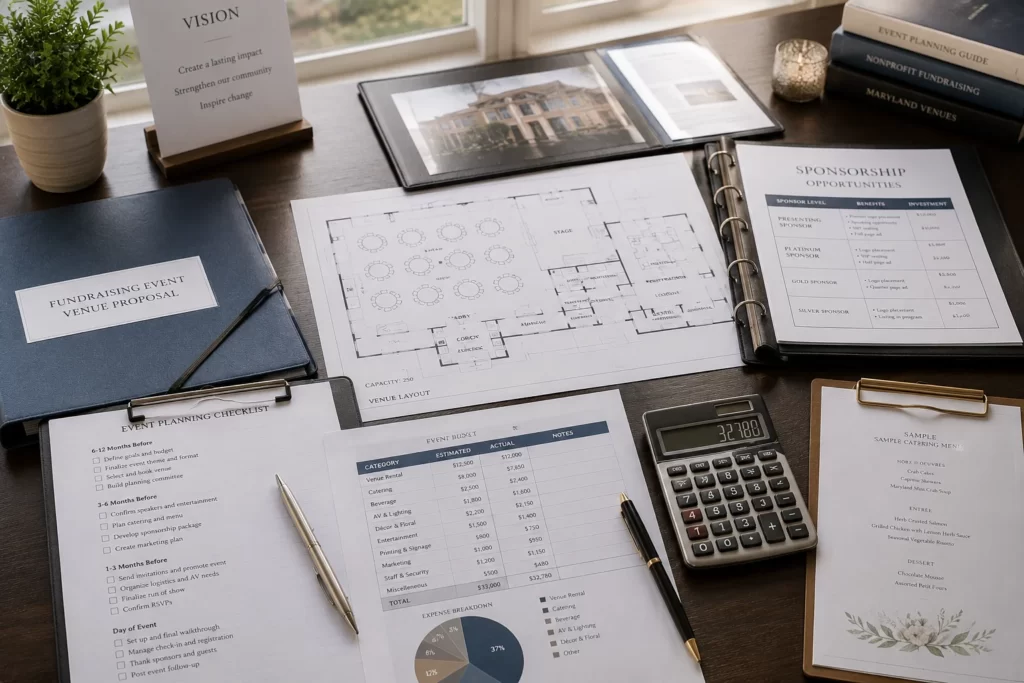
Build the budget before booking the venue or vendors.
Separate fixed expenses from per-person expenses and identify opportunities for sponsorships or in-kind support.
Fundraising Event Budget Checklist
- Venue rental
- Setup and cleanup
- Overtime
- Food and beverage
- Service charges and taxes
- Dietary requirements
- Technology and AV
- Entertainment
- Registration and ticketing
- Payment processing
- Décor
- Auction supplies
- Staffing
- Security
- Marketing
- Printing
- Permits
- Insurance
- Transportation
- Accessibility services
- Volunteer support
- Contingency reserve
The source specifically recommends separating confirmed costs from estimates and accounting for items such as promotion, volunteer preparation, technology testing, and follow-up.
If professional planning support is part of the budget, compare the scope of work rather than looking only at a headline price. A useful reference is this guide to how much event planners charge, especially when deciding whether outside planning support makes financial sense.
A Simple Budget Decision Framework
Before approving an expense, ask:
Will this expense help us:
- Raise more money?
- Improve donor experience?
- Reduce operational risk?
- Improve accessibility?
- Support the mission?
- Save staff time?
If the answer is no to all six, reconsider the expense.
Step 4: Choose a Maryland Venue That Supports Fundraising
Venue selection can influence almost every part of the guest experience.
Start with:
- Expected attendance
- Event format
- Room capacity
- Seating layout
- Registration requirements
- Donation or auction activity
- Parking
- Accessibility
- Technology
- Catering
- Vendor policies
- Sponsor visibility
- Weather backup
Maryland offers different venue environments depending on where supporters live and how they will travel. Annapolis, Baltimore, Columbia, BWI, National Harbor, and the Washington, DC area can serve different audiences and event formats.
A hotel may work well for a dinner, luncheon, or conference-style fundraiser. A community or outdoor venue may be more appropriate for a family-focused or activity-based event.
Venue Capacity Is Only the Beginning
Do not ask only:
“How many people can this venue hold?”
Ask:
“How many people can this venue comfortably support while allowing the event to function?”
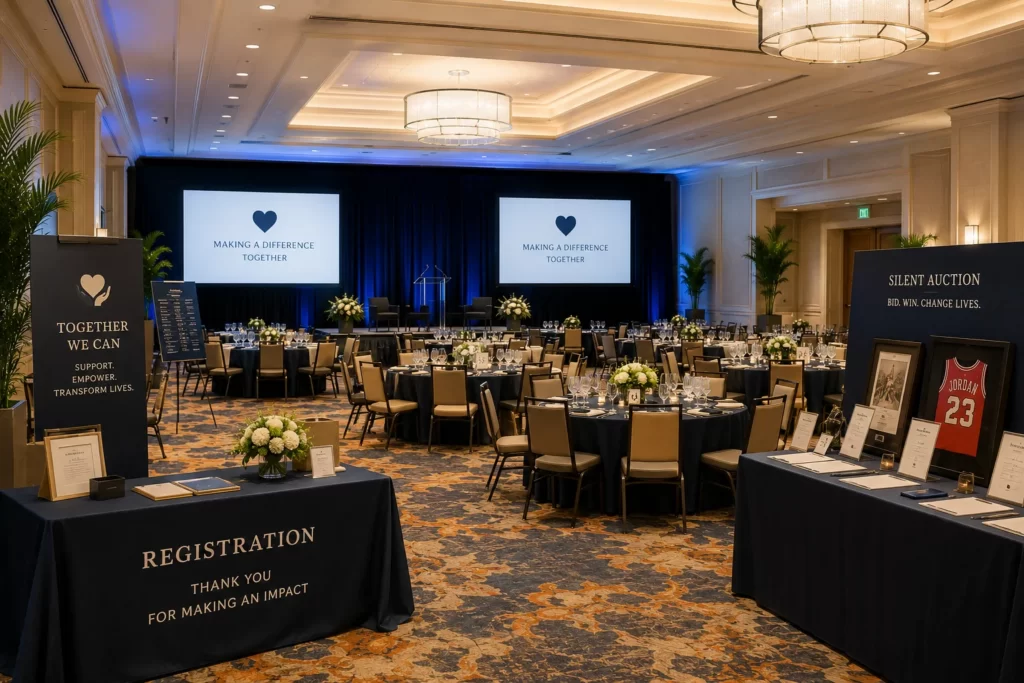
A room that technically holds 250 guests may not be appropriate for 250 people if you also need:
- Registration
- Buffet stations
- Auction displays
- Sponsor tables
- Stage equipment
- Dance or entertainment space
- Accessible circulation
- Donation stations
For outdoor events, consider weather backup, parking, restrooms, route safety, power, and guest accessibility.
If your event is expected to have around 100 guests and you are considering an outdoor setting, review this guide to outdoor event spaces for 100 guests for additional planning considerations.
Venue Questions to Ask Before Booking
| Area | Questions |
| Capacity | What is the capacity for our planned layout? |
| Setup | How early can vendors access the space? |
| Catering | Can we use an outside caterer? |
| Technology | What AV and internet infrastructure is included? |
| Accessibility | Are entrances, restrooms, seating, and stage areas accessible? |
| Parking | Is parking available and easy to navigate? |
| Fundraising | Can we use auction displays and donation stations? |
| Sponsors | Where can sponsor signage be placed? |
| Weather | What is the backup plan for outdoor activities? |
| Vendors | Are there preferred or exclusive vendors? |
| Cleanup | What is included in the rental? |
| Cancellation | What happens if the event must be changed or canceled? |
Step 5: Design the Guest Journey and Donation Moments
Think through the event from the guest’s perspective.
A supporter should not have to figure out where to register, where to sit, how to donate, where to find an auction item, or what happens next.
Map the journey:
Invitation → Registration → Arrival → Check-In → Event Experience → Mission Story → Fundraising Appeal → Donation/Checkout → Thank You → Follow-Up
This exercise often reveals problems before event day.
Build Donation Moments Into the Experience
Donation opportunities should be clear without becoming intrusive.
Depending on the format, you may use:
- Ticket purchases
- Sponsorships
- Silent auctions
- Live auctions
- Paddle raises
- Direct donations
- Peer-to-peer fundraising
- In-kind contributions
Test every donation method before guests arrive.
Volunteers should know how to direct guests to the appropriate process without pressuring them or mishandling private financial information.
Step 6: Secure Sponsors and In-Kind Support
Sponsors can help reduce upfront expenses while expanding an event’s reach.
Start with organizations that have a natural connection to your mission, audience, or community.
Potential prospects can include:
- Local businesses
- Corporate partners
- Foundations
- Existing supporters
- Board connections
- Community leaders
- Vendors
- Professional networks
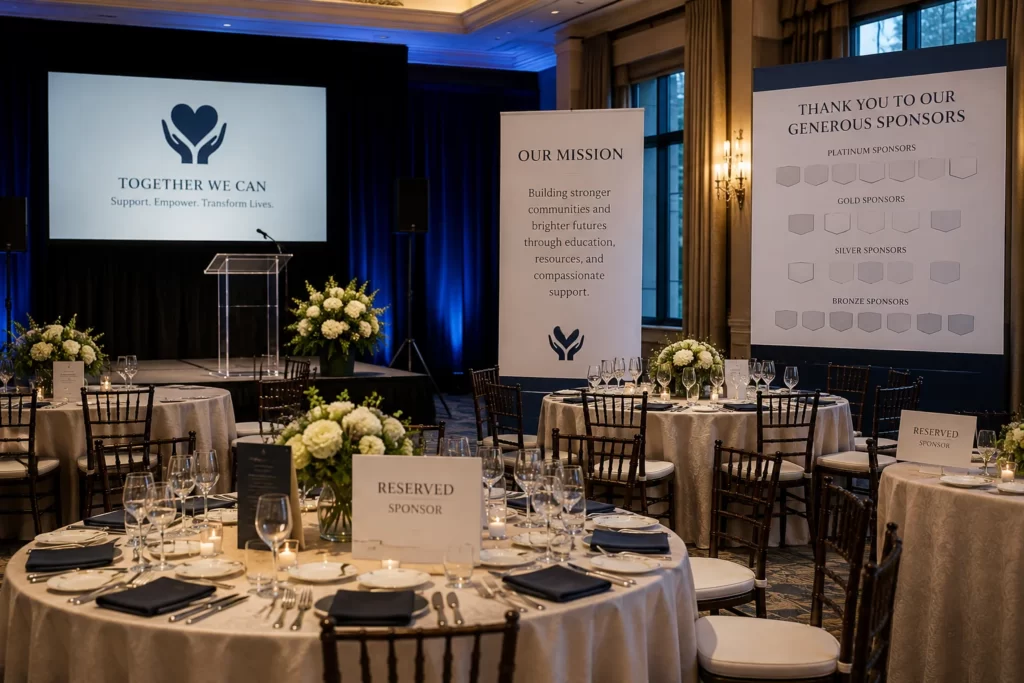
Create Clear Sponsorship Packages
| Level | Example Benefits |
| Presenting sponsor | Prominent recognition, speaking opportunity, reserved seating |
| Program sponsor | Recognition connected to a meal, speaker, activity, or program |
| Community sponsor | Name/logo placement and defined ticket allocation |
| In-kind sponsor | Recognition in exchange for food, printing, transportation, auction items, or services |
Do not promise benefits you cannot deliver.
A sponsorship proposal should explain:
- The mission
- The event purpose
- The audience
- Expected reach
- Sponsorship opportunity
- Specific benefits
- What the sponsor’s support makes possible
Personalized outreach is generally more useful than sending the same generic sponsorship request to every business.
Step 7: Recruit the Right Vendors
A fundraising event may require considerably more than a venue and caterer.
Depending on the format, you may need:
- Event planner
- Caterer
- Photographer
- Videographer
- DJ or band
- Florist
- Decorator
- Rental company
- Security
- Transportation
- Technology provider
- Auction support
- Registration staff
- Accessibility professionals
When evaluating vendors, ask whether they have experience with events that have similar guest counts and operational requirements.
For example, a vendor who understands an auction checkout process or sponsor visibility may be a better fit than a vendor who has only worked on general private parties.
Review:
- Proposals
- References
- Insurance
- Contracts
- Cancellation terms
- Setup requirements
- Breakdown requirements
- Backup plans
For organizations comparing professional planning support, it is also useful to understand the difference between event planners and coordinators. This event planners vs. coordinators comparison can help clarify responsibilities before hiring.
If the event requires more extensive corporate-style planning support, review the cost of hiring a corporate event planner as another budgeting reference.
The source material emphasizes verifying each provider’s availability and terms rather than assuming that a listed service or venue is automatically available.
Step 8: Build a Volunteer Plan
Volunteers can be one of the most valuable resources at a nonprofit event—but only when their responsibilities are clearly defined.
Common roles include:
- Registration
- Guest direction
- Auction assistance
- Donation assistance
- Sponsor hospitality
- Speaker support
- Photography coordination
- Meal service
- Accessibility assistance
- Cleanup
- Checkout
Each volunteer should receive:
- Role description
- Shift time
- Contact information
- Location
- Escalation instructions
- Basic event information
Shorter shifts can make volunteer participation more manageable.
Assign a lead staff member or experienced volunteer who can answer questions.
Do not expect volunteers to improvise around payment handling, donor data, or safety procedures without training.
Step 9: Promote the Event With a Mission-Centered Message
Your promotional message should answer three questions:
- Why does this event matter?
- Why should someone attend or donate?
- What should they do next?
Use the channels your supporters already use:
- Organization website
- Social media
- Sponsor networks
- Board members
- Community organizations
- Local media
- Partner organizations
The registration page should make important information easy to find, including:
- Date
- Location
- Ticket price
- Registration instructions
- Dress or activity expectations
- Accessibility information
- Parking
- Donation options
- Mission impact
Keep the message truthful. Avoid exaggerating outcomes or using personal stories without appropriate consent.
The source also recommends keeping registration mobile-friendly and collecting dietary, accessibility, and communication information only when the organization actually needs and can responsibly manage it.
Step 10: Prepare a Detailed Run of Show
A run of show turns the event from a collection of vendors and activities into an operational plan.
It should identify:
| Time | Activity | Location | Owner | Notes |
| Before event | Vendor arrival/setup | Venue | Event lead | Confirm access |
| Opening | Registration | Entrance | Registration lead | Guest check-in |
| Opening | Guest seating | Main room | Guest services | Direct guests |
| Program | Welcome/mission story | Stage | Speaker | Keep timing controlled |
| Program | Meal/main activity | Dining area | Catering/event lead | Confirm service |
| Fundraising | Appeal | Stage | Fundraising lead | Donation instructions |
| Fundraising | Auction closes | Auction area | Auction lead | Confirm checkout |
| Closing | Thank-you/next steps | Stage | Event lead | Explain follow-up |
| Departure | Checkout | Exit | Finance/checkout team | Verify process |
| End | Breakdown | Venue | Vendors/event lead | Venue handover |
Share the final run of show with:
- Staff
- Vendors
- Speakers
- Sponsors
- Key volunteers
Prepare contingencies for:
- Bad weather
- Speaker cancellation
- Technology failure
- Low attendance
- Vendor delays
- Registration problems
- Payment issues
The source specifically recommends treating the run of show as the event-day operational map rather than simply a program schedule.
Step 11: Make Accessibility and Safety Part of the Plan
Accessibility should be considered from the first venue search through the final guest communication.
Ask venues about:
- Accessible entrances
- Restrooms
- Parking
- Seating
- Stage access
- Dietary needs
- Captioning
- Interpretation
- Quiet areas
- Transportation
Safety planning should cover:
- Emergency exits
- Crowd movement
- Weather procedures
- First aid
- Food safety
- Alcohol policies
- Security
- Volunteer responsibilities
Requirements vary by event, venue, and jurisdiction. Ask the venue and appropriate local authorities what applies to your specific event.
This article is general planning information and should not be treated as legal, tax, insurance, or regulatory advice.
Maryland Fundraising Compliance Check
Because this is a Maryland-specific guide, organizers should also verify applicable charitable-solicitation requirements before promoting or soliciting donations.
The Maryland Secretary of State states that charitable organizations soliciting in Maryland generally must register before solicitation begins, subject to applicable exemptions and requirements.
For federal considerations, the IRS explains that fundraising events involving charitable contributions can involve substantiation and disclosure requirements, particularly when donors receive goods or services in exchange for payment.
Best practice: Have the organization’s leadership, accountant, attorney, or qualified compliance professional verify the requirements applicable to the specific fundraiser before launch.
Step 12: Follow Up With Donors and Measure Results
The event does not end when the last guest leaves.
Post-event follow-up should include:
- Thank-you messages
- Sponsor recognition
- Volunteer appreciation
- Donation documentation through the organization’s approved process
- Impact updates
- Donor feedback
- Financial reconciliation
Measure:
- Total revenue
- Total expenses
- Net revenue
- Attendance
- Registration conversion
- Average gift
- Sponsor retention
- Donor engagement
- Volunteer experience
- Operational problems
The source material emphasizes that post-event gratitude and impact communication are part of donor retention rather than an optional final step.
If your organization also plans celebrations or donor-focused social events during the year, planning costs can vary significantly by event type. For example, this guide to birthday party planner costs can provide useful context when evaluating professional event-planning expenses outside the main fundraiser.

A Practical Maryland Fundraising Event Timeline
The planning timeline below provides a useful framework rather than a universal rule. Smaller events may need less lead time, while major galas, conferences, and multi-day events can require substantially more preparation.
| Planning period | Main priorities |
| 6–12 months before | Set goals, choose format, create budget, identify audience, research venues, build committee |
| 4–6 months before | Book venue and key vendors, secure sponsors, confirm program, begin promotion |
| 2–3 months before | Launch registration, recruit volunteers, finalize auction/donation tools, confirm accessibility |
| 4–6 weeks before | Confirm menus, vendors, speakers, sponsors, technology, signage, and guest information |
| 1–2 weeks before | Train volunteers, test technology, confirm counts, send reminders, distribute final schedule |
| Event day | Manage registration, guest experience, donations, safety, program timing, and vendors |
| After event | Thank supporters, reconcile finances, share impact, collect feedback, document lessons |
Fundraising Event Venue Scorecard
Before signing a contract, score each potential venue from 1 to 5.
| Criteria | Score |
| Location convenience | /5 |
| Capacity | /5 |
| Layout flexibility | /5 |
| Parking | /5 |
| Accessibility | /5 |
| Catering | /5 |
| Technology/AV | /5 |
| Donation/auction space | /5 |
| Sponsor visibility | /5 |
| Vendor flexibility | /5 |
| Weather backup | /5 |
| Cost/value | /5 |
| Guest experience | /5 |
Maximum score: 65
The highest score is not automatically the winner. Use the scorecard alongside your budget, mission, guest profile, and operational requirements.
How to Find the Right Fundraising Venue in Maryland
Start by defining the practical requirements:
Guest count + format + location + budget + layout + fundraising activities + accessibility + technology
Then compare venues against those requirements.
For organizations exploring Maryland wedding and event properties that may also have suitable event infrastructure, the Maryland venue search can be another starting point for researching available locations.
Not every listing will be appropriate for a fundraiser, so verify the venue’s current capacity, event policies, services, availability, and contract terms.
Location also matters when your donor base crosses state lines. If your supporters are traveling from nearby markets, you may want to compare venue options in other destinations, such as Washington, DC venues, Washington, DC wedding venues, New York wedding venues, or San Antonio wedding venues.
The key is not to choose a venue simply because it looks attractive online.
Choose the venue that makes the fundraising experience work.
Common Fundraising Event Planning Mistakes
1. Choosing the Venue Before Building the Budget
A venue should fit the financial model, not force the financial model to fit the venue.
2. Measuring Success by Attendance Alone
A full room can still produce poor net revenue.
3. Overcomplicating the Event
Additional entertainment, décor, technology, and activities can increase costs without necessarily improving fundraising results.
4. Ignoring Guest Flow
Registration, food service, auction displays, donations, seating, and checkout all need space.
5. Treating Accessibility as an Afterthought
Accessibility should influence venue selection, registration, programming, communication, and transportation planning.
6. Assuming Vendors Understand Fundraising
Ask specifically about experience with auctions, donation appeals, sponsors, registration, and nonprofit events.
7. Leaving Technology Testing Until Event Day
Test microphones, screens, internet, streaming, donation tools, payment systems, and presentation equipment before guests arrive.
8. Forgetting the Follow-Up
Thank-you communication and impact reporting should already be planned before the event begins.
Expert Planning Tips for a More Effective Fundraiser
- Keep the mission visible : Guests should understand what their participation supports.
- Make giving simple : Donation instructions should be easy to find and easy to understand.
- Protect the guest experience : Registration, parking, seating, food, restrooms, accessibility, and timing all influence how supporters remember the event.
- Use sponsorships strategically : The best sponsorships are not only sources of cash. In-kind contributions can also reduce event expenses.
- Plan for operational reality : If the event requires more staffing, technology, or coordination than your team can realistically provide, simplify the format or bring in appropriate support.
- Document lessons immediately : Record what worked, what failed, and what should change while the experience is still fresh.
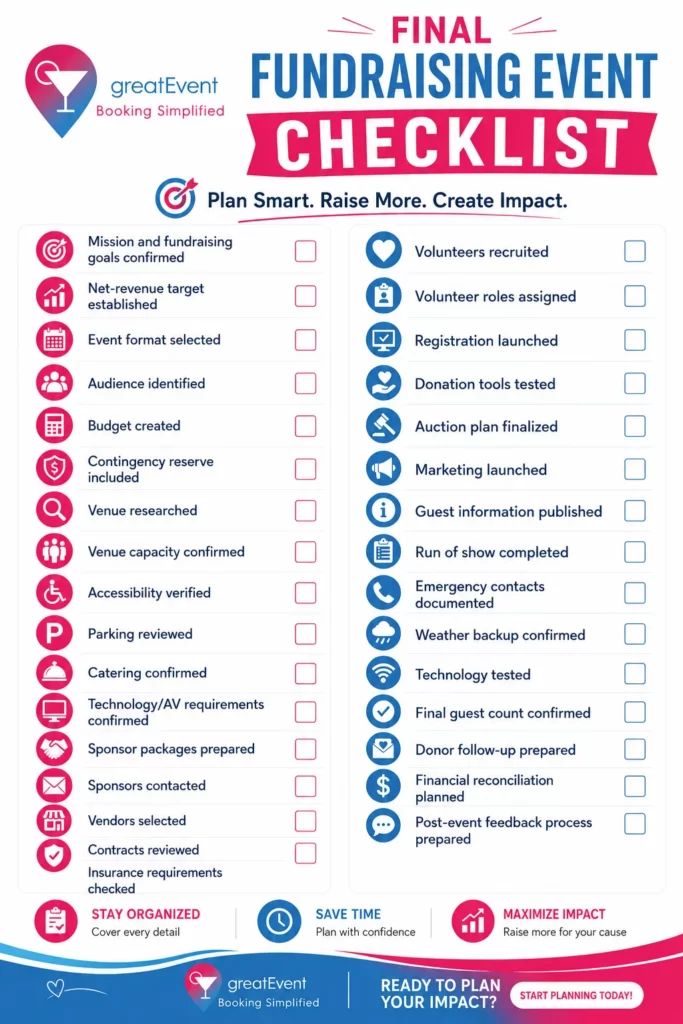
Final Thoughts
A successful fundraising event in Maryland begins with a clear reason for gathering and ends with a clear expression of impact.
The strongest events are not necessarily the largest or most elaborate. They are the ones where the mission, budget, venue, guest experience, sponsors, vendors, volunteers, and fundraising strategy work together.
Choose a format your organization can execute well. Build the budget before committing to expenses. Select a venue based on how guests will actually use the space. Make donations straightforward. Prepare staff and volunteers with clear responsibilities. Plan for accessibility and safety. Then continue the relationship after the event through timely appreciation and meaningful impact communication.
For organizations ready to research event locations and services, greatEvent can be used to explore relevant venue and event-service options. Always confirm current availability, capacity, services, pricing, and contract terms directly through the current venue or provider information before making a commitment.
Frequently Asked Questions
How do I plan a fundraising event in Maryland? ▾
Start with a measurable fundraising and mission goal. Choose an event format that matches your audience and resources, create a detailed budget, select a suitable Maryland venue, secure sponsors and vendors, recruit volunteers, promote the event, prepare a run of show, test technology, and follow up with donors.
What type of venue is best for a fundraising event? ▾
The best venue depends on the guest count, event format, budget, accessibility requirements, fundraising activities, catering needs, technology, and weather plan. Hotels, conference spaces, community venues, restaurants, and outdoor locations can all work when their facilities match the event’s requirements.
How much does a fundraising event cost? ▾
There is no single cost because expenses depend on venue rental, guest count, food and beverage, entertainment, technology, marketing, staffing, security, transportation, and event format. Build a line-item budget and evaluate projected net revenue rather than focusing only on ticket income.
How can a Maryland nonprofit find a fundraising venue? ▾
Search venues according to location, event type, date, guest count, layout, accessibility, parking, technology, and vendor requirements. Compare several options and verify current availability, capacity, services, pricing, and contract terms before booking.
What should I ask a Maryland fundraising venue before booking? ▾
Ask about capacity by layout, registration space, auction or donation areas, catering, technology, parking, accessibility, weather backup, vendor rules, setup and cleanup, security, insurance, payment terms, cancellation policies, and the event-day contact.
Compare vendors for your next event
Search caterers, photographers, florists, planners, and rentals — then send one request to several vendors at once.