Quick answer: An event brief template is a one- or two-page record of what the client wants: objectives, dates and pattern, headcount, meeting space, room block, food and beverage, budget range, and who approves what. Fill it in from a structured intake call, read it back to the client, and get a written OK before you contact venues. Your event proposal then answers the brief with scope, timeline, a venue shortlist, the plan for your vendors and suppliers, assumptions, a change process, and a sign-off block.
Example scenario (fictional): A regional trade association calls in March. The executive director wants “about 250 people, two days in the fall, somewhere members can drive to, and nothing fancy.” The board chair wants a proposal at Thursday’s meeting. You have a 20-minute call, no budget number, no list of past venues, and no idea whether the board, the director, or the finance committee signs the venue contract.
This guide is for professional planners and agencies who already plan events for clients: corporate meetings, association conferences, sports team travel and tournaments, and weddings. It gives you the intake questions, a copyable event brief template, a proposal outline, a brief-vs-proposal table, and a checklist. Setting your own fees is a separate job, covered in our guide to pricing your event planning services.
In this guide:
- Event brief vs. event proposal
- Intake questions for the first client call
- Event brief template (copy and paste)
- How the brief maps to a venue search
- Get the brief approved before you source
- How to write a proposal for an event
- Adjust the brief by event type
- Brief-to-proposal checklist
Event brief vs. event proposal
The brief records what the client told you and what you both agreed. The proposal is your answer: what you will do, with which venues, by when, and on what assumptions. A third document, the request for proposal (RFP) or venue inquiry, goes from you to venues and hotels, built from the approved brief.
| Event brief | Event proposal | |
|---|---|---|
| Who writes it | You, from the client’s answers | You |
| Who reads it | The client, then your team | The client’s decision-makers |
| When | After the intake call, before you contact venues | After the brief is approved and venue proposals are in |
| What it answers | What does the client need, and what are the limits? | How will you deliver it, and what will it take? |
| Main contents | Objectives, dates, headcount, space, room block, food and beverage, budget range, decision-makers | Scope, timeline, venue shortlist, plan for your vendors and suppliers, assumptions, change process, sign-off |
| Approval | A written OK (an email reply is enough for most events) | A signature from someone with authority to approve |
| What happens next | It becomes your venue requests | Contracts, then the event specifications guide |
The industry has a standard name for the detailed document that comes later. The Events Industry Council defines the Event Specifications Guide (ESG) as “a comprehensive document that outlines the complete requirements and instructions for an event,” typically written by the planner and shared with vendors. Your brief is the early, short version. The ESG is the operational version, and the APEX ESG template says to send it to all facilities and vendors at least four weeks before the event. If you want an event brief template in Word for that later stage, the council’s templates page offers the ESG in Word and PDF (the page notes the templates are under review).
Intake questions for the first client call
Send the questions before the call so the client can pull numbers from past events. Ask about objectives and decision-makers first, because they shape every other answer.
Purpose and people
- Why is this event happening, and what has to be true afterward for it to count as a success?
- Who will attend? Job titles, members, players and families, or wedding guests, and roughly where they travel from.
- Who makes the final decision on the venue, and who signs contracts? Who else has to approve: a board, finance, procurement, legal, parents?
Dates, place, and size
- Preferred dates, acceptable alternates, and dates that won’t work. Is the day pattern flexible (for example, Tuesday to Thursday vs. Sunday to Tuesday)?
- Preferred cities or the maximum drive or travel time for attendees.
- Headcount: lowest likely, expected, and highest likely.
- Has this event run before? Ask for past venues, attendance, room pickup by night, and food and beverage spend.
Venues ask for that history. In a 2014 survey reported in a 2015 white paper by the Global Business Travel Association (GBTA) and the Convention Industry Council’s APEX eRFP workgroup, suppliers said they had to ask for additional information 42 percent of the time to answer a request. The paper lists date flexibility, past venues and locations, past day-by-day room pickup, and food and beverage spend as information that is often missing.
Space, rooms, and food
- What happens in the room? General session, breakouts, meals, reception, exhibits, ceremony, team meetings. How many people at each, in what setup?
- Do attendees need sleeping rooms? How many on each night, who pays (master account or individual guests), and how do they book?
- Which meals and breaks, and any dietary needs or allergies you already know about?
- AV, accessibility, and venue must-haves such as parking or outdoor space.
Budget and your role
- What is the budget range for the event, and what does it include (venue, food and beverage, AV, rooms, travel)?
- Which of your vendors and suppliers, or the client’s existing contracts, must be used or avoided?
- What exactly do they want from you: venue sourcing only, full planning, or on-site management?
- When do they need the proposal, and when must the venue be confirmed?

Event brief template (copy and paste)
Copy this into Word, Google Docs, or your project tool. Fill in every line, and write “TBC” with an owner and a date instead of leaving a field blank. Fields marked * are the ones a venue needs to quote.
CLIENT EVENT BRIEF
Version: ___   Date: ___   Prepared by: ___

1. CLIENT AND CONTACTS
Client organization: ___
Day-to-day contact (name, role, email, phone): ___
Final decision-maker on venue: ___
Contract signer (authorized signatory): ___
Other approvers and their step (board, finance, procurement,
legal, family): ___
Approval turnaround we can expect: ___

2. EVENT BASICS
Event name and type*: ___
Purpose and objectives (what success looks like): ___
Has it run before? Past venues, attendance, room pickup,
food and beverage spend: ___

3. DATES AND PATTERN
Preferred dates*: ___
Alternate dates: ___   Dates that won't work: ___
Day pattern flexible? Yes / No   Arrival and departure days: ___

4. LOCATION
Preferred city or area*: ___
Maximum travel or drive time for attendees: ___
Must-haves nearby (airport, office, field, church): ___

5. ATTENDEES
Headcount* low / expected / high: ___ / ___ / ___
Attendee profile (who they are, where they come from): ___
Accessibility needs known now: ___

6. MEETING AND EVENT SPACE (one line per function)
Day | Function | Start-end | People | Setup | 24-hour hold? | AV
___ | ___      | ___       | ___    | ___   | ___           | ___
Exhibit, registration, storage, or office space: ___

7. SLEEPING ROOMS (ROOM BLOCK)
Needed? Yes / No
Rooms per night*: Night 1 ___  Night 2 ___  Night 3 ___
Room types: ___   Target rate range: ___
Who pays: master account / individual guests / mix
How guests book: ___   Past pickup vs. block (if known): ___

8. FOOD AND BEVERAGE
Meals and breaks by day: ___
Service style (plated, buffet, stations, reception): ___
Alcohol: ___   Dietary needs and allergies known now: ___

9. BUDGET
Event budget range (total): ___ to ___
What it covers (venue, F&B, AV, rooms, transport): ___
Who holds the budget and approves changes: ___

10. YOUR ROLE
In scope: ___
Out of scope: ___
Required or preferred vendors and suppliers: ___

11. TIMELINE
Proposal due: ___   Venue decision by: ___
Contract signed by: ___

12. OPEN QUESTIONS (owner and due date for each)
___

CLIENT CONFIRMATION
"This brief reflects our requirements as of [date]."
Name: ___   Role: ___   Date: ___
Keep the budget field to the client’s event budget. Your own fee belongs in the proposal, and if you want benchmarks on what event planners charge, read what event planners charge before you quote.
Ask for allergies again closer to the event, through registration or RSVPs. The U.S. Food and Drug Administration lists nine major food allergens: milk, eggs, fish, crustacean shellfish, tree nuts, peanuts, wheat, soybeans, and sesame. Sesame became the ninth on January 1, 2023.
How the brief maps to a venue search
Sections 2 to 8 of the brief are the fields you need for a venue search and inquiry on greatEvent. The search asks for event type (business meeting or wedding and social), location, date and guests, duration from one day to a week, and distance. From there you can compare meeting-room capacities and send one detailed inquiry to multiple venues.
| Brief field | Where it goes | Tip |
|---|---|---|
| Event type | Event type in the search | Pick the type that matches the client, so the venue sees a business meeting or a social event |
| Preferred city and travel time | Location and distance | Start with the city, then widen the distance only if the shortlist is thin |
| Preferred dates and pattern | Date and duration | Add alternate dates and pattern flexibility to your inquiry |
| Headcount | Guests, then room capacities | Search on the expected number, and check each room against the high number |
| Meeting space table | Your inquiry message | List each function with people, setup, and whether you need a 24-hour hold |
| Room block | Hotel room block, after you choose a venue | Give rooms per night as well as the total |
| Food and beverage | Your inquiry message, then services | Name every meal and break so the venue can quote menus and minimums |
The Events Industry Council defines a room block as the total number of sleeping rooms used by and attributable to one event. Hotels quote against a nightly pattern, so give them rooms per night.
Get the brief approved before you source
Turn your call notes into the brief the same day if you can, then send it back with three things marked:
- Conflicts. If the budget, headcount, and city don’t fit together, say so now. A 250-person, two-day meeting in a downtown hotel on peak dates and a small budget may not be possible, and the client should choose which constraint moves.
- Assumptions. Anything you filled in yourself, such as “we assume theater seating for the general session,” gets flagged for confirmation.
- Open questions. Each gets an owner and a due date.
Ask for a written reply confirming the brief. An email that says “approved” is enough for most clients and gives you a record if the headcount changes later.
The same GBTA and APEX paper gives practical limits for the next step. It recommends confirming the event will actually happen before sending requests, narrowing to no more than three cities when the destination is open, sending requests to three to five venues per city, and telling venues the date you’ll pick a shortlist. It also found that third-party planners sent requests to more properties per meeting than corporate buyers did (14 vs. 8 in 2013), and that pressure from clients was one reason. An approved brief with clear objectives makes it easier to keep the list short when the client asks for more options.
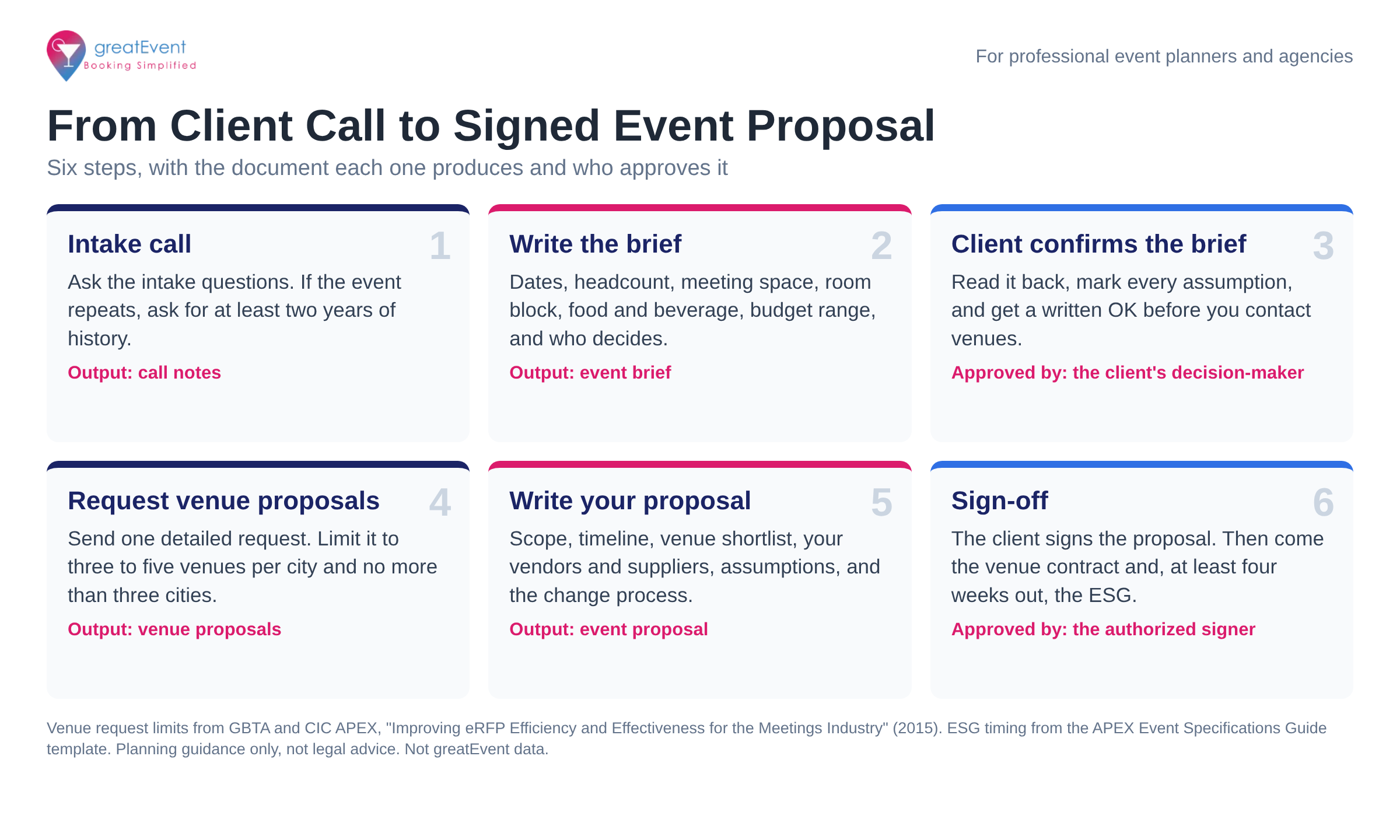
Text version of the infographic:
- Intake call. Ask the intake questions. If the event repeats, ask for at least two years of history. Output: call notes.
- Write the brief. Dates, headcount, meeting space, room block, food and beverage, budget range, and who decides. Output: event brief.
- Client confirms the brief. Read it back, mark every assumption, and get a written OK before you contact venues. Approved by: the client’s decision-maker.
- Request venue proposals. Send one detailed request. Limit it to three to five venues per city and no more than three cities. Output: venue proposals.
- Write your proposal. Scope, timeline, venue shortlist, your vendors and suppliers, assumptions, and the change process. Output: event proposal.
- Sign-off. The client signs the proposal. Then come the venue contract and, at least four weeks out, the ESG. Approved by: the authorized signer.
How to write a proposal for an event
Address the proposal to the decision-makers named in the brief. Restate their objectives in their own words from the brief, then show how each section serves them. Here is an event proposal outline you can copy.
EVENT PROPOSAL: [Event name] for [Client]
Prepared by: ___   Date: ___   Valid until: ___
Based on: Event brief version ___, approved [date] by [name]

1. SUMMARY
What the client wants to achieve (from the brief), in 3-4 lines.
Our recommendation in one sentence.

2. SCOPE OF SERVICES
Included: venue sourcing, contract support, room block
management, vendor coordination, on-site management (edit).
Not included: ___
Deliverables (e.g., run of show, rooming list, final ESG): ___

3. TIMELINE AND MILESTONES
Proposal approval: ___
Venue site visits: ___
Venue contract signed: ___
Room block cutoff date: ___
Final headcount and menus due: ___
Event dates: ___

4. VENUE SHORTLIST (2-4 options)
For each: venue, dates offered, meeting rooms and capacities,
room block offered (rooms per night, rate), food and beverage
minimum, main contract terms to review, why it fits the brief.
Recommendation and reason.

5. PLAN FOR YOUR VENDORS AND SUPPLIERS
Category | Recommended | Status | Who contracts and pays
AV | ___ | ___ | ___
Catering (if not the venue) | ___ | ___ | ___
Transport | ___ | ___ | ___
Photography / entertainment | ___ | ___ | ___

6. BUDGET SUMMARY
Estimated event costs by category, against the brief's range.
Our fees and payment terms: ___

7. ASSUMPTIONS
Headcount ___, dates ___, room block ___ nights,
venue terms as quoted on [date], subject to availability.

8. CHANGE PROCESS
How changes are requested, priced, and approved in writing.

9. APPROVAL
Name: ___   Title: ___   Signature: ___   Date: ___
Scope and timeline
Words like “full-service” cause scope disputes. List what you will do and what you won’t. Tie each milestone to the client decision it depends on, such as proposal approval before a venue contract date.
Venue shortlist
Put the venue proposals into one format so the client compares like with like: same dates, same headcount, same room pattern. Our template to compare hotel proposals side by side shows the rows to use for a corporate meeting, and the wedding venue proposal comparison template does the same for weddings. Show the terms that carry risk, too. The Events Industry Council describes attrition as the difference between the sleeping rooms (or food and beverage, or revenue) actually used and the number agreed in the contract, and a cutoff date as the date the hotel releases unsold rooms from the block.
Your vendors and suppliers
For each category, say who you recommend, whether availability is confirmed, and who contracts and pays. Note any supplier the client must use and any in-house provider a venue requires.
Assumptions and change process
List the assumptions behind every number: headcount, dates, room pattern, and venue quotes subject to availability. They define what counts as a change. Then describe the process: the client asks in writing, you confirm the effect on cost and timeline, and the client approves before you act. How you charge for changes comes from your own fee structure.
Sign-off
Get the signature from the person the brief names as authorized to approve. Under the federal E-SIGN Act, a signature, contract, or other record “may not be denied legal effect, validity, or enforceability solely because it is in electronic form,” so an e-signature tool works for most U.S. clients. This is general information, not legal advice. Have your own attorney review your proposal and contract terms, and remember that a proposal approval is not the venue contract. The client still needs to review and sign each venue and supplier agreement.
Adjust the brief by event type
The same template works for every client type. What changes is which sections need the most detail and who approves.
| Client type | Sections that need extra detail | Approval line to confirm |
|---|---|---|
| Corporate meeting | Objectives, meeting space by function, AV, company travel or meeting policy | Meeting owner, budget holder, procurement, and who can sign |
| Association conference | Past attendance and room pickup, exhibits, registration space | Executive director, board or committee, and the contract signer |
| Sports team or tournament | Rooms per team and per night, travel distance to the venue or field, meals for teams | Club, league, or school contact, and who pays for rooms |
| Wedding | Ceremony and reception spaces, guest room block, the weekend’s events | The couple, and any family members paying or approving |
For a wedding, a venue-only search often needs its own document. Our wedding venue sourcing brief covers that case in more detail. For a corporate client whose team will handle the venue themselves, the requirements sheet in our guide to booking a venue for a corporate event is a useful handoff.
Brief-to-proposal checklist
- ☐ Intake questions sent before the call
- ☐ Past event history requested (venues, attendance, room pickup, food and beverage spend)
- ☐ Decision-maker, approvers, and contract signer named
- ☐ Headcount recorded as low, expected, and high
- ☐ Preferred and alternate dates, and pattern flexibility, recorded
- ☐ Meeting space listed by function, with setup and people
- ☐ Room block written as rooms per night
- ☐ Budget range and what it covers confirmed
- ☐ In-scope and out-of-scope work listed
- ☐ Conflicts, assumptions, and open questions flagged
- ☐ Brief approved in writing before venue requests go out
- ☐ Venue requests limited and sent with a shortlist date
- ☐ Venue proposals compared in one format
- ☐ Proposal includes scope, timeline, shortlist, vendors and suppliers, assumptions, change process, and sign-off
- ☐ Proposal signed by the authorized person before contracts
Plan your next client event on greatEvent
Once the brief is approved, you have everything a venue search needs. Planners can book venues, meeting space, and hotel room blocks for their clients’ events, and find event vendors such as caterers, photographers, and entertainment. You can send one detailed inquiry to multiple venues and get quotes back, then add services and a hotel room block and finalize the details with your event specialist. A member of the greatEvent team can help you source venues that match the requirements in your client’s brief. There are no fees for planners. We pay you commission on any qualifying booking you make on greatEvent.
Register as a professional planner
Frequently Asked Questions
What is an event brief?
▾
An event brief is a short document that records what a client needs from an event: objectives, dates, headcount, space, sleeping rooms, food and beverage, budget range, and who approves decisions. The planner writes it from the client’s answers, and the client confirms it before venues are contacted.
What should an event brief template include?
▾
Include client contacts and decision-makers, event purpose, dates and alternates, location, headcount as low, expected, and high, meeting space by function, room block by night, food and beverage, budget range, your role, a timeline, and open questions.
What is the difference between an event brief and an event proposal?
▾
The brief describes what the client needs. The proposal is the planner’s answer, with scope, timeline, venue shortlist, vendors and suppliers, assumptions, a change process, and a signature line.
How do you write a proposal for an event?
▾
Start from the approved brief. Restate the client’s objectives, define scope, set milestones, compare two to four venue options in one format, list vendors and suppliers, state your assumptions and change process, and ask the authorized person to sign.
Is there an event brief template in Word?
▾
Yes. You can paste the template in this guide into Word. For a detailed operational version, the Events Industry Council publishes the APEX Event Specifications Guide as a Word and PDF template.
Who should sign off on an event brief?
▾
The person who will make the final venue decision, or someone they name in writing. Record the contract signer and any other approvers in the brief so the proposal goes to the right people.
Research and sources
Sources were checked on October 28, 2026. The opening scenario is fictional. No figures in this article are greatEvent data. Contract and e-signature points are general information, not legal advice.
- Events Industry Council, APEX Industry Glossary entries for “Event Specifications Guide (ESG),” “Room Block,” “Attrition,” and “Cut-Off Date,” insights.eventscouncil.org.
- Convention Industry Council, “The APEX Event Specifications Guide Template” (approved September 30, 2004, updated June 2005), and the Events Industry Council templates page, insights.eventscouncil.org. ESG parts, required narrative fields, and timing.
- GBTA Meetings Committee and Convention Industry Council APEX eRFP Efficiencies Workgroup, “Improving eRFP Efficiency and Effectiveness for the Meetings Industry” (June 2015). Missing information, the 42 percent figure, request limits, and the 14 vs. 8 properties comparison.
- U.S. Code, 15 U.S.C. 7001(a), Electronic Signatures in Global and National Commerce Act, via Cornell Law School Legal Information Institute, law.cornell.edu.
- U.S. Food and Drug Administration, “Food Allergies,” fda.gov. The nine major food allergens and the 2023 addition of sesame.
Compare vendors for your next event
Search caterers, photographers, florists, planners, and rentals — then send one request to several vendors at once.