Quick answer: After a client event, run two separate feedback steps. Send attendees a short post-event survey of about 10 questions: one overall rating, a likelihood-to-recommend question, a few questions on the venue, food and beverage, hotel, and program, and one or two open-ended questions. Then hold a client debrief within two weeks that covers what was supposed to happen, what actually happened, what went well, and what to change, plus budget versus actuals, vendor performance, and what to rebook. Feed both into the next venue brief.
A post-event survey tells you how attendees experienced the event. A client debrief tells you whether the event did the job the client hired you for, and what they want different next time. Planners who run only the survey end up with satisfaction scores and no decisions. Planners who run only the debrief hear the client’s view and miss what attendees noticed in the session rooms, at the buffet, and at hotel check-in. You need both, and you need them written down in a form you can use when you source the next venue.
This guide is for professional planners, agencies, and DMC teams in the US who plan meetings, conferences, and incentive events for corporate, association, and nonprofit clients. It gives you a copyable attendee survey question bank, a sponsor and exhibitor set, a short pre-event survey, a client debrief agenda and question set, and a venue wrap-up checklist. It doesn’t repeat how to calculate event ROI or build the full post-event report. Our guide on how to measure event ROI and write the post-event report covers that, and the answers you collect here feed straight into it.
In this guide:
- Survey, debrief, or wrap-up: which feedback goes where
- How to write survey questions that give usable answers
- Post-event survey question bank for attendees
- Questions for sponsors and exhibitors
- Pre-event survey questions
- How long the survey should be and when to send it
- Client debrief meeting: agenda and questions
- Venue and vendor wrap-up
- Turn the answers into the next venue brief
- Common mistakes
Survey, debrief, or wrap-up: which feedback goes where
A client event produces four kinds of feedback, and each comes from a different group at a different time. Decide in the proposal which ones you will run, who owns each, and when the client will see the results.
| Feedback step | Who gives it | When | What it tells you | Where the results go |
|---|---|---|---|---|
| Internal team wrap-up | Your planning and on-site team | Last day on site or the day after | Operational problems while details are fresh | Your own file and the client debrief |
| Attendee post-event survey | Attendees (and speakers, if you add a short set) | Sent as soon as the event ends | How attendees rated the program, venue, F&B, hotel, and logistics | Client debrief, post-event report |
| Venue post-event meeting | You and each venue or hotel | Right after the event ends | Room pickup, F&B counts, function space use, billing questions | Post-event report (PER), next RFP |
| Client debrief | Your client contact and their stakeholders | Within about two weeks | Whether objectives were met, budget versus actuals, what to rebook | Action list, post-event report, next proposal |
The timing in the last two rows comes from two published methods. The Events Industry Council’s APEX Post-Event Report instructions call for a face-to-face meeting between the primary organizer and each venue “immediately following the end of the event.” USAID’s after-action review guidance says a review should happen as soon as possible after an event, and when possible within the first two weeks. The client debrief in this guide borrows that review format.
How to write survey questions that give usable answers
Pew Research Center’s guide to writing survey questions covers the wording problems that show up most often in event feedback forms.
- Ask one thing per question. “How satisfied were you with the food and the venue?” is double-barreled. Pew notes that questions asking about more than one concept are hard to answer and the results are hard to interpret. Split it into two.
- Keep answer lists short. Pew advises keeping closed-ended answer choices to “just four or perhaps five at most” in most circumstances, especially in telephone surveys. A five-point satisfaction scale works for most event questions.
- Prefer clear choices over agree-disagree statements. Pew reports that some respondents tend to agree with whatever statement they are shown, which it calls acquiescence bias. “How useful was the opening keynote?” with a rated scale is cleaner than “The opening keynote was useful. Agree or disagree?”
- Ask the overall rating before the details. Pew cites studies showing that asking a specific question before a general one can produce a contrast effect. Put “Overall, how satisfied were you with the event?” first, then the venue, F&B, and session questions.
- Group by topic and save personal questions for the end. Pew recommends grouping questions on the same topic and not asking demographic questions near the start of a survey. Role and organization type go last.
- Use the same wording every year. Pew says that to measure change over time, you need the same question wording, asked in a similar place in the questionnaire. If the client runs an annual meeting, freeze the core questions so this year’s scores compare with last year’s.
- Make open-ended questions count. Open questions let people answer in their own words. One or two at the end (“What is the one thing we should change next year?”) usually produce more usable comments than five.
Answer scales for event surveys
| Scale | Answer choices | Use it for |
|---|---|---|
| Satisfaction (5 points) | Very satisfied, Somewhat satisfied, Neither satisfied nor dissatisfied, Somewhat dissatisfied, Very dissatisfied | Overall event, venue, F&B, hotel, registration |
| Usefulness (4 points) | Very useful, Somewhat useful, Not too useful, Not at all useful | Sessions, speakers, networking time |
| Likelihood to recommend (0 to 10) | 0 = Not at all likely, 10 = Extremely likely | Net Promoter Score style question |
| Yes / No / Did not use | Yes, No, Did not use | Services some attendees skipped, such as the hotel block or the event app |
| Choice between options | Two or three specific options | Format and date preferences for next year |
Calculating a Net Promoter Score for an event
Bain & Company’s Net Promoter System asks “How likely are you to recommend us to a friend or colleague?” on a zero-to-ten scale. For an event, change “us” to “this event.” Bain classifies 9 or 10 as promoters, 7 or 8 as passives, and 0 to 6 as detractors. The score is the percentage of promoters minus the percentage of detractors, so it runs from -100 to 100.
Fictional example: 200 attendees answer the question. 90 give a 9 or 10 (45% promoters), 70 give a 7 or 8 (passives), and 40 give 0 to 6 (20% detractors). The event NPS is 45 minus 20, or 25. Report the number of responses next to the score, and compare it with the same client’s earlier events rather than with other companies’ figures.
Post-event survey question bank for attendees
Pick a core set of about 10 questions and add a module only where the client has a decision to make. If the client is choosing between two hotels for next year, include the hotel module. If the venue is already contracted for the next three years, skip most of the venue questions and ask about the program. Codes in the first column make it easy to map answers to the debrief and report.
Core questions for every attendee
| Code | Question | Answer format |
|---|---|---|
| C1 | Overall, how satisfied were you with [event name]? | 5-point satisfaction |
| C2 | How likely are you to recommend [event name] to a friend or colleague? | 0 to 10 |
| C3 | How well did the event meet your reasons for attending? | Completely, Mostly, Partly, Not at all |
| C4 | Which part of the event was most useful to you? | List of sessions or elements, plus Other |
| C5 | How satisfied were you with the venue? | 5-point satisfaction |
| C6 | How satisfied were you with the food and beverage? | 5-point satisfaction |
| C7 | How satisfied were you with registration and check-in? | 5-point satisfaction |
| C8 | How likely are you to attend next year? | Very likely, Somewhat likely, Not too likely, Not at all likely |
| C9 | What is the one thing we should change next time? | Open text |
| C10 | Is there anything else you would like the organizers to know? | Open text (optional) |
Venue and meeting room questions
| Code | Question | Answer format |
|---|---|---|
| V1 | How easy was it to find your way around the venue? | Very easy, Somewhat easy, Somewhat difficult, Very difficult |
| V2 | How comfortable were the meeting rooms (seating, temperature, sound)? | 5-point satisfaction |
| V3 | Could you see and hear the presenters clearly in general sessions? | Always, Most of the time, Sometimes, Rarely |
| V4 | How reliable was the Wi-Fi when you needed it? | Very reliable, Somewhat reliable, Not too reliable, Did not use |
| V5 | Were there enough spaces to meet or talk between sessions? | Yes, No, Did not look |
| V6 | Did you need any accessibility accommodations? If yes, were they met? | Yes and met, Yes and not fully met, No |
| V7 | How would you rate the venue location for getting to and from the event? | 5-point satisfaction |
Food and beverage questions
Ask about meal periods separately so each comment points to a specific function. Compare the answers with the guarantees and actual counts on each banquet event order (BEO) before the client debrief.
| Code | Question | Answer format |
|---|---|---|
| F1 | How satisfied were you with the quality of the meals? | 5-point satisfaction |
| F2 | Was there enough food at each meal and break? | Always, Most of the time, Sometimes, Rarely |
| F3 | If you had a dietary need, was it handled correctly? | Yes, Partly, No, No dietary need |
| F4 | Which meal or break would you change, and how? | Open text |
| F5 | How satisfied were you with the evening reception? | 5-point satisfaction, Did not attend |
Hotel and room block questions
| Code | Question | Answer format |
|---|---|---|
| H1 | Where did you stay during the event? | Event hotel (in the block), Event hotel (booked separately), Another hotel, Local or did not stay overnight |
| H2 | If you stayed outside the event hotel, why? | Rate, Sold out, Loyalty program, Location, Booked through my company, Other |
| H3 | How easy was it to book a room in the event block? | Very easy, Somewhat easy, Somewhat difficult, Very difficult, Did not try |
| H4 | How satisfied were you with your hotel room and check-in? | 5-point satisfaction |
| H5 | How satisfied were you with the hotel overall? | 5-point satisfaction |
H1 and H2 matter most for the next contract. If a large share of attendees stayed outside the block, that explains a pickup shortfall and gives you something concrete to negotiate with when you size next year’s block.
Program, session, and speaker questions
| Code | Question | Answer format |
|---|---|---|
| P1 | How useful was [session or speaker name]? | Very useful, Somewhat useful, Not too useful, Not at all useful, Did not attend |
| P2 | How satisfied were you with the number of sessions per day? | 5-point satisfaction |
| P3 | Was there enough time for networking? | Too much, About right, Too little |
| P4 | Which topics would you like covered next time? | Open text |
| P5 | What will you do differently at work after this event? | Open text |
P5 asks about planned action. It’s the question to keep if the client wants to report on more than satisfaction, and it feeds directly into the ROI levels in the post-event report.
Registration, communications, and on-site questions
| Code | Question | Answer format |
|---|---|---|
| R1 | How easy was the registration process? | Very easy, Somewhat easy, Somewhat difficult, Very difficult |
| R2 | Did you get the information you needed before the event? | Yes, Mostly, No |
| R3 | How useful was the event app or online agenda? | Very useful, Somewhat useful, Not too useful, Did not use |
| R4 | How helpful were the event staff on site? | 5-point satisfaction |
| R5 | How satisfied were you with the event dates and length? | 5-point satisfaction |
| R6 | Which best describes your role? | Client-defined list (ask last) |
Questions for sponsors and exhibitors
If the client sells sponsorships or exhibit space, send this group a separate, shorter survey. Their renewal decisions affect the client’s budget for next year, and they care about different things than attendees do.
| Code | Question | Answer format |
|---|---|---|
| S1 | Overall, how satisfied were you with your sponsorship or exhibit? | 5-point satisfaction |
| S2 | How satisfied were you with the quality of attendees you met? | 5-point satisfaction |
| S3 | How satisfied were you with the amount of traffic at your booth or activation? | 5-point satisfaction |
| S4 | How smooth were move-in and move-out? | Very smooth, Somewhat smooth, Somewhat difficult, Very difficult |
| S5 | How likely are you to sponsor or exhibit next year? | Very likely, Somewhat likely, Not too likely, Not at all likely |
| S6 | What would make you increase your investment next year? | Open text |
Pre-event survey questions
A short pre-event survey, sent with the registration confirmation, gives you a baseline for the post-event questions and catches problems while you can still fix them. Keep it to five or six questions.
| Code | Question | Answer format |
|---|---|---|
| E1 | What is your main reason for attending? | Client-defined list, plus Other |
| E2 | Which topics or sessions are you most interested in? | List of sessions |
| E3 | Do you have any dietary needs? | List, plus Other |
| E4 | Do you need any accessibility accommodations? | Yes (please describe), No |
| E5 | Do you plan to stay at the event hotel? | Yes, No, Not sure yet |
| E6 | Is there anything you want from this event that you did not get last time? | Open text (for returning attendees) |
Ask E1 again after the event as C3 (“How well did the event meet your reasons for attending?”). Comparing the two shows whether the program delivered what people came for. E5 gives you an early read on hotel pickup before the cut-off date.
How long the survey should be and when to send it
SurveyMonkey analyzed completion times for about 100,000 surveys of 1 to 30 questions. Respondents took about 75 seconds on the first question and about 5 minutes in total for a 10-question survey. Abandon rates rose for surveys that took more than 7 to 8 minutes, with completion rates dropping anywhere from 5% to 20%. SurveyMonkey also found that people tolerated longer surveys when they were work-related, which helps for business events, but its advice is still to keep surveys under 10 minutes.
For a client event, that means the core 10 questions plus one or two modules. If the client wants 30 questions, split them: the core set to everyone, and different modules to different attendee groups using skip logic.
Sending the survey
- Agree with the client, in writing, who owns the attendee list and the responses, who sends the survey, from whose address, and how you will share the results.
- Send the link the day the event ends, or put a QR code on the screen in the final session and give people two minutes to answer before they leave.
- Give attendees about a week and send one reminder. Close it before the client debrief so you discuss final numbers.
- Tell people why you are asking. One line in the invitation, such as “Your answers decide next year’s venue and program,” gives people a reason to finish.
- Every score in the report should show how many people answered it.
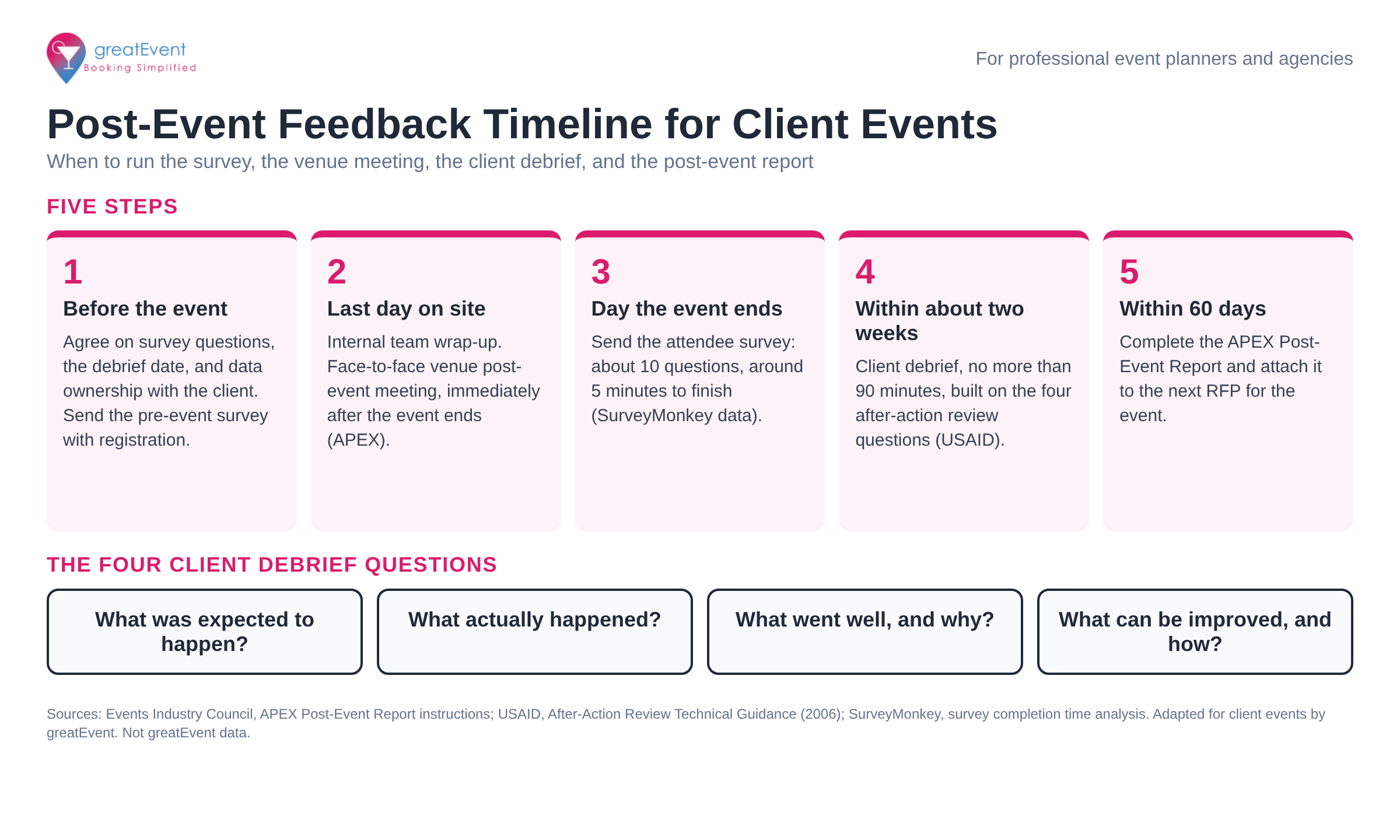
Text version of the infographic: Post-event feedback timeline for client events. (1) Before the event: agree on the survey questions, the debrief date, and data ownership with the client, and send the pre-event survey with registration. (2) Last day on site: hold an internal team wrap-up and the face-to-face venue post-event meeting, which the APEX instructions place immediately after the event ends. (3) Day the event ends: send the attendee survey, about 10 questions, around 5 minutes to finish according to SurveyMonkey’s data. (4) Within about two weeks: hold the client debrief, no more than 90 minutes, using the four after-action review questions: What was expected to happen? What actually happened? What went well, and why? What can be improved, and how? (5) Within 60 days: complete the APEX Post-Event Report and attach it to the next RFP for that event.
Client debrief meeting: agenda and questions
Run the client debrief as a working meeting where decisions get made. USAID’s after-action review guidance, which this format is based on, frames the review around four questions: what was expected to happen, what actually occurred, what went well and why, and what can be improved and how. It recommends planning for no more than 90 minutes, collecting input from stakeholders beforehand, and assigning a scribe. It also warns against turning the session into a critique, because a meeting focused on what went wrong discourages candid discussion.
Bring the survey results, the final bill against the budget, room block pickup by night, F&B guarantees against actual counts, and your internal wrap-up notes. Send a one-page summary of these to the client two or three days before the meeting so the time goes to decisions.
Client debrief agenda (copy and adapt)
CLIENT DEBRIEF: [Event name], [dates], [venue]
Date of debrief: [within about two weeks of the event]
Length: 60 to 90 minutes
Attendees: [client lead], [client stakeholders], [lead planner], [scribe]
Sent in advance: one-page summary of survey results, budget vs. actuals,
room pickup, F&B counts, open issues

1. Objectives (10 min)
   What did we expect to happen? Restate the agreed objectives and targets.

2. What actually happened (15 min)
   Attendance, survey scores and response count, room pickup,
   F&B counts, budget vs. actuals.

3. What went well, and why (15 min)
   What do we keep exactly as it was?

4. What to improve, and how (20 min)
   Venue, hotel, F&B, program, vendors, registration, communications.

5. Vendor and venue performance (10 min)
   Who do we rebook? Who do we replace?

6. Next event (10 min)
   Dates, location, size, budget, and what goes into the next venue brief.

7. Actions (5 min)
   Each action gets one owner and one due date.

ACTION LIST
Action | Owner | Due date | Status
______ | _____ | ________ | ______
Client debrief question bank
| Topic | Questions to ask the client |
|---|---|
| Objectives | Did the event do what you needed it to do? Which objective fell short, and what would have changed that? What will your leadership ask you about this event? |
| Budget vs. actuals | Which lines ran over or under, and were the reasons in our control? Were there any charges on the final bill you did not expect? Where would you spend more or less next time? |
| Attendees | Do the survey results match what you heard from attendees? Which comments surprised you? Did the right people attend? |
| Venue | Did the venue fit the program and the group size? Would you return to this venue? If not, what would the next one need to do better? |
| Hotel and room block | Was the block the right size? Why did attendees book outside it? Should we change the hotel, the rate, the cut-off date, or the block size next time? |
| F&B | Which meals worked and which didn’t? Were the guarantees right? Were dietary needs handled well? |
| Vendors and suppliers | How did your vendors and suppliers perform? Who would you hire again? |
| Working together | What should we do differently in how we communicate with you and your team? Were approvals and decisions made at the right time? |
| Next event | Are you planning this event again? Same dates, region, and size? What needs to be decided first, and by when? |
If you plan to include survey design, the debrief, and the report in your scope, list them as deliverables in the proposal and price them like any other planning work. Our guide to how much event planners charge shows how planners price their services.
Venue and vendor wrap-up
The Events Industry Council’s APEX Post-Event Report (PER) is the industry’s accepted-practice template for recording what an event actually used. Its instructions recommend completing it for events of all sizes, “especially for those of 25 rooms on peak night and larger,” finishing all applicable sections within 60 days of the end of the event, and sending the most recent PER with any RFP for future occurrences of the event. The template records room block when contracted, final block, and pickup, including pickup at the cut-off date, plus F&B covers guaranteed against covers actually served, and function and exhibit space use.
Questions for the venue or hotel post-event meeting
| Area | Questions to cover with the venue |
|---|---|
| Room block | What was pickup by night against the block? What was pickup at the cut-off date? How many attendees stayed in house but booked outside the block? |
| F&B | What were the guaranteed and actual counts for each function? Where was there waste, and where did food run out? |
| Function space | Which rooms were too large, too small, or unused? Were set and reset times enough? |
| Billing | Are there any charges on the master account we need to review before the final invoice? |
| Service | What went wrong on site from your side, and what would you change in the setup or timing next time? |
| Future dates | Are there dates or rates you can hold for this group’s next event? |
Do a similar wrap-up call with your vendors and suppliers. For corporate meetings, compare each vendor’s account with the session questions in the survey before you decide whether to rebook them. Our guide to corporate event production companies covers what to look for when you need a replacement. Add any operational fixes to your event logistics checklist so they carry over to every event, not just this client’s.
Turn the answers into the next venue brief
Once the debrief is done, turn the results into three documents.
- The action list. USAID’s guidance ties every recommendation to an owner and a schedule. Send the list to the client the same week as the debrief.
- The post-event report. Put survey scores, response counts, NPS, and the client’s objectives in one place. Our guide to how event planners prove ROI to clients has a report template you can copy.
- The next venue brief. Turn the comments into requirements: “General session room with clear sight lines from every seat” instead of “the ballroom was bad.” Attach the APEX PER, size the room block from actual pickup, and set F&B guarantees from actual counts. Our guide on what a hotel RFP for group bookings should include shows where these details go.
| Survey or debrief finding | Requirement for the next venue brief |
|---|---|
| Many attendees booked outside the block because of rate | Ask for a group rate at or below the public rate over the same dates, and a smaller initial block with review dates |
| Low scores for seeing and hearing presenters | Specify ceiling height, screen size, and audio coverage for the general session room |
| Long lines at breaks | Specify more break stations or a larger prefunction area near the session rooms |
| Dietary meals not handled correctly | Ask how the venue labels and tracks special meals, and confirm counts on each BEO |
| Low scores for the venue location | Require a site within a set travel time of the main hotel or airport |
| Sponsors unhappy with booth traffic | Place exhibits next to breaks and meals in the floor plan |
Common mistakes
- A 40-question survey costs you completions. Keep the core short and rotate modules.
- Don’t ask about things you can’t change. If the venue is under contract for three more years, don’t spend five questions on it.
- If the core questions change every year, you lose the trend line the client cares about.
- Don’t treat the debrief as a defense. Admit what went wrong, explain what you will change, and move on to decisions.
- An action without an owner and a date usually doesn’t happen.
- Always show the response count. A 4.6 average from 18 responses means less than one from 400. Show both.
Plan your next client event on greatEvent
Once the debrief tells you what the next event needs, the next step is finding the right space. On greatEvent, planners can book venues, meeting space, and hotel room blocks for their clients’ events and find event vendors in one place. A member of the greatEvent team can help you source venues that match the requirements from your debrief. There are no fees for planners. We pay you commission on any qualifying booking you make on greatEvent.
Register as a professional planner
Frequently Asked Questions
What questions should I ask in a post-event survey?
▾
Start with an overall satisfaction rating and a 0 to 10 likelihood-to-recommend question. Add a few questions on the venue, food and beverage, hotel, program, and registration, and end with one or two open-ended questions such as what to change next time.
How many questions should a post-event survey have?
▾
About 10 is a practical limit for attendees. SurveyMonkey’s data shows a 10-question survey takes about 5 minutes and that abandon rates rise once a survey takes more than 7 to 8 minutes.
When should I send a post-event survey?
▾
Send it the day the event ends, or show a QR code in the final session. Keep it open for about a week, send one reminder, and close it before the client debrief.
What is an event debrief?
▾
An event debrief is a meeting after the event where the planner and client compare what was supposed to happen with what actually happened, agree what worked and what to change, and assign follow-up actions.
What should a client debrief agenda include?
▾
Cover objectives, results, what went well, what to improve, vendor and venue performance, plans for the next event, and an action list with owners and due dates.
What is the difference between a pre-event and post-event survey?
▾
A pre-event survey asks attendees why they are coming and what they need, such as dietary needs or a hotel room. A post-event survey asks how the event met those needs and what to change.
What is an APEX Post-Event Report?
▾
It is the Events Industry Council’s accepted-practice template for recording what an event actually used, such as room block pickup, food and beverage counts, and function space. It is filed with the venues and sent with the next RFP for that event.
Research and sources
Sources were checked on October 27, 2026. Example figures in this article are fictional and labeled as such. They are not greatEvent data.
- Events Industry Council, “APEX Post-Event Report Template” and instructions (approved October 30, 2003; updated August 10, 2005), insights.eventscouncil.org. Post-event meeting timing, 60-day completion, use with future RFPs, and report fields.
- USAID, “After-Action Review Technical Guidance” (February 2006, PN-ADF-360), based on US Army Training Circular 25-20. Four review questions, timing within two weeks, 90-minute limit, scribe, and follow-up actions.
- Pew Research Center, “Writing Survey Questions,” pewresearch.org. Open and closed questions, number of answer choices, double-barreled questions, acquiescence bias, question order, and measuring change over time.
- Bain & Company, “Measuring Your Net Promoter Score,” netpromotersystem.com. The recommend question, the zero-to-ten scale, and how promoters, passives, and detractors are scored.
- Brent Chudoba, “How long should a survey be? The ideal survey length,” SurveyMonkey, surveymonkey.com. Completion time per question and abandon rates by survey length.
Compare vendors for your next event
Search caterers, photographers, florists, planners, and rentals — then send one request to several vendors at once.