TL;DR
Planning a class reunion in Maryland starts with a small committee, an updated classmate list, a realistic budget, and a venue that works for the actual guest list. Start early for larger or travel-heavy reunions, compare several venues, collect RSVPs before committing to expensive details, and prioritize conversation, accessibility, food, parking, lodging, and clear contracts. The goal is simple: make the logistics easy enough that classmates can focus on reconnecting.
Introduction
A class reunion is more than a dinner reservation. After years apart, classmates may be traveling from Baltimore, Annapolis, Montgomery County, Washington, DC, Northern Virginia, or much farther away. The right venue, date, budget, and communication plan can determine whether the evening feels effortless or becomes a series of last-minute problems.
If you’re figuring out how to plan a class reunion in Maryland, start by thinking about the guest experience rather than the decorations. How far will people travel? Will older classmates need accessible entrances and seating? Should guests stay overnight? Does the venue make conversation easy? What happens if attendance changes?
This guide walks through the major decisions from the first planning meeting to the final thank-you message. You’ll learn how to organize the committee, locate classmates, build a budget, compare Maryland venues, manage RSVPs, plan food and activities, arrange hotel rooms, and review the venue contract.
For a broader look at the financial side of private event spaces, you can also review this guide to event space costs and party venue pricing.
Start With the Purpose of the Reunion
Before contacting venues, define what the reunion is supposed to accomplish.
A reunion might celebrate a graduation milestone, reconnect classmates after many years, honor teachers, remember classmates, support the school, or simply give old friends a reason to spend time together.
That purpose affects almost every other decision.
For example, a relaxed 25-year reunion for 100 classmates and guests might include:
- Dinner
- Music
- A memory display
- Class photographs
- Informal conversation
- Optional hotel rooms nearby
Writing a short event brief helps the committee stay focused. It can be as simple as:
Event: 25-year high school reunion
Expected attendance: Approximately 100 classmates and guests
Format: Evening dinner and reception
Location: Maryland
Extras: Music, memory display, photographs and nearby hotel options
Once that brief is established, venue research becomes much easier.
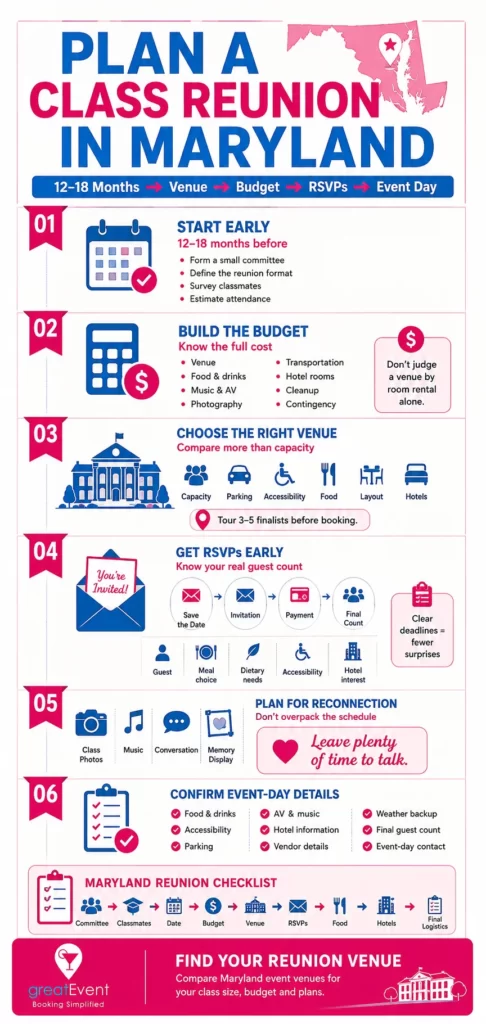
Step 1: Form a Small Planning Committee
One person rarely needs to manage every reunion task.
A small committee gives the event structure while keeping decisions manageable. The source material recommends clearly assigning responsibilities rather than simply creating a large group with unclear ownership.
| Role | Main Responsibility |
|---|---|
| Reunion chair | Overall planning and decisions |
| Outreach lead | Finding classmates and sending announcements |
| Finance lead | Budget, payments, deposits and refunds |
| Venue lead | Venue research, proposals and tours |
| Program lead | Music, memories, speakers and activities |
| Communications lead | Invitations, reminders and updates |
| Event-day lead | Vendors, volunteers and event timeline |
Create one shared planning document containing:
- Classmate contacts
- RSVP status
- Budget
- Venue proposals
- Payment information
- Vendor details
- Deadlines
- Open decisions
- Event-day responsibilities
Pro Tip: Decide in advance who can approve expenses. A reunion committee can lose time when every small purchase becomes a group debate.
Step 2: Find Classmates and Update the Contact List
Finding classmates may take longer than finding the venue.
Use appropriate sources such as permitted school or alumni contacts, class officers, personal networks, professional networks, social platforms, and referrals from classmates. The original source specifically recommends respecting privacy and using contact information only for the reunion purpose.
Create one clean contact list with fields such as:
- Classmate name
- Phone number, if voluntarily provided
- City
- Guest information
- RSVP status
- Dietary needs
- Accessibility needs
- Payment status
- Communication preference
Don’t rely on a single social media post.
Ask classmates to forward the announcement to people who may have been missed. A multi-channel approach gives the committee a better chance of reaching people who no longer live near Maryland.
Step 3: Choose the Date and Reunion Format
The best reunion date needs to work for the class, venue, travel patterns and planned activities.
Common formats include:
| Reunion Format | Best Planning Focus |
| Formal dinner | Seating, meal service, speeches and music |
| Casual reception | Flexible arrival, food stations and conversation |
| School/community gathering | Parking, accessibility and weather backup |
| Multi-day reunion | Hotels, transportation and multiple activities |
| Milestone reunion | Memory displays, photographs and tributes |
Ask classmates early about preferred dates and attendance.
A short survey can ask:
- Which dates work?
- Will you attend alone or with a guest?
- Would you travel for the reunion?
- Would you need a hotel?
- What type of event would you prefer?
- Are there accessibility or dietary considerations the committee should know about?
For larger reunions, the source recommends beginning roughly 12–18 months ahead, giving the committee time to identify classmates, compare venues, establish the budget and secure an appropriate date.
Step 4: Build a Realistic Class Reunion Budget
Don’t choose a venue based only on the advertised room rental.
Your actual reunion budget may include:
- Venue rental
- Food and beverage
- Service charges
- Taxes
- Décor
- Music
- Photography
- Name badges
- Printing
- Registration
- Payment processing
- Transportation
- Hotel rooms
- Insurance
- Deposits
- Cleanup
- Gifts or memorabilia
- Contingency funds
Separate fixed costs from per-person costs.
Sample Budget Framework
| Budget Category | Questions to Ask |
| Venue | What rooms, furniture and hours are included? |
| Food & beverage | Dinner, buffet, stations or reception? |
| Registration | Are tickets, badges and check-in supplies included? |
| Program | Is music, photography or AV required? |
| Travel | Are shuttles, parking or hotel rooms needed? |
| Communication | What will invitations and registration tools cost? |
| Contingency | What happens if attendance changes? |
A venue with a low rental price may become more expensive after catering minimums, staffing, AV, security, overtime, taxes and cleanup are added. The source specifically recommends requesting an itemized proposal.
If you’re considering professional assistance, compare the potential cost of an event planner using this guide to how much event planners charge.
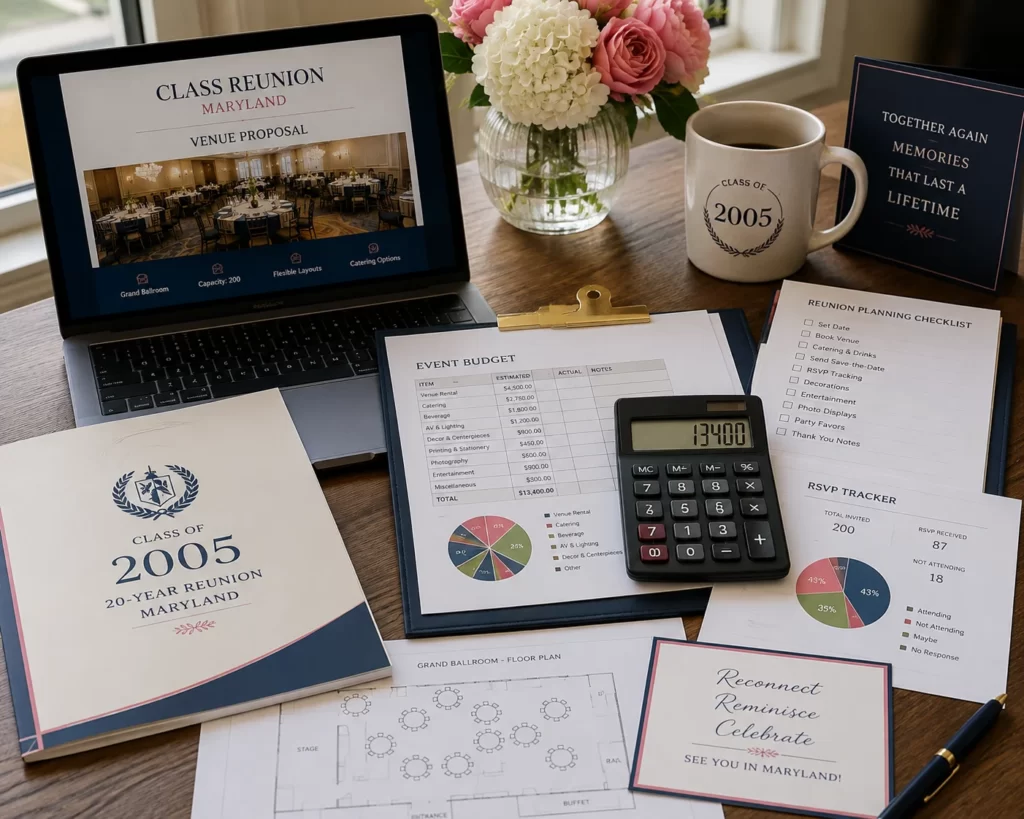
Step 5: Choose a Maryland Location That Works for the Class
Maryland reunions can attract classmates from across the state and nearby Washington, DC and Northern Virginia.
Possible areas may include:
- Annapolis
- Baltimore
- Columbia
- BWI area
- Bethesda
- National Harbor
- Locations near Washington, DC
The best location depends on where classmates actually live and how they plan to travel—not simply which city looks most central on a map.
Compare:
- Driving access
- Public transportation
- Airport proximity
- Parking
- Nearby hotels
- Restaurants
- Accessibility
- Venue hours
- Noise restrictions
- Outdoor backup options
- Room layouts
- Event capacity
If classmates are considering Washington, DC as part of a weekend reunion, a guide to events in Washington, DC in 2026 can help with broader local planning.
Step 6: Compare Venues Based on Guest Experience
A reunion venue should make conversation easy.
Guests need to be able to hear one another, find registration, read name badges, access food and restrooms, move around comfortably, take photographs and leave safely.
Potential venue types include:
- Hotels
- Restaurants
- Ballrooms
- Private event rooms
- Community spaces
- Historic venues
- Outdoor spaces
- Flexible event venues
Hotels can be especially practical when many classmates are traveling. Restaurants can work well for smaller dinner-focused reunions. Ballrooms and flexible spaces may provide more room for music, displays and activities.
Maryland Reunion Venue Scorecard
| Factor | What to Evaluate |
| Capacity | Does the room fit the actual guest count? |
| Layout | Can people comfortably talk and move? |
| Acoustics | Can guests hear conversations and speeches? |
| Accessibility | Entrances, restrooms, seating and routes |
| Parking | Availability and convenience |
| Food | Menu, service style and dietary options |
| Technology | Microphone, screen, AV and presentation needs |
| Photography | Space for class photos and displays |
| Hotels | Nearby rooms and transportation |
| Contract | Deposits, cancellation and overtime terms |
For groups interested in a more flexible event setup, you can also review this guide to outdoor event spaces for 100 guests.
Expert Tip: Walk through the venue as if you were an arriving guest. Start at parking or drop-off, then follow the route to registration, the event room, restrooms, food service, activity areas and exit.
Step 7: Shortlist and Tour Three to Five Venues
Don’t make the final decision from photographs alone.
The source recommends comparing multiple venues and touring finalists before committing.
A useful shortlist might include:
- One or two venues close to the target budget
- One or two lower-cost alternatives
- One venue offering a different event format
During each tour, ask:
- What is included?
- When can setup begin?
- When must the event end?
- Are outside vendors permitted?
- What food and beverage rules apply?
- Is AV included?
- What costs extra?
- What happens if attendance changes?
- What is the cancellation policy?
- Is there an overtime charge?
- Who is the event-day contact?
- What is the weather backup?
Record answers in the same scorecard for every venue. That makes an objective comparison much easier.
Step 8: Create an RSVP and Payment Process
Don’t wait until the final weeks to discover your actual attendance.
Start with a save-the-date, then send the formal invitation when the essential details are confirmed.
Include:
- Date
- Venue
- Event format
- Ticket price
- RSVP deadline
- Payment method
- Guest policy
- Hotel information
- Accessibility contact
- Cancellation policy
Useful RSVP fields include the classmate’s name, guest name, attendance, meal preference, dietary needs, accessibility requests, city and hotel interest.
State the payment policy clearly.
If tickets are refundable only before a specific date, say so. If the reunion depends on reaching a minimum attendance, explain when that decision will be made.
Step 9: Design Activities That Encourage Reconnection
A reunion doesn’t need a packed entertainment schedule.
In fact, too many activities can leave classmates with little time to talk.
Good reunion elements can include:
- Graduation-year photo name badges
- Class timeline
- Memory table
- School-year music
- Teacher tribute
- Slideshow
- Short welcome
- Class photographs
- Informal dancing
Ask classmates what they actually want before spending money.
Some groups may want dancing and music. Others may prefer dinner and conversation. A quick survey can prevent the committee from paying for activities that few guests will use.
If the reunion includes photography or a slideshow, assign one person to collect images and verify presentation files before event day.
For event-planning support involving larger celebrations, you may also find this resource on how much birthday party planners charge useful when comparing professional planning costs.
Step 10: Plan Food, Drinks and Accessibility
Food should support the format of the reunion.
A seated dinner works well for a structured evening. Buffets and food stations provide more flexibility. A reception with small bites can encourage guests to move between conversations.
Ask the venue or caterer about:
- Dietary requirements
- Non-alcoholic drinks
- Water
- Coffee
- Dessert
- Cake
- Service timing
- Leftovers
- Cleanup
- Alcohol policies
- Staffing
- Identification requirements
- Last-call timing
- Transportation options
Accessibility deserves equal attention.
Confirm:
- Accessible entrances
- Restrooms
- Parking
- Seating
- Lighting
- Sound
- Signage
- Clear movement routes
Ask classmates to communicate accessibility needs privately and give the venue sufficient time to respond.
If your committee is comparing event costs across different types of celebrations, resources such as this average wedding cost guide for 2026 can provide broader context for understanding how event budgets are structured.
Step 11: Arrange Hotel Rooms and Transportation
A hotel room block can make a major difference when classmates are traveling from outside Maryland.
Ask about:
- Room types
- Group rates
- Block deadlines
- Cancellation policies
- Parking
- Breakfast
- Shuttle options
- Distance from the event venue
Share confirmed hotel information with classmates rather than promising a room block before an agreement exists.
For a multi-day reunion, prepare a simple arrival guide containing:
- Venue address
- Hotel address
- Parking information
- Transportation
- Meal times
- Event schedule
- Emergency contact
If your reunion becomes a multi-event weekend, consider using a step-by-step wedding planning checklist as a structural reference for managing multiple deadlines and vendors—even though the event itself is a reunion.

Step 12: Review the Venue Proposal and Contract
Before paying a deposit, confirm every important detail in writing.
Review:
- Exact event room
- Date
- Guest count
- Access and setup hours
- Furniture
- Food and beverage
- Outside vendors
- Music rules
- AV
- Displays
- Parking
- Hotel rooms
- Accessibility
- Deposit
- Payment schedule
- Cancellation
- Rescheduling
- Overtime
- Cleanup
- Damage terms
- Insurance
- Weather provisions
Request an itemized proposal that clearly separates included services from additional charges.
If the venue promises a particular room, setup period, microphone, screen, food package or outside-vendor policy, get that promise in writing.
For larger or professionally managed events, you can compare the role of different planning professionals using event planners vs. coordinators: roles, responsibilities and costs.
For contracts, insurance, alcohol requirements and accessibility compliance, consult the venue and appropriate professionals.
Class Reunion Planning Timeline
| Planning Period | Main Priorities |
| 12–18 months before | Committee, purpose, survey and initial budget |
| 9–12 months before | Venue shortlist, tours and proposals |
| 6–9 months before | Venue agreement, event announcement and ticket process |
| 3–6 months before | RSVPs, food, music, hotels, transportation and memories |
| 1–2 months before | Vendors, program, accessibility and final communication |
| Event week | Schedule, files, supplies and event-day roles |
| Event day | Registration, vendors, timeline and guest questions |
| After event | Budget reconciliation, thank-you message and approved photos |
The source notes that smaller local gatherings can move faster, while larger classes, travel-heavy reunions, popular dates and multi-day programs generally need more lead time.
Class Reunion Communication Plan
Communication should become more detailed as the reunion approaches.
| Timing | Communication | Purpose |
| 12–18 months | Interest survey/save-the-date | Test dates and attendance |
| 9–12 months | Preliminary update | Announce format and planning progress |
| 6–9 months | Venue/ticket announcement | Explain location, price and RSVP process |
| 3–5 months | Invitation | Collect payment and guest details |
| 4–6 weeks | Reminder | Confirm attendance and hotel information |
| 1–2 weeks | Final logistics email | Parking, schedule, dress and weather |
| After event | Thank-you | Share approved photos and close the loop |
Clear communication is one of the simplest ways to reduce confusion during reunion planning.
Common Mistakes to Avoid
Choosing a venue because the rental price looks cheap
Compare the complete proposal, including food, service charges, AV, staffing, taxes, cleanup and overtime.
Booking before estimating attendance
A room that is too large can feel empty, while a room that is too small can make conversation uncomfortable.
Relying on one communication channel
Former classmates may have changed cities, email addresses and social profiles. Use multiple appropriate channels.
Overloading the schedule
A reunion is primarily about reconnecting. Leave substantial unstructured conversation time.
Ignoring accessibility
Accessibility should be considered during venue selection—not added as a last-minute adjustment.
Making verbal promises
Put important venue commitments into the written agreement.
Forgetting out-of-town guests
Hotel rooms, parking, transportation and nearby dining can influence attendance.
Final Class Reunion Checklist
- Form the planning committee
- Define the purpose and event format
- Update the classmate contact list
- Survey preferred dates
- Estimate attendance
- Establish the budget
- Research Maryland locations
- Shortlist three to five venues
- Compare complete proposals
- Tour finalist venues
- Confirm accessibility
- Review parking and transportation
- Confirm food and beverage plans
- Decide on activities and music
- Establish RSVP and payment policies
- Arrange hotel information if needed
- Review the venue contract
- Confirm vendors
- Send final logistics
- Assign event-day responsibilities
- Reconcile expenses afterward
- Send thank-you communications
How greatEvent Can Help With Venue Discovery
Once you know your approximate guest count, location preference, date and budget, venue discovery becomes much easier.
You can browse Maryland wedding venues as a starting point for venue profiles and compare spaces based on the needs of your reunion.
For committees considering destinations outside Maryland, you can also browse Washington, DC event venues, unique wedding venues in Washington, DC, or hidden-gem venues in Washington, DC.
Some reunions may also combine several activities or celebrations. If your committee is exploring an informal hourly venue format, see these pop-up party venues in DC.
For broader venue comparisons, greatEvent also provides Washington, DC wedding venue listings, along with venue options in New York and San Antonio.
A reunion committee should always verify current availability, pricing, capacity, amenities and contract terms before booking. Venue inventory and policies can change.
Final Thoughts
A successful class reunion is one where the logistics become quiet enough for people to reconnect.
Start early, keep responsibilities clear, communicate consistently and compare venues based on the complete guest experience—not simply the rental price. The venue should support conversation, comfortable movement, food service, accessibility, photographs and the activities your classmates actually want.
Before publishing current venue recommendations, verify the venue’s location, capacity, amenities, availability, booking method and policies because listings can change.
Once the basics are clear, begin exploring current Maryland venue options and build a shortlist around your class size, location, budget, program and lodging needs.
Frequently Asked Questions
How do I plan a class reunion in Maryland? ▾
Start by forming a committee, locating classmates, choosing a date and format, establishing a budget, comparing Maryland venues, opening RSVPs, planning food and activities, and confirming event-day logistics.
How early should I start planning a class reunion? ▾
For a larger reunion, starting approximately 12–18 months ahead gives the committee more time to locate classmates, compare venues, collect attendance information and secure a suitable date.
What should I ask a class reunion venue? ▾
Ask about capacity by layout, parking, accessibility, food, drinks, music, AV, displays, setup, cleanup, outside vendors, hotel rooms, deposits, cancellation, overtime and final attendance deadlines.
How can I find class reunion venues in Maryland? ▾
Start by defining the guest count, location, date and budget, then compare venue types such as hotels, restaurants, ballrooms, private rooms and flexible event spaces. Review complete proposals rather than room-rental prices alone.
What should I consider for a Maryland reunion during a busy travel or event season? ▾
Reserve desirable venues earlier, especially when classmates are traveling from outside Maryland. Confirm hotel availability, transportation, parking and weather backup early, and communicate deadlines clearly.
Compare vendors for your next event
Search caterers, photographers, florists, planners, and rentals — then send one request to several vendors at once.