Quick answer: Corporate hospitality in Washington, DC, for an executive or delegation visit, usually means six pieces of work: airport arrivals and departures (sometimes through a private terminal), executive and group transportation, the manifest, on-site hospitality for the principals, concierge and itinerary work, and private dining or tours. Give one lead a single written brief that covers who is coming, what each person needs, and who decides protocol. Then confirm each piece in writing. Two DC rules surprise planners. A White House tour has to be requested through a Member of Congress 7 to 90 days ahead. Private (general aviation) flights into Reagan National must follow a TSA security program and need an FAA slot reservation, so settle the airport with the flight department early.
Example scenario (fictional): On a Monday, an agency planner hears that a client’s CEO and five board members land Thursday on a private jet. They have two days of meetings near Capitol Hill, a dinner for 12 partners, and the CEO would like a White House tour. The dinner and the cars can still be arranged. The tour can’t, because the request window closes 7 days before the tour date.
This is for professional planners and agencies running executive, VIP, board, and delegation visits for corporate clients in Washington, DC and the greater Washington area. It covers what to brief, what to confirm, which public rules affect the itinerary, and what to ask a local hospitality provider. Each section ends with what Arrival DC, Hospitality Partners, a DC service provider that recently signed up with greatEvent, says it offers for that part of the visit. Vehicle rules, curb pickups, and driver hours are covered in our guide to corporate event transportation in Washington, DC, so they are only summarized here. Personal security, official state protocol, and visas belong to the client’s security team, the host government office, or counsel, and are outside this guide.
In this guide:
- The six services in a DC executive visit
- One brief, one lead
- Airport arrivals, departures, and private terminals
- Executive and group transportation
- Manifest management
- On-site executive hospitality
- Concierge, itinerary, and private dining
- Tours and curated experiences in DC
- Working with a DC hospitality provider
- Copyable delegation visit brief
- FAQ
The six services in a DC executive visit
A visit for a CEO, a board, or a client delegation looks small on paper: a small group arrives, attends meetings, eats well, and leaves. Most problems happen in the handoffs, because each piece is often booked with a different vendor and nobody owns the gaps between them. List the six pieces and assign an owner to each before you request a single quote.
| Service | What it covers | What you brief | What you confirm in writing |
|---|---|---|---|
| Arrivals and departures | Meet and greet at the gate or terminal, luggage, private terminal (FBO) arrivals | Flights or tail details, arrival airport, who travels with whom | Greeter name, meeting point, what happens when a flight is delayed |
| Executive and group transportation | Sedans and SUVs for principals, vans or coaches for the wider group | Daily movements, ride pairings, standby needs | Vehicle class per movement, hold times, the on-site contact |
| Manifest management | Who is where, when, and in which vehicle | Final names, flights, phone numbers, special needs | One owner, a version number, and who receives which rows |
| On-site executive hospitality | Meeting support, VIP handling, guest relations | Preferences, titles, sensitivities, accessibility | Staff names and hours, the escalation path |
| Concierge and itinerary | Daily schedules, reservations, tickets, personal requests | Free time, dining preferences, dietary needs | Each reservation, whose name it is under, and the cancellation terms |
| Private dining and tours | Private dinners, guided tours, team activities | Group size, purpose of the evening, guest list | Room privacy, timing against transport, tour entry rules |
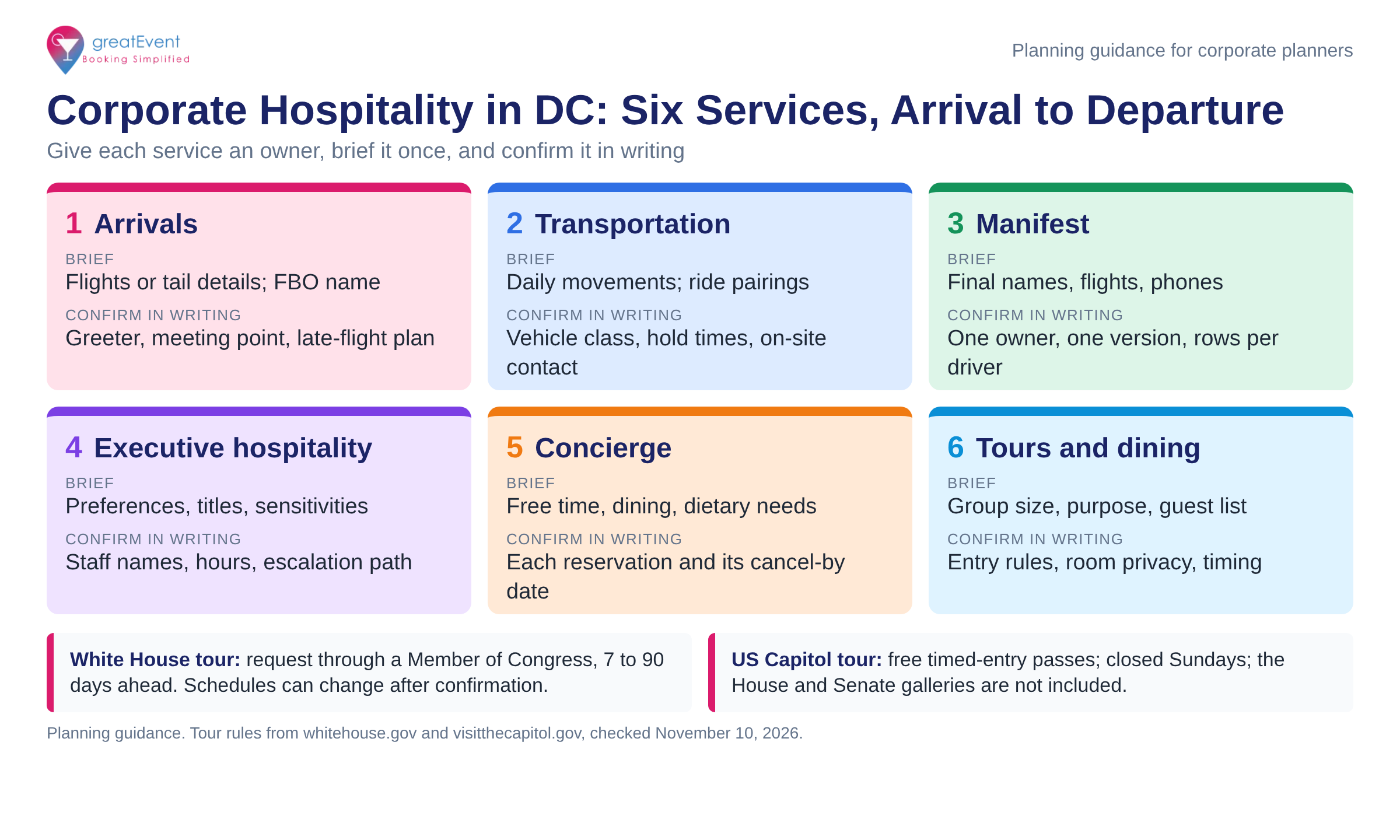
Text version of the infographic: Corporate hospitality in DC has six services, from arrival to departure. Give each one an owner, brief it once, and confirm it in writing. Arrivals: brief flights or tail details and the FBO name; confirm the greeter, meeting point, and late-flight plan. Transportation: brief daily movements and ride pairings; confirm vehicle class, hold times, and the on-site contact. Manifest: brief final names, flights, and phone numbers; confirm one owner, one version, and rows per driver. Executive hospitality: brief preferences, titles, and sensitivities; confirm staff names, hours, and the escalation path. Concierge: brief free time, dining, and dietary needs; confirm each reservation and its cancel-by date. Tours and dining: brief group size, purpose, and guest list; confirm entry rules, room privacy, and timing. White House tour: request through a Member of Congress, 7 to 90 days ahead; schedules can change after confirmation. US Capitol tour: free timed-entry passes, closed Sundays, and the House and Senate galleries are not included. Planning guidance, with tour rules from whitehouse.gov and visitthecapitol.gov, checked November 10, 2026.
One brief, one lead
Start with a single written brief. Send it to whoever runs the visit on the ground, whether that is your own staff or a provider. When the same facts are spread across six vendor emails, a dietary restriction can reach the restaurant and never reach the staff ordering lunch between meetings.
The brief should answer these questions:
- Who are the principals, and how should each be addressed? Get the titles and preferred names from the client, and spell them the way the client does.
- Who decides protocol, such as seating order, gifts, and who greets whom? On a corporate visit, that is often the client’s executive office or chief of staff. If a foreign government delegation is involved, ask the client who represents the government side.
- What is confidential? Some visits can’t be named on signs, in reservations, or on a driver’s phone.
- Who is the single contact on the client side, and who can approve a change at 10 p.m.?
- What are the accessibility, medical, and dietary needs, and who is allowed to see them?
- What is the budget authority? Executive visits drift upward one small request at a time.
Our event brief template covers client intake in more detail. The delegation visit brief near the end of this guide is a shorter version for this kind of program.
Arrival DC’s about page describes this model directly: it says a single hospitality partner manages every detail from first contact to final departure. Ask any provider who that person is, by name, and whether the same person will be on the ground during the visit.
Airport arrivals, departures, and private terminals
The arrival is the first part of the visit the principals see, and it is the part with the least room to recover. A late flight, a greeter at the wrong door, or a car held at the curb can set the tone for two days of meetings.
Commercial flights into DCA, IAD, and BWI
Brief the greeter with the flight number, the number of bags, and a photo or description of each traveler if the client allows it. Confirm where the greeter will stand, and what happens if the flight lands early or two hours late. At Reagan National and Dulles, the Metropolitan Washington Airports Authority’s limousine and sedan services pages say only permitted sedan and limousine services may operate, and pickups must be prearranged. MWAA’s limousine transportation services permit page says any for-hire limousine operator providing pickups or drop-offs at either airport must be authorized to do so. BWI pickup rules and curb details are in the transportation guide linked above.
Arrival DC’s FAQ says it handles arrivals and departures at Dulles, Reagan National, and BWI. It describes its meet and greet as a professional greeter who meets the party at the gate or terminal, helps with luggage, escorts guests to the vehicle, and handles last-minute itinerary changes.
Private aviation and FBO arrivals
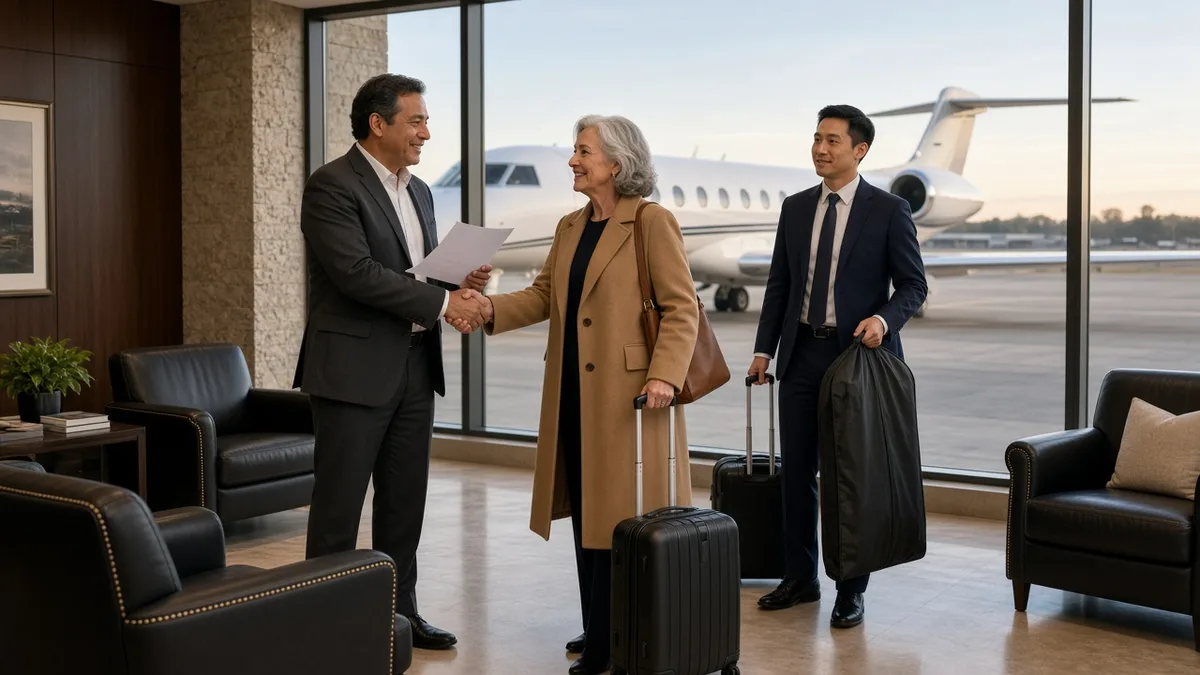
Executives who fly privately usually arrive at a fixed base operator (FBO), the private terminal that serves business aircraft at an airport. The flight department or charter operator chooses the airport and the FBO, and that choice drives your pickup plan. Ask for the FBO name, the expected arrival time, and the crew’s contact as soon as the trip is confirmed.
Reagan National is a special case. The TSA’s general aviation page says all general aviation operators flying into or out of DCA must follow the DCA Access Standard Security Program, and all unscheduled general aviation operations to and from DCA need a Federal Aviation Administration slot reservation. That is the aircraft operator’s job, not yours. Still, ask early whether the flight is going to DCA, Dulles, BWI, or another airport, because the answer changes the drive time to the first meeting.
At the FBO, confirm with the provider:
- Where the vehicle waits, and whether the FBO allows vehicles past the lobby. Ask the FBO directly, because its own rules apply.
- Who tracks the flight, and who tells the driver when the aircraft is on the ground.
- How luggage moves from the aircraft to the car.
- For departures, what time the principals must leave the hotel or the last meeting, set by the crew.
For private flights, Arrival DC’s FAQ says its airport service includes private terminals and FBO coordination when requested.
Executive and group transportation
An executive visit typically mixes two kinds of vehicles. Principals ride in sedans or SUVs, often with a car held near each meeting. The wider group moves in a van or coach to dinners and offsite events. Brief each day as a list of movements, then decide which ones need a vehicle on standby and which can be simple drop-offs. A held car costs more, but it saves the CEO waiting at a curb when a meeting ends early.
Settle ride pairings in advance. Who rides with whom matters on a board visit, and it is awkward to sort out on the sidewalk. Ask for a spare vehicle or a clear plan for when one breaks down, and confirm the driver can reach the on-site lead directly.
District rules shape where a coach can stop and how long it can idle, and federal limits cap a driver’s hours. The transportation guide linked above explains those rules, the four separate transportation bookings, and how each is priced.
Arrival DC’s services page lists airport transfers with meet and greet, manifest management, chauffeured black-car and SUV service, event transportation, logistics management, and staff support. Its FAQ lists executive sedans, SUVs, sprinter vans, mini and motor coaches, and trolleys, and says it coordinates single or multi-vehicle movements and provides on-site coordinator staff.
Manifest management
The manifest is the working list of every person, flight, vehicle, and time across the visit. On a delegation visit it changes constantly. Someone’s flight moves, a spouse joins for dinner, two board members decide to share a car. It needs one owner and a version number. Send each driver, greeter, and venue only the rows that concern them, and log every change with who asked for it.
If you hand the manifest to a provider, put that in writing and agree on how changes reach you. If you keep it yourself, budget the time, because on a busy visit keeping it current can become one person’s main job. A copyable manifest format is in our transportation guide.
According to Arrival DC’s FAQ, it builds, updates, and distributes arrival and departure manifests for groups of any size, tracks flight details, and coordinates with greeters, chauffeurs, and venue contacts.
On-site executive hospitality
This is the part of corporate hospitality that is hardest to put in a quote: a person who is with the principals, knows their schedule, and fixes small problems before the principals notice them. In practice it means meeting support (the room is ready, the water is there, the next car is outside), VIP handling, and guest relations for partners and invited guests.
Brief the hospitality staff on each principal’s preferences and on anything that should not be mentioned. Then confirm:
- Names of the staff who will be on site, and their hours
- Where they will be during meetings (outside the room, in the lobby, or on call)
- Who they report to, and what they can approve without asking
- How they will dress, if the client cares
- What happens after the last scheduled event of the day
If you are pricing your own time for a visit like this, our guide to what event planners charge covers how planners price their services. Price the on-site hours separately from the planning hours, because executive visits tend to need someone available late.
Arrival DC’s services page describes its executive hospitality as on-site coordination, meeting support, VIP handling, and guest relations with experienced hospitality staff.
Concierge, itinerary, and private dining
Concierge work turns the agenda into a schedule each principal can follow. Give each person a one-page daily itinerary with times, addresses, the vehicle, and one phone number to call. Leave buffers between meetings, because DC traffic and building security both add time.
For reservations, decide whose name each booking is under. A confidential visit may need bookings under the agency’s name. Record every cancellation deadline in one place, since a changed agenda on day one can affect three reservations on day two.
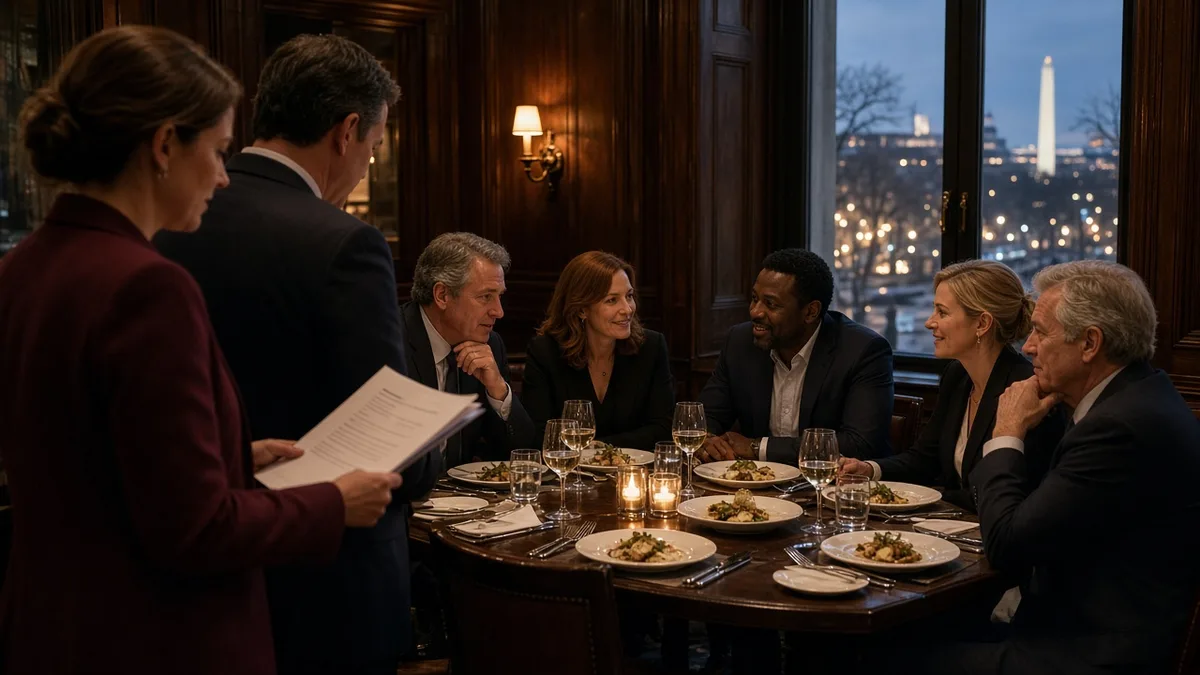
Private dining needs its own short brief. Ask the restaurant:
- Is the room fully private, or separated by a partition or curtain?
- Can the menu be set in advance, and how are dietary needs handled?
- Is there a minimum spend, and what does it include?
- How long will the room be held, and can the cars wait nearby?
- Can the seating plan be placed on the table before guests arrive?
If the dinner or a working lunch is in a private room at a hotel or a standalone venue, our guide to corporate event venues in Washington, DC covers hotel ballrooms, historic spaces, and other rooms used for board meetings and client events.
Arrival DC’s services page lists itinerary planning, private dining, tickets, and personal assistance as concierge services. Its FAQ says it arranges private dinners at local restaurants.
Tours and curated experiences in DC
Many executive visits include one cultural or civic stop, and in Washington the best-known ones have fixed rules and deadlines. Check them before you promise anything to the client.
| Experience | How to request it | Timing and limits | Source |
|---|---|---|---|
| White House tour | Through a Member of Congress (a US Representative or Senator) | Requests 7 to 90 days ahead. Tours are generally 7:30 a.m. to 11:30 a.m. Tuesday to Thursday, and 7:30 a.m. to 1:30 p.m. Friday and Saturday. Schedules can change even after a tour is confirmed | whitehouse.gov |
| US Capitol tour | Free timed-entry passes; reservations recommended | Visitor Center open 8:30 a.m. to 4:30 p.m. Monday to Saturday, closed Sunday; last tour 3:20 p.m. The tour visits the Crypt, the Rotunda, and National Statuary Hall, and does not include the House and Senate galleries | US Capitol Visitor Center tour booking page |
The White House request goes through the visitor’s own Member of Congress, so for a mixed or international group, ask the client early who would make the request and whether it is possible at all. Keep it off the printed itinerary until it is confirmed, and have a backup ready for the same morning.
For private tours of monuments and neighborhoods, ask the provider who leads the tour, how long it runs, what happens in bad weather, and how the group gets from the vehicle to the start point.
Arrival DC’s FAQ says it arranges private tours of Washington sites, private dinners at local restaurants, team building events, and recreational tours of the city on foot, running, by Segway, or by bike. Its home page describes Washington experiences and VIP tours arranged by locals.
Working with a DC hospitality provider
You can split these six services across your vendors and suppliers, or give most of them to one local provider and manage that provider. The second option means fewer handoffs, and the risk sits with one company, so check it more carefully. If the client is used to working with a destination management company, our guide to DMC vs DMO vs CVB explains what each type of organization does.
Arrival DC, Hospitality Partners is one DC provider that covers all six areas on its website. Its about page describes it as a boutique agency serving diplomats, executives, and private planners throughout the Washington, DC metropolitan area. Its home page says it partners with corporate and private planners on transportation, hospitality coordination, and curated experiences. Its FAQ says it serves the greater Washington area, including Montgomery County and greater Baltimore in Maryland and Arlington and Fairfax Counties in Virginia. On lead times, the FAQ says 24 to 48 hours is preferred for standard reservations, and it recommends booking as early as possible for complex itineraries, multi-day delegations, or high-profile events.
Its public pages don’t state licensing, insurance, whether vehicles are its own or arranged through partners, or prices. Ask for those directly, as you would with any provider.
Arrival DC’s description here comes only from its own website, read on November 10, 2026. We haven’t verified its licensing, insurance, fleet, or track record, and this isn’t an endorsement or a recommendation of one provider over another.
Questions to ask any DC hospitality provider
- Who is our single lead, and will that person be on the ground during the visit?
- Which services do you deliver with your own staff, and which through partners?
- Are the vehicles your own or subcontracted? For DCA and IAD pickups, does the operator hold the MWAA permit?
- Have you coordinated arrivals at the FBO our principals will use?
- Who holds the manifest, and how do changes reach us?
- How do you handle confidential visits, including names on reservations and signs?
- What is included in the quote, and what is billed separately (gratuity, parking, waiting time, tickets)?
- What are your cancellation and change deadlines for each service?
- Who do we call at 11 p.m., and how fast do they answer?
Copyable delegation visit brief
Copy this into your planning document and fill it in before you request quotes. Send the full brief only to the lead. Drivers, greeters, and restaurants get the parts that concern them.
DELEGATION / EXECUTIVE VISIT BRIEF
Client: ______________ Program: ______________ Version: ___ Updated: ___ (date/time)
Client contact (approves changes): ______________ After-hours approver: ______________
On-the-ground lead: ______________ Planner contact: ______________1. PRINCIPALS (one row per person)
Name as it should appear | Title | Preferred form of address | Mobile
Arrival (flight # or FBO + tail/operator contact) | Departure | Bags
Dietary | Accessibility | Notes the hospitality staff may see2. PROTOCOL AND CONFIDENTIALITY
Who decides protocol (seating, gifts, greeting order): ______________
Can the client or principals be named on signs/reservations? Y / N
Press or photography allowed? Y / N Restrictions: ______________3. ARRIVALS AND DEPARTURES
Airport (DCA / IAD / BWI / other): ___ Terminal or FBO name: ___
Greeter name + meeting point: ___ Late-flight plan: ___
Departure: leave hotel/meeting by ___ (set by airline or crew)4. DAILY MOVEMENTS (one row per movement)
Date | Time | From | To | Who | Vehicle class | Hold or drop | Driver contact5. ON-SITE HOSPITALITY
Staff names + hours: ___ Position during meetings: ___
Can approve without asking (up to $___): ___ Escalation: ___6. RESERVATIONS AND EXPERIENCES
Item | Date/time | Booked under (name) | Confirmation # | Cancel by | Entry rules
(White House: via Member of Congress, 7 to 90 days ahead. Capitol: timed-entry passes.)7. CHANGE LOG (never edit silently)
Time | Change | Requested by | Approved by | Who was toldPlan the venues and the visit on greatEvent
Settle the hospitality plan while you are still choosing the hotel and meeting venues. The distance from the hotel to the meetings and the dinner affects how many cars you hold, how early people leave, and how much the visit costs.
On greatEvent, start a venue search with the meeting type, location, date, and attendee count. You can compare hotels and venues side by side, check real-time availability, or send one inquiry to several venues and get quotes back. For DC options, see our list of Washington, DC event venues. If the group needs a hotel room block, set it up through the hotel at the same time as the meeting space.
Arrival DC, Hospitality Partners also has a service provider profile on greatEvent.
There are no fees for planners. We pay you commission on any qualifying booking you make on greatEvent.
Register as a professional planner
Frequently asked questions
What does corporate hospitality include for an executive visit in Washington, DC?
▾
Usually six services: airport arrivals and departures, executive and group transportation, the manifest, on-site hospitality for the principals, concierge and itinerary work, and private dining or tours. Each needs an owner and written confirmation, whether one provider covers them or several do.
How far ahead do you request a White House tour?
▾
The White House says tour requests go through a Member of Congress and may be submitted 7 to 90 days before the tour date. Schedules can change even after a tour is confirmed, so keep a backup plan for that morning.
Can a private jet fly into Reagan National for an executive visit?
▾
General aviation flights into and out of DCA must follow the TSA's DCA Access Standard Security Program, and unscheduled flights need an FAA slot reservation. The aircraft operator handles this. Ask the flight department early which airport and private terminal it will use.
Do US Capitol tours include the House and Senate galleries?
▾
No. The standard Capitol tour visits the Crypt, the Rotunda, and National Statuary Hall. Passes are free and timed, reservations are recommended, and the Capitol Visitor Center is closed on Sundays.
Who should own the manifest on a delegation visit?
▾
One named person, either you or the provider, agreed in writing. The manifest changes often during a visit, so it needs a version number, a change log, and a rule that drivers and greeters only get their own rows.
What should I ask a DC hospitality provider before booking?
▾
Who your single lead is, which services it delivers itself, whether its vehicles are its own, whether it holds the airport permits it needs, how it handles confidential visits, what the quote excludes, and its cancellation deadlines.
Research and sources
Sources were checked on November 10, 2026. Tour rules and airport requirements change, so confirm them with the agency or airport before the visit. The six-service structure, briefing points, and provider questions are planning guidance based on general meeting-planning practice. The opening scenario is fictional. No prices are given because none were verified.
- Arrival DC, Hospitality Partners: home page, with its services, about, and FAQ pages, arrivaldc.com, read November 10, 2026.
- General Aviation: DCA Access Standard Security Program, Transportation Security Administration, https://www.tsa.gov/for-industry/general-aviation, read November 10, 2026.
- Visit the White House, The White House, https://www.whitehouse.gov/visit/, read November 10, 2026.
- Book a Tour, U.S. Capitol Visitor Center, https://www.visitthecapitol.gov/visit/book-a-tour, read November 10, 2026.
- Limousine and Sedan Services, Reagan National Airport and Limousine and Sedan Services, Dulles International Airport, Metropolitan Washington Airports Authority, read November 10, 2026.
- Limousine Transportation Services Permit, Metropolitan Washington Airports Authority, read November 10, 2026.
Compare vendors for your next event
Search caterers, photographers, florists, planners, and rentals — then send one request to several vendors at once.