Quick answer: A seminar is a small, instructional session, usually a half day or a full day, led by an expert. A conference is a larger, multi-session event, often over several days, built around discussion and breakouts. A convention is a large, usually yearly gathering of a membership or industry group, and it often includes exhibits. Seminar vs. conference vs. convention is mostly a question of scale: the bigger the format, the bigger the venue and the earlier you book.
Example scenario (fictional): A planner at a small Denver agency gets two emails on the same morning. One client wants “a seminar for our regional managers.” Another wants “a summit for our top dealers.” The first turns out to be 40 people for one day of training. The second is 120 owners for two days of talks, dinners, and a short product display. The seminar fits in one classroom. The summit needs a general session room, private dining, and display space, and it has to be booked months earlier.
This is for professional US event planners and agencies who turn a client’s event label into a venue search. It defines seminars, conferences, conventions, symposiums, summits, and workshops, compares them side by side, and maps each format to room sets, venue types, and lead times.
In this guide:
- Seminar vs. conference vs. convention comparison table
- Seminar
- Conference
- Convention
- Symposium, summit, and workshop
- Webinar vs. seminar, and hybrid options
- How the format changes your venue search
- FAQ
Seminar vs. conference vs. convention: comparison table
Clients use these words loosely, so treat the label as a starting point and confirm the headcount and agenda. The table below shows what each format usually looks like. Sizes and lengths are general working guidance. Lead times for seminars, conferences, conventions, and trade shows follow the ranges in our guide on how far in advance to book a conference venue. The workshop, symposium, and summit lead times are working estimates.
| Format | Typical size | Length | Sessions | Room sets | Venue type | Venue lead time |
|---|---|---|---|---|---|---|
| Workshop | Often 10 to 30 | Half day to one day | One hands-on session or a short series | U-shape, boardroom, cabaret rounds | Hotel meeting room, training room | Weeks to a few months |
| Seminar | Often 10 to 100 | Half day to one day | One instructional track | Classroom or theater | Hotel meeting room, conference center | About 2 to 6 months |
| Conference | Often 100 to a few thousand | One to three days | General sessions plus breakouts | Theater for general sessions, classroom or rounds for breakouts | Conference hotel, conference center | About 6 to 12 months at 100 to 500 people |
| Convention | Hundreds to many thousands | Several days, usually yearly | General sessions, concurrent sessions, business meetings, social events | Theater or rounds, plus breakout rooms and exhibit space | Convention center, large convention hotel | About 12 to 24 months or more |
| Symposium | Often under a few hundred | One or two days | Expert papers or presentations, then discussion | Theater or classroom, with a panel table | Conference center, hotel, university venue | About 3 to 9 months |
| Summit | Small and senior | One to three days | Plenary talks, roundtables, dinners | Boardroom, hollow square, rounds | Upscale hotel, resort, private venue | About 4 to 9 months |
| Trade show | Exhibitors plus buyers | Two to four show days | Show floor plus some education | Exhibit hall with booths | Convention center exhibit hall | About 12 to 36 months by size |
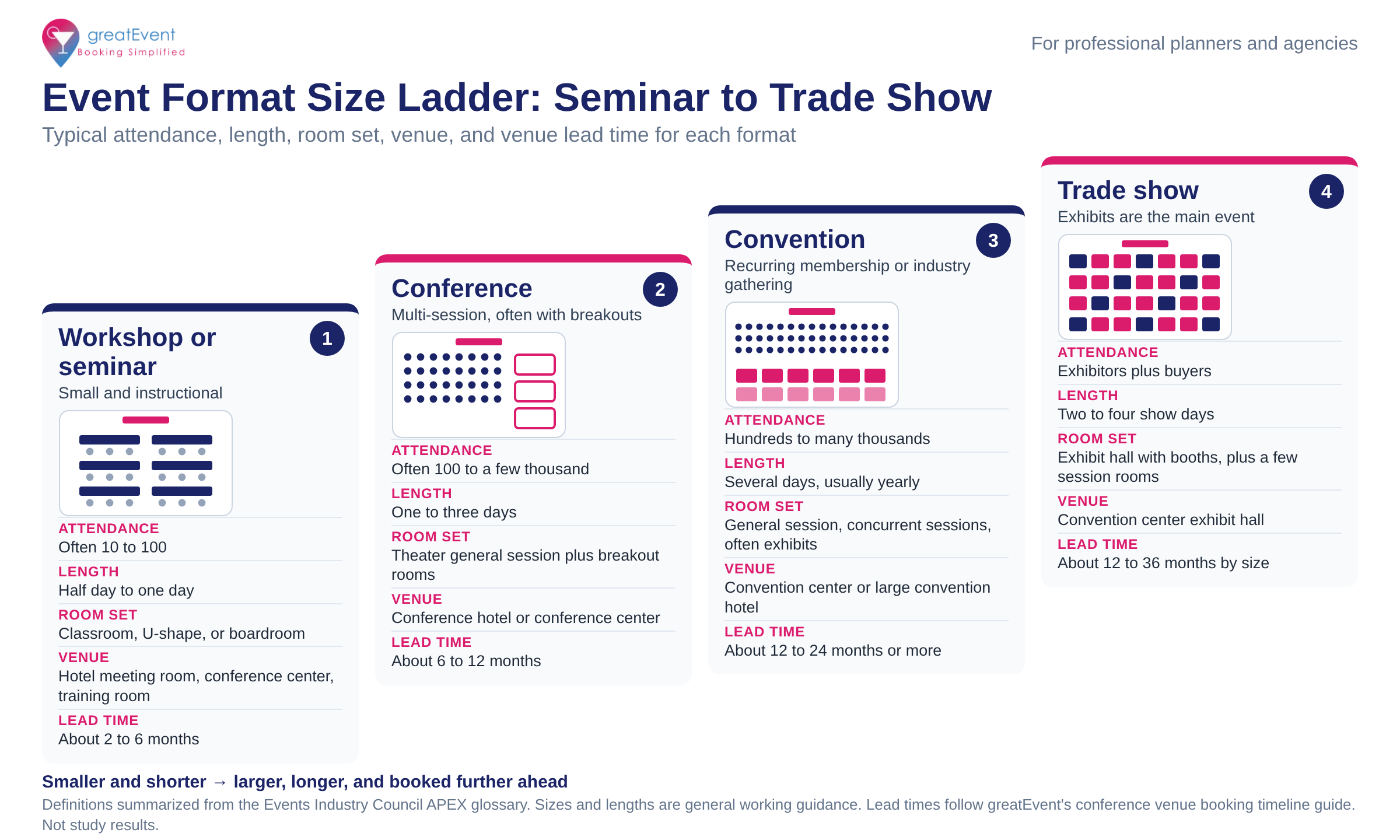
Text version of the infographic:
- 1. Workshop or seminar. Small and instructional. Attendance: Often 10 to 100. Length: Half day to one day. Room set: Classroom, U-shape, or boardroom. Venue: Hotel meeting room, conference center, training room. Lead time: About 2 to 6 months.
- 2. Conference. Multi-session, often with breakouts. Attendance: Often 100 to a few thousand. Length: One to three days. Room set: Theater general session plus breakout rooms. Venue: Conference hotel or conference center. Lead time: About 6 to 12 months.
- 3. Convention. Recurring membership or industry gathering. Attendance: Hundreds to many thousands. Length: Several days, usually yearly. Room set: General session, concurrent sessions, often exhibits. Venue: Convention center or large convention hotel. Lead time: About 12 to 24 months or more.
- 4. Trade show. Exhibits are the main event. Attendance: Exhibitors plus buyers. Length: Two to four show days. Room set: Exhibit hall with booths, plus a few session rooms. Venue: Convention center exhibit hall. Lead time: About 12 to 36 months by size.
The sizes, lengths, and room sets in the table and the infographic are general working guidance, not study results.
What is a seminar?
The Events Industry Council’s APEX glossary defines a seminar as “lecture and dialogue allowing participants to share experiences in a particular field under the guidance of an expert discussion leader.” Its second definition describes a meeting of a small group of specialists who come together for training or learning. Both definitions describe teaching, with one leader and a group small enough to ask questions.
Seminars usually run a half day or a full day with one track. Corporate clients use them for compliance updates, sales training, and client education. Associations run them as continuing education or regional events between their larger meetings.

Room sets for a seminar
If attendees will take notes or work on laptops, choose a classroom set. APEX describes a classroom set-up as rows of tables with chairs facing the front of the room, where each person has a space for writing. For a lecture with little writing, a theater set-up puts rows of chairs facing the stage area with no tables, and fits more people in the same room. A classroom set needs roughly twice the floor space per person, so check our meeting room capacity chart before you shortlist.
Venues for a seminar
A hotel meeting room, a conference center, or a dedicated training room covers most seminars. You rarely need a hotel room block unless attendees travel in. For pricing patterns, see our guide to company meeting room rental cost, and you can browse seminar venues near you on greatEvent.
What is a conference?
APEX defines a conference as a “participatory meeting designed for discussion, fact-finding, problem solving and consultation.” It adds that conferences are usually short, have specific objectives, and are generally smaller than congresses or conventions. In practice, a conference has several sessions, more than one speaker, and time for attendees to meet each other.
The format usually mixes a general session, which APEX describes as a meeting open to everyone at the event, with smaller breakouts. When breakouts run side by side, APEX calls them concurrent sessions: multiple sessions scheduled at the same time. For your venue search, that means a main room that fits everyone in theater or rounds, and enough smaller rooms for each track.
Count those rooms before you send an RFP. Our guide on how many breakout rooms a conference needs walks through it. A conference of a few hundred people often needs a hotel room block too, so ask each venue for meeting space and sleeping rooms in the same request. If your client is weighing a smaller, more private format, our comparison of a corporate offsite vs. conference covers that choice.
What is a convention?
APEX defines a convention as a gathering of delegates, representatives, and members of a membership or industry group who meet for a common purpose. Common features include educational sessions, committee meetings, social functions, and meetings to run the group’s governance business. APEX also notes that “conventions are typically recurring events with specific, established timing.” Outside the US you will often hear the same event called a congress, which APEX lists as the European term for a convention.
So the convention vs. conference difference comes down to who owns the event and how often it happens. A convention belongs to a membership or industry group, recurs on a set schedule, and carries governance business such as board meetings and elections. A conference can be organized by anyone, once or on no set schedule, around a specific topic.

Many conventions include an exhibit hall where suppliers sell to members. If the exhibits are the main draw, the event is closer to a trade show, and our guide on how to plan a trade show covers floor plans, exhibitor services, and room blocks. For a convention, plan for a large general session space, many breakout rooms, exhibit space, registration areas, and hotel room blocks that may span several hotels. Convention centers and exhibit halls are bookable on greatEvent, and you can compare trade show and exhibit venues near you.
Convention vs. conference: which is bigger?
Usually the convention. APEX describes conferences as generally smaller in scale than congresses or conventions. A large industry conference can still outdraw a small association’s convention, so size alone does not settle the label. Ask the client whether the event belongs to a membership group and recurs on a set schedule. If it does, plan it as a convention.
Symposium, summit, and workshop
Clients use these words too, and each one points to a different agenda and room set. APEX defines them as follows.
| Format | APEX definition (summarized) | What it means for your venue search |
|---|---|---|
| Symposium | A meeting of experts in a field where specialists present and discuss papers on specific subjects, with a view to making recommendations | Theater or classroom set for presentations, a panel table at the front, and time for questions |
| Summit | A formal meeting of heads of government, or of industry leaders convened to address a specific issue | Smaller and senior: boardroom or hollow square sets, private dining, and upscale hotel rooms |
| Workshop | A meeting for intensive discussion, or a training session where participants build skills through exercises | Rounds or U-shape so groups can work together, wall space, and a room that is not too large |
| Forum | An open discussion with an audience, a panel, and a moderator | Theater set with a stage for the panel and room for audience questions |
In corporate use, a summit usually means a small, invitation-only event for senior people, such as top customers or an executive team, built around discussion. Expect a smaller headcount, higher-end venue, and more private dining. Our guide on how to book a venue for a corporate event covers the RFP and site visit steps.
A symposium is closer to an academic conference. Medical, scientific, and university groups often use the word for an event built around expert papers and panel discussions. A panel discussion, in APEX terms, is a group of people chosen to discuss a topic in front of an audience.
Webinar vs. seminar, and hybrid options
Merriam-Webster defines a webinar as “a live online educational presentation during which participating viewers can submit questions and comments.” The word blends web and seminar. A webinar keeps the seminar’s teaching format and moves it online, so you have no meeting room or travel to book. An in-person seminar suits hands-on training and group discussion, and attendees can meet each other.
Between the two sits the hybrid event. APEX defines a hybrid meeting as one that “combines face to face and virtual aspects.” A seminar with a live audience and online viewers is a hybrid seminar. When a client wants that format, the venue search shifts toward rooms that support remote attendees, and our hybrid event venue selection guide covers what to ask venues before you sign.
How the format changes your venue search
Once you know the format, translate it into a venue brief. These five questions work for any of the formats above.
- How many people, and in what room set? Headcount alone is not enough. A room listed for 100 in theater may hold far fewer in classroom. Our guide on how much meeting space you need for 100 people shows how layout changes the square footage.
- One room or many? A seminar may need one room. A conference or convention needs a general session room plus breakouts, and sometimes exhibit space.
- Does anyone need to stay overnight? Local seminars often need no hotel room block. Conferences and conventions usually do.
- Which venue type fits? Use the table below to match the format to a venue.
- How far ahead are you booking? The larger the format, the earlier you need to start. Check the timeline in our conference venue booking guide.
| Format | Best-fit venue types | What to confirm with the venue |
|---|---|---|
| Seminar or workshop | Hotel meeting room, conference center, training room | Classroom or U-shape capacity, natural light, break space |
| Conference | Conference hotel, conference center | General session capacity, number of breakout rooms, hotel room block |
| Convention | Convention center, large convention hotel | Session rooms, exhibit space, registration area, room blocks across hotels |
| Symposium | Conference center, hotel, university venue | Theater capacity, panel seating, room for questions |
| Summit | Upscale hotel, resort, private venue | Boardroom or hollow square sets, private dining, guest room quality |
| Trade show | Convention center exhibit hall | Exhibit space, move-in and move-out times, exhibitor room blocks |
For the wider planning process, from brief to close-out, see our guide to what event management covers. Seminars, conferences, and conventions all sit inside the meetings and conferences segments of MICE, which our guide to what MICE means explains.
Find seminar rooms, conference venues, and vendors on greatEvent
On greatEvent, you can see live inventory across hotels, convention centers, and venues, filter by event type, location, date, capacity, and distance, and compare real meeting room capacities side by side. For seminars, conferences, conventions, and exhibitions, book real-time availability instantly or send one detailed inquiry to multiple venues and get quotes back, then add vendors and a hotel room block in the same booking flow.
There are no fees for planners. We pay you commission on any qualifying booking you make on greatEvent.
greatEvent serves all four MICE segments: meetings, incentives, conferences, and exhibitions.
Register as a professional planner
Frequently asked questions
What is the difference between a seminar and a conference?
▾
A seminar is a small, instructional session, usually a half day or one day with one leader and one topic. A conference is larger, with several sessions, many speakers, and often breakouts over one or more days.
Which is bigger, a convention or a conference?
▾
Usually a convention. APEX describes conferences as generally smaller than conventions. Conventions are recurring gatherings of a membership or industry group and often include exhibits.
What is a symposium?
▾
A symposium is a meeting of experts where specialists present and discuss papers on a subject, often to make recommendations. Academic, medical, and scientific groups use the term most.
What is a summit?
▾
In APEX terms, a summit is a formal meeting of heads of government or of industry leaders on a specific issue. In corporate use it means a small, senior, invitation-only event.
What is the difference between a webinar and a seminar?
▾
A webinar is a live online educational presentation where viewers can send questions and comments. A seminar brings people into the same room for teaching and discussion.
What venue works for a seminar?
▾
A hotel meeting room, conference center, or training room works for most seminars. Choose a classroom set if attendees need to write, or theater seating for a lecture.
Research and sources
Sources were checked on November 3, 2026. The opening scenario is fictional. The sizes, lengths, room sets, and venue notes are general working guidance, not results from a study. Lead times follow greatEvent’s conference venue booking timeline guide.
- Events Industry Council, APEX glossary: seminar, conference, convention, congress, symposium, summit, workshop, forum, panel discussion, general session, concurrent sessions, classroom set-up, theater set-up, and hybrid meeting, insights.eventscouncil.org.
- Merriam-Webster, webinar, merriam-webster.com.
Compare vendors for your next event
Search caterers, photographers, florists, planners, and rentals — then send one request to several vendors at once.