Quick answer: To plan a trade show, set the show’s goals and audience first, then work back from the show dates. For a mid-size show, plan on roughly 18 months: contract the convention center or exhibit hall and the hotel room blocks first, then build the floor plan, sell booths and sponsorships, open attendee registration, publish the exhibitor service manual, and schedule move-in and move-out. Track the budget by category from day one, and decide before you open sales how you will measure trade show ROI for your client.
Example scenario (fictional): An association in Ohio asks a three-person agency to take over its regional trade show, 14 months before the dates. The agency finds the exhibit hall is on a tentative hold that nobody confirmed, there is no room block, and last year’s floor plan lives in one person’s inbox. The agency spends its first month confirming the venue and the hotel, rebuilding the floor plan, and writing down every exhibitor deadline. From then on, the show runs on a written timeline and checklist like the one in this guide.
This is for professional US event planners and agencies who organize trade shows for clients or associations, from a 60-booth regional expo to a large industry show. It is written from the organizer’s side, the team that runs the show, not the companies that exhibit. It covers how to plan a trade show step by step: the timeline, picking a convention center, exhibit hall, or hotel, the floor plan and exhibitor services, hotel room blocks, the trade show budget, marketing and registration, show-day logistics, and how to measure trade show effectiveness. It ends with a trade show checklist and a budget template you can copy.
In this guide:
- What trade show planning involves
- Trade show planning timeline
- Choosing a trade show venue
- Floor plan, booths, and exhibitor services
- Hotel room blocks for attendees and exhibitors
- Trade show budget categories
- Marketing and registration
- Move-in, show days, and move-out
- How to measure trade show ROI
- Trade show planning checklist and budget template
- FAQ
What trade show planning involves
The Events Industry Council’s APEX glossary defines a trade show as an exhibition of products or services held for members of a common or related industry and not open to the general public. That makes it a different job from a conference. You still plan rooms, food, and a program, but most of the work goes into the exhibit floor: who exhibits, where each booth sits, how their freight gets in and out, and whether the buyers they came to meet actually show up. If you want the wider picture first, see what event management covers.
A trade show also has two groups of customers. Exhibitors pay for booth space and sponsorships, and attendees register to see them. Your plan has to sell to both and keep both happy, which is why trade show planning tends to start earlier and involve more outside companies than most corporate events you plan for clients.
| Who | What they do | What you need from them |
|---|---|---|
| Show management (you or your client) | APEX calls this the company or group that manages an exhibition. Sets goals, sells space, owns the budget and the rules. | Decisions, approvals, and one owner for each area |
| Venue (convention center, exhibit hall, or hotel) | Licenses the space and dates and sets building rules | Move-in and move-out times, dock access, exclusive services, insurance terms |
| General service contractor | Per APEX, provides services to show management and exhibitors, which can include the exhibitor manual, installation and dismantle, signage, carpet, material handling, and booth furniture | Floor plan drawings, the exhibitor service manual, freight schedule |
| Exhibitor appointed contractors | Any company other than the official contractor that an exhibitor hires, such as an install and dismantle company, photographer, or florist | Proof of insurance and arrival times, per your rules |
| Hotels | Hold room blocks for attendees and exhibitors | Block sizes, cutoff dates, and pickup reports |
| Your vendors and suppliers | Catering, security, signage, registration, and other services | Contracts, staffing plans, and delivery times |
Trade show planning timeline
The timeline depends mostly on when you can get the hall. Large national shows often book convention centers years ahead, and our guide on how far ahead to book a conference venue covers those booking windows by event size. The timeline below assumes a regional or mid-size show with about 18 months to work with. If you have less time, compress the middle phases. Don’t skip the venue and room block steps, because everything else hangs off them.
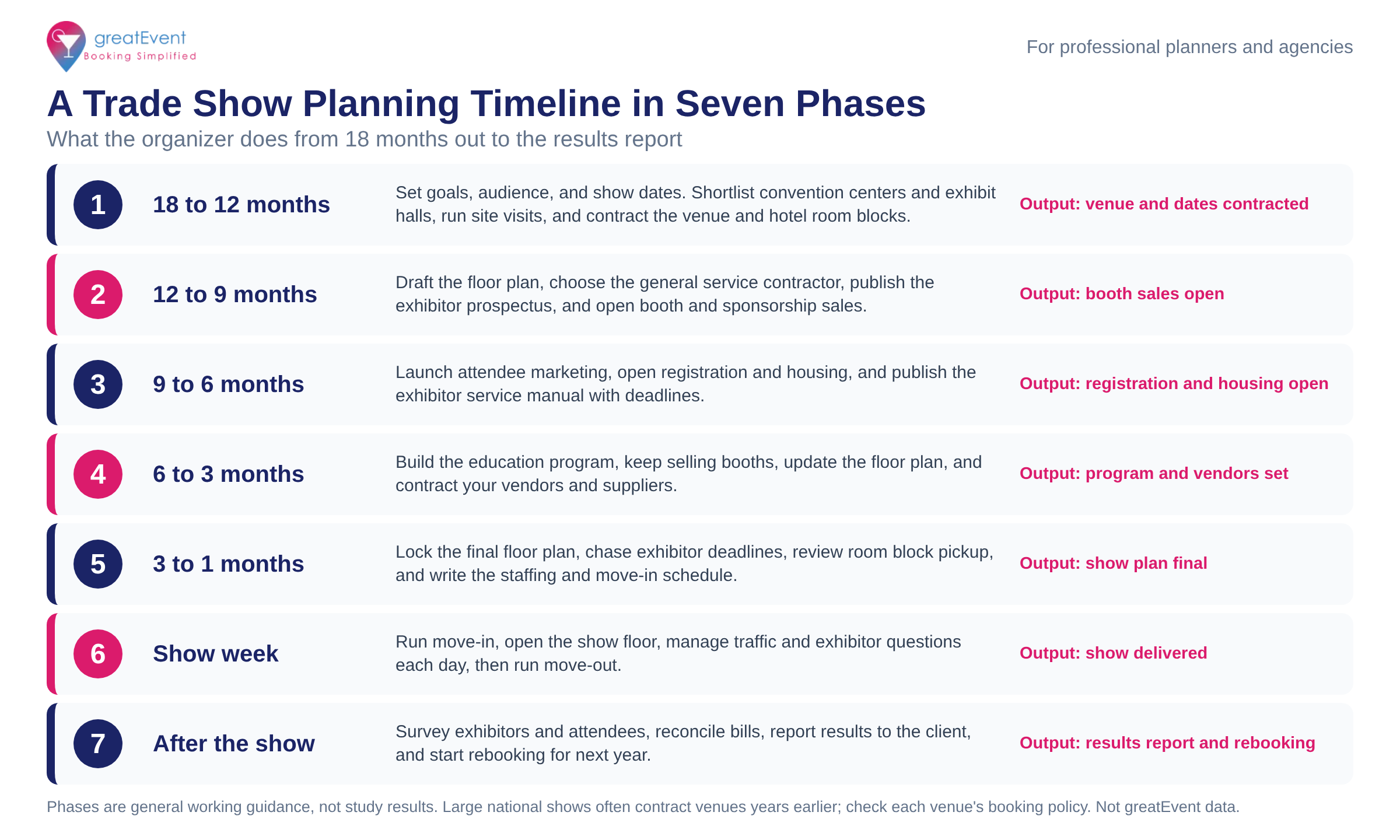
Text version of the timeline:
- 18 to 12 months. Set goals, audience, and show dates. Shortlist convention centers and exhibit halls, run site visits, and contract the venue and hotel room blocks. Output: venue and dates contracted.
- 12 to 9 months. Draft the floor plan, choose the general service contractor, publish the exhibitor prospectus, and open booth and sponsorship sales. Output: booth sales open.
- 9 to 6 months. Launch attendee marketing, open registration and housing, and publish the exhibitor service manual with deadlines. Output: registration and housing open.
- 6 to 3 months. Build the education program, keep selling booths, update the floor plan, and contract your vendors and suppliers. Output: program and vendors set.
- 3 to 1 months. Lock the final floor plan, chase exhibitor deadlines, review room block pickup, and write the staffing and move-in schedule. Output: show plan final.
- Show week. Run move-in, open the show floor, manage traffic and exhibitor questions each day, then run move-out. Output: show delivered.
- After the show. Survey exhibitors and attendees, reconcile bills, report results to the client, and start rebooking for next year. Output: results report and rebooking.
The phases are general working guidance, not study results. Write your own dates next to each one as soon as the venue contract is signed, and share them with the client, the contractor, and the hotels.
Choosing a trade show venue: convention center, exhibit hall, or hotel
APEX defines an exhibit hall as the area within a facility where an exhibition is located, usually designed for large shows. You will usually choose between three kinds of space.
| Venue type | Usually fits | Check before you sign |
|---|---|---|
| Convention center | Large regional and national shows with many booths, education sessions, and several hotels | Booking priority rules, exclusive services, move-in days, and how far the nearest hotels are |
| Stand-alone exhibit hall or expo center | Regional shows that need open floor space and dock access more than meeting rooms | Loading docks, floor load limits, utilities, parking, and food options |
| Hotel with exhibit or ballroom space | Smaller shows, tabletop exhibits, and shows paired with a conference | Ceiling height, freight route to the room, how booths fit around food functions, and room block terms |
Convention centers set their own booking rules, so read the policy early. The Orange County Convention Center in Orlando is one example. Its scheduling policy (effective January 1, 2014, revised February 2020) gives first priority to regional, national, and international conventions, trade shows, and conferences with significant economic impact, judged on factors including peak hotel room use, expected attendance, exhibit hall square footage, time of year, and event history. Second priority events, such as local corporate meetings and events without hotel room nights, may not contract dates or exhibit halls more than 12 months ahead. The same policy explains the difference between a first option tentative hold, a second option tentative hold, and a contracted booking, which is why you should confirm in writing which kind of hold you have. Read the OCCC scheduling policy for the full wording, and ask every venue on your list for its own version.
Questions to ask each venue on your shortlist:
- How many gross and net square feet of exhibit space are available on your dates?
- How many loading docks are there, and how will freight reach the hall?
- Which move-in and move-out days and hours are included in the rental?
- Which services are exclusive to the venue, such as food, utilities, or security?
- What insurance does the venue require from you and from exhibitors?
- How many meeting rooms come with the hall for education sessions?
- Which hotels are close enough for attendees to walk or take a short shuttle?
Convention centers and exhibit halls are bookable on greatEvent, alongside hotels and other venues. You can browse current trade show venues near you and filter by meeting space, number of meeting rooms, and distance. For breakout sessions, our meeting room capacity chart by layout helps you check room sizes. If the show is part of a larger meeting, start with how much meeting space you need.
Floor plan, booths, and exhibitor services
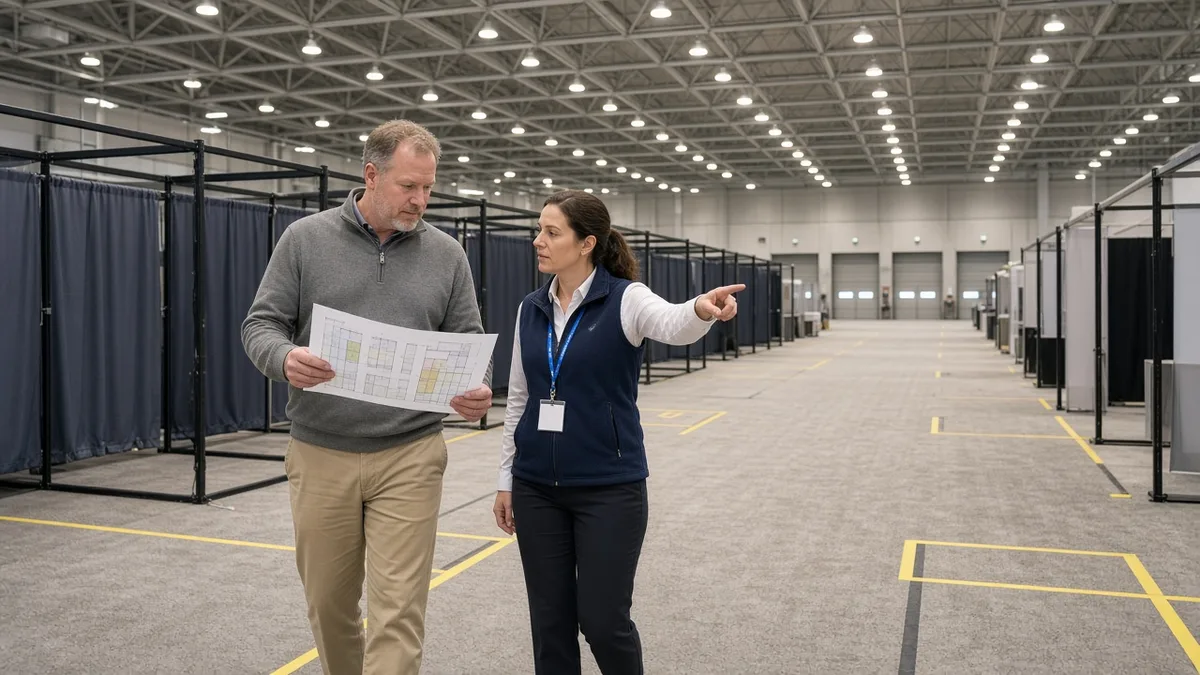
APEX describes a floor plan as a scale drawing that shows the placement of exhibit booths and all other features in an exhibit hall, and a booth as the specific display area that show management assigns to an exhibitor under contract. You will use the same drawing to sell booths, get the layout approved, and run move-in.
Build it in this order:
- Start from the venue’s drawing. Mark exits, columns, docks, utility points, and fire lanes before you place a single booth.
- Set booth sizes and types. Decide how many inline, corner, peninsula, and island spaces you will sell, and price them by category.
- Plan the traffic. Put registration, food, restrooms, and education rooms where they pull attendees through the whole floor.
- Ask the venue and your contractor whether the floor plan needs approval from the venue or the local fire marshal, and by what date.
- Keep one live version. Update it each time a booth sells or moves, and date every version you send out.
Two documents carry the exhibitor side. The exhibitor prospectus is what you send to current and prospective exhibitors: APEX lists the value of exhibiting, technical details, the cost of space, a floor plan, and an application. The exhibitor service manual, also called the exhibitor kit, is usually prepared by the general service contractor and holds the show information, labor and service order forms, and rules. Publish the manual early and put every exhibitor deadline in one table.
Explain material handling clearly in the manual so exhibitors can plan for it. APEX defines it as the contractor’s service of moving exhibit materials from the dock to the booth, removing and storing empty crates, returning them at the end of the show, and taking materials back to the dock for the carrier. It is a two-way charge, incoming and outgoing. The older term is drayage. List the rates and rules, and tell exhibitors who to call when freight is late.
Hotel room blocks for attendees and exhibitors
APEX defines a room block as the total number of sleeping rooms used by and attributable to one event. For a trade show you may need blocks at several hotels, with some rooms set aside for exhibitor staff who arrive for move-in days before attendees. A housing bureau, which APEX describes as an organization that provides reservation services for a group and its attendees, can run bookings across hotels for larger shows. Smaller shows often work directly with one or two hotels.
Room nights also matter to the venue. Some convention centers, like the Orlando example above, weigh hotel room use when they decide which events get priority dates. Track pickup monthly and compare it with your block before each cutoff date. Our guide on managing conference room blocks covers pickup, cutoff, and attrition, and the hotel contract concessions guide covers what you can ask hotels to include.
Trade show budget categories
Trade show costs vary too much by city, building, season, and show size for any single figure to be useful, so this section lists categories only. Get written quotes for each line, and keep an estimate, a quote, and an actual column from the start.
| Category | What it usually covers | Questions to ask |
|---|---|---|
| Venue rental | Exhibit hall, meeting rooms, and lobby or registration space for move-in, show, and move-out days | Which days are included? What does an extra move-in day cost? |
| General service contractor | Aisle carpet, show signage, booth structures, show office, and furniture for show management | What is in the base package, and what is billed separately? |
| Utilities and building services | Electrical, internet, cleaning, and similar services, often exclusive to the venue | Which services must come from the venue? |
| Food and beverage | Attendee meals, receptions, exhibitor breaks, and any minimum spend | Is there a food and beverage minimum tied to the space? |
| Hotel room blocks | Your liability if pickup falls short, plus any staff rooms | What are the attrition terms and cutoff dates? |
| Marketing and registration | Event website, email, ads, registration system, and badges | Which costs scale with attendance? |
| Staffing and security | Your team on site, temporary staff, security, and first aid | What does the venue require for crowd size? |
| Insurance and permits | Event liability insurance and any local permits | What limits does the venue contract require? |
| Program and speakers | Speaker fees, travel, and education session costs | Who covers speaker travel and rooms? |
The other side of the trade show budget is revenue: booth sales, sponsorships, and attendee registration. You can also build the budget backward from what you expect exhibitors and sponsors to pay. Our guide to selling event sponsorships covers packages and pricing approaches.
Marketing and registration
You are marketing two things at once. Exhibitor sales come first, using the prospectus, last year’s exhibitor list, and a clear story about who will attend. Attendee marketing starts once you have enough exhibitors to promote, because attendees want to know who will be on the floor before they register. Use your event marketing plan to set channels, owners, and dates for both audiences.
Plan registration around your audience. A trade show is not open to the general public, so decide who qualifies to attend and how you will check it, such as a business email, a company name, or a member number. Collect job title, company, and buying role if exhibitors will want that data, and tell attendees how it will be shared. Open hotel booking in the same flow so people reserve inside your block.
Some organizers add a smaller education day or a regional seminar to build the audience between shows. If that’s part of your plan, you can browse seminar venues near you on greatEvent.
Move-in, show days, and move-out

APEX defines move-in as installing an exhibit or equipment, and move-out as the dates set for dismantling, also called tear down. Both run on tight windows, so write a schedule that sets target times for each exhibitor group and shares it with the contractor, the venue, and security. Our event logistics checklist covers the general run-of-show items. For a trade show, add these:
- A freight and target move-in schedule by booth row or exhibitor size
- A show office with posted hours and one phone number for exhibitor questions
- Exhibitor badge pickup separate from attendee registration
- A daily floor walk before doors open to check aisles, exits, and signs
- Security for the hall overnight between move-in and the last show day
- Clear rules for when exhibitors may start packing, so booths stay open until the show closes
- A move-out schedule and a plan for crates and freight left behind
How to measure trade show ROI
Trade show ROI looks different for the organizer than for an exhibitor. An exhibitor counts leads and sales. As the organizer, you are measuring whether the show worked as a business for your client. Agree on the measures before you open sales so you can track them from the start. Our guide on measuring event ROI explains the general method.
| What to measure | How to track it | Why it matters |
|---|---|---|
| Booth sales vs goal | Booths and square feet sold by category | Your core exhibit revenue against the plan |
| Sponsorship revenue | Packages sold and deliverables met | Sponsors look at delivered benefits when they decide whether to renew |
| Attendance by type | Registered vs badged attendees, by job role | Exhibitors judge the show by who walks the floor |
| Exhibitor satisfaction | Post-show survey and rebooking intent | Tells you early whether next year will sell |
| Rebooking | Exhibitors who sign for next year at or soon after the show | Shows how many exhibitors plan to return |
| Room block pickup | Room nights booked in your blocks | Affects hotel terms and venue priority next time |
| Net result | Revenue minus costs, by budget category | Shows the client where money was made or lost |
To measure trade show effectiveness for exhibitors too, ask them in the survey how many useful conversations they had and whether they met the buyers they expected. Sharing those results with exhibitors also gives you material for next year’s sales.
Trade show planning checklist and budget template
Copy this trade show planning template into your own document and fill in the brackets.
TRADE SHOW PLANNING CHECKLIST
Show name: [Name]
Client or association: [Name]
Show dates: [Dates]   Move-in: [Dates]   Move-out: [Dates]

18 TO 12 MONTHS
[ ] Goals, audience, and success measures agreed with the client
[ ] Venue shortlist and site visits done
[ ] Venue contract signed (hold type confirmed in writing)
[ ] Hotel room blocks contracted; cutoff dates: [Dates]
[ ] Budget by category approved

12 TO 9 MONTHS
[ ] General service contractor selected
[ ] Floor plan draft approved by the venue
[ ] Exhibitor prospectus published; booth sales open
[ ] Sponsorship packages published

9 TO 6 MONTHS
[ ] Attendee marketing launched
[ ] Registration and housing open
[ ] Exhibitor service manual published with deadlines

6 TO 3 MONTHS
[ ] Education program and speakers confirmed
[ ] Contracts signed with your vendors and suppliers
[ ] Insurance certificates collected

3 TO 1 MONTHS
[ ] Final floor plan approved
[ ] Exhibitor deadlines tracked: [Owner]
[ ] Room block pickup reviewed before cutoff
[ ] Staffing, security, and move-in schedule final

SHOW WEEK
[ ] Move-in schedule run; show office open
[ ] Daily floor walk before doors open
[ ] Move-out schedule run

AFTER THE SHOW
[ ] Exhibitor and attendee surveys sent
[ ] Bills reconciled against the budget
[ ] Results report sent to the client: [Date]
[ ] Rebooking open for next year
And a trade show budget template with categories only. Add your own quotes.
TRADE SHOW BUDGET TEMPLATE
Category | Estimate | Quote | Actual | Notes
Venue rental | [ ] | [ ] | [ ] | [Days included]
General service contractor | [ ] | [ ] | [ ] | [Base package]
Utilities and building services | [ ] | [ ] | [ ] | [Exclusive?]
Food and beverage | [ ] | [ ] | [ ] | [Minimum?]
Hotel room block exposure | [ ] | [ ] | [ ] | [Attrition terms]
Marketing and registration | [ ] | [ ] | [ ] | [ ]
Staffing and security | [ ] | [ ] | [ ] | [ ]
Insurance and permits | [ ] | [ ] | [ ] | [ ]
Program and speakers | [ ] | [ ] | [ ] | [ ]
Contingency | [ ] | [ ] | [ ] | [ ]

REVENUE
Booth sales | [ ] | | [ ] | [Booths sold]
Sponsorships | [ ] | | [ ] | [Packages sold]
Registration | [ ] | | [ ] | [Paid attendees]
Find convention centers, exhibit halls, and room blocks on greatEvent
On greatEvent, you can see live inventory across hotels, convention centers, and venues, filter by event type, location, date, capacity, and distance, and compare real meeting room capacities side by side. Book real-time availability instantly, or send one detailed inquiry to multiple venues and get quotes back. Then add services and a hotel room block and confirm online.
There are no fees for planners. We pay you commission on any qualifying booking you make on greatEvent.
Register as a professional planner
Frequently asked questions
How far in advance should you plan a trade show?
▾
Plan a regional or mid-size trade show about 18 months ahead. Large national shows often contract convention centers years earlier, so check each venue’s booking policy first.
What should a trade show planning checklist include?
▾
It should cover the venue and hotel contracts, the floor plan, exhibitor and sponsor sales, the exhibitor service manual, registration and housing, show-week schedules, and the post-show survey and results report.
What are the main trade show budget categories?
▾
Venue rental, the general service contractor, utilities and building services, food and beverage, hotel room block exposure, marketing and registration, staffing and security, insurance, and the program.
What is material handling at a trade show?
▾
Material handling, also called drayage, is the contractor’s service of moving exhibit freight between the dock and the booth and handling empty crates. It is charged both ways.
How do you measure trade show ROI as the organizer?
▾
Track booth and sponsorship revenue against goals, attendance by type, exhibitor satisfaction, rebooking, room block pickup, and the net result by budget category.
Research and sources
Sources were checked on November 3, 2026. The opening scenario is fictional. The timeline, budget categories, and ROI measures are general working guidance, not results from a study. Venue policies change, so confirm the current terms with each venue.
- Events Industry Council, APEX glossary: trade show, exhibit hall, show management, general service contractor, exhibitor appointed contractor, floor plan, booth, exhibitor prospectus, exhibitor service manual, material handling, room block, housing bureau, move-in, and move-out, insights.eventscouncil.org.
- Orange County Convention Center, Planner Scheduling Policies (effective January 1, 2014, rev. February 2020), occc.net.
Compare vendors for your next event
Search caterers, photographers, florists, planners, and rentals — then send one request to several vendors at once.