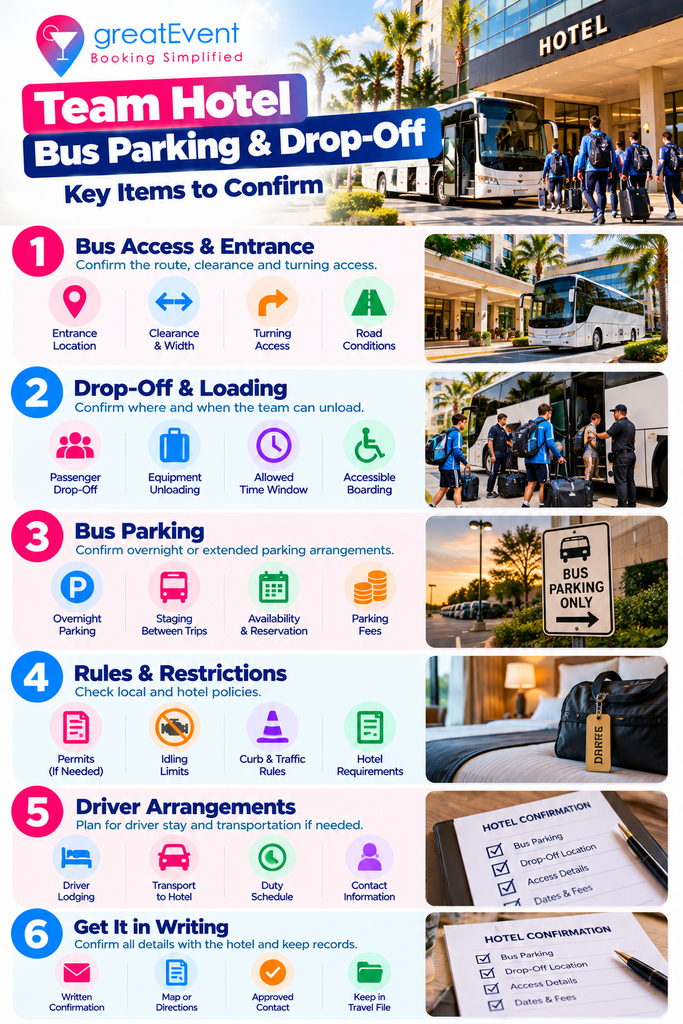
Quick answer: Before booking, confirm the exact bus entrance, clearance and turning access, the passenger loading location, the overnight parking arrangement, the fees and the departure access. Send the assigned vehicle’s dimensions to both the hotel and the carrier. Get separate confirmation for unloading, waiting between trips, and parking overnight, then document driver lodging and transport if the coach parks off-site.
“Bus parking available” is where the conversation starts, not where it ends. A hotel can have a perfect loading area and nowhere to leave the coach overnight. Another can offer an off-site lot that opens an hour after your team needs to be on the road.
This is for club administrators, athletic travel managers and sports travel planners arranging US team trips. The checklist is an editorial recommendation. Hotel policies and local rules have to be verified for your property, your vehicle and your dates.
What “hotel bus parking” actually covers
Ask the hotel to name three locations: where passengers and equipment unload, where the coach waits between movements, and where it sits overnight. Those are frequently three different places with different permissions, hours and fees.
| Bus activity | What you need confirmed | The planning question |
|---|---|---|
| Passenger loading | Approved stopping point and usable time window | Can athletes and equipment unload here at our arrival time? |
| Waiting between trips | Authorized staging or layover location | Where does the empty coach wait until pickup? |
| Overnight parking | Reserved or permitted space for the whole stay | Can the driver retrieve the coach before our first departure? |
The Hotel at Arundel Preserve publishes that motorcoach parking is off-site and available on request, with pricing confirmed directly by the hotel. [1] For a coordinator, that is a signal to investigate the lot and the driver transfer before treating parking as settled.
Get a written confirmation naming the lot or loading point, the bus count, the dates and the approving contact. An amenity line on a booking page confirms nothing about space for your specific movement.
If you are still choosing the hotel, how to book hotels for a sports tournament covers the wider process and blocking hotel rooms for sports teams covers the rooms.
The checklist
Give every item an owner and a status: confirmed, pending, or not applicable. Attach the hotel’s written reply, the carrier’s review, a current map, and any permit or parking confirmation.
| Check | Question to resolve | Evidence to keep |
|---|---|---|
| Assigned vehicles | How many coaches or minibuses, and is there a trailer? | Carrier vehicle list and dimensions |
| Approach and entrance | Which street and driveway can this vehicle use? | Carrier-reviewed approach map |
| Physical access | Are clearance, width, turns, slopes and surface suitable? | Hotel information and carrier acceptance |
| Passenger loading | Where can passengers board and unload legally? | Exact pin, entrance name and time window |
| Equipment unloading | Can luggage bays open without blocking traffic or access? | Approved unloading position and handling plan |
| Accessible boarding | Where can a lift or ramp deploy and reach the entrance? | Agreed boarding point and accessible route |
| Multiple arrivals | How many buses fit, and where do the others wait? | Bus sequence and approved staging area |
| Overnight parking | Is space reserved, first come, or shared with another operator? | Lot address, permission and fallback |
| Lot access | Can the driver enter and leave at every required time? | Gate hours, credentials, after-hours contact |
| Local restrictions | What permits, curb rules and idling limits apply? | Current official guidance and permit owner |
| Cost and payment | What does parking cost for this stay and vehicle count? | Itemized price and responsible payer |
| Driver arrangements | Are lodging, transfers and the duty schedule workable? | Carrier-approved itinerary and arrangements |
| Changes and backup | What if the bay is blocked, arrival is late, or the lot is full? | Approved alternate and escalation contact |
Reconfirm the whole plan if the carrier substitutes a vehicle, the hotel changes its access route, or the tournament moves your arrival or departure. Schedule changes have their own hotel consequences, and the bus plan is one of the first things they break.
Can the assigned coach actually reach the hotel?
Get real vehicle dimensions from the carrier rather than planning from the seat count. Ask for length, overall height, operating width including mirrors, trailer details, and the space needed to open luggage doors and deploy any lift or ramp.
Send that to the hotel’s operations contact. Ask about the full path from the street to the loading position, then to the parking area, then out. Review overhead canopies, garage entrances, gate openings, tight turns, steep transitions and temporary obstructions. Have the carrier assess maneuvering and clearance, because an aerial image cannot establish whether a 45-foot coach makes that turn.
The driver needs the correct entrance, not the hotel’s postal address. Supply a marked map showing the approach direction, the approved stopping point and the exit. Flag any entrance that only takes passenger cars or deliveries.
NYC DOT publishes specific charter-bus routing requirements and tells operators to review construction and traffic conditions. [2] That is one city’s rule set, and a good illustration of why ordinary car directions do not work as a motorcoach itinerary.
Where should the team unload?
Choose a hotel-approved location where passengers reach the entrance without walking through moving vehicles. Check which side the passenger doors and luggage bays open on. Keep the unloading plan clear of emergency access, pedestrian routes, and other vehicles’ operating space.
Agree the arrival window and how long the coach may hold the bay. For a heavy equipment load, ask whether hotel staff can help and whether handling charges apply. If room keys will not be ready, identify an indoor waiting area and approved equipment storage so the team can clear the loading point rather than standing in it.
Curb rules still need checking. NYC DOT separates active passenger pickup and drop-off from parking, and prohibits using its designated pickup and drop-off zones as parking spaces. San Antonio identifies its own authorized loading and parking locations. [2][3] Check the current signs for your hotel instead of assuming the street outside belongs to the property.
Confirm accessible boarding for the actual vehicle
Ask the carrier what boarding assistance and equipment the trip needs, then confirm the hotel location has room to use it and a continuous accessible route to the entrance. Check the return trip as well as the arrival.
A wheelchair-accessible guest room does not answer the bus-boarding question. They are separate arrangements that frequently get treated as one.
The US Access Board’s ADA standards address passenger-loading access aisles, surfaces, clearances and the connection to an accessible route. [4] Those design requirements do not substitute for checking your coach’s clearance and how its lift or ramp actually operates. Have the hotel and carrier confirm the arrangement between them.
Sequencing two or more coaches
Where the loading area takes one coach, give each bus an arrival slot and a separate approved waiting location. Name a team lead to manage passengers and equipment while the carrier handles vehicle movements, and keep drivers updated through the agreed dispatch contact. For youth teams, check this against the supervision requirements covered in booking hotel rooms for youth sports teams, since the adult who manages the bay may also be the one a rooming rule expects upstairs.
Overnight parking
Record the exact lot address and entrance, who operates it, whether spaces are reserved, and whether trailers are accepted. Confirm bus count, arrival and departure dates, access hours, and any permit, payment or vehicle-registration requirement.
For off-site parking, plan two journeys: the empty coach out, and the driver back to the hotel. Ask who provides that transfer, when it runs, and who pays. Then plan the same thing in reverse for the morning, allowing time for the carrier’s required preparation plus the trip back to the loading point.
Ask concrete questions about lighting, controlled access, staffing and equipment policy. A lot is not secure because it is fenced. Confirm with the carrier whether equipment can stay aboard overnight or whether the team needs hotel storage instead.
Set a fallback for a full or inaccessible lot: an alternate the carrier and the operator have both approved, with a named decision-maker and a cost approval route. “Find somewhere nearby” leaves a driver at 11 p.m. with no plan.
Which costs belong in the travel budget
Request an itemized total for the planned stay. Check whether charges run per bus, per night, per calendar day or per entry, and whether taxes, permits or facility fees sit on top. Confirm what happens if the tournament adds a day or moves the departure.
| Cost item | What to verify |
|---|---|
| Parking and permits | Vehicle count, dates, payment method, cancellation terms |
| Repositioning the empty coach | Included mileage and time versus additional carrier charges |
| Driver transfers and lodging | Who books and pays; what the charter price already covers |
| Loading and handling | Hotel staffing, porterage or equipment-storage charges |
| Changes or extended access | Extra days, entries, waiting time and approval requirements |
Compare these against the room proposal before you choose a hotel, which means knowing how many rooms the club team actually needs first. Watch for double-counting where the charter contract already includes a movement. And a complimentary parking offer still needs its access hours, space availability and any separate transfer or facility charge confirmed before it counts as free.
How parking affects the driver’s schedule
Ask the carrier to approve the complete itinerary: unloading, moving to the lot, returning to the hotel, morning preparation, and any extra team trips. The hotel arrival time is not the time the driver stops working, and that gap is where plans quietly fail.
FMCSA separates passenger-carrier hours-of-service rules from freight rules, and its guidance explains that qualifying off-duty time requires the driver to be relieved of duties and responsibilities. [5] A gap between games, or time spent waiting in the coach, should not be assumed to count as rest.
Have the carrier determine the applicable limits and the staffing plan. Confirm the driver’s room, check-in arrangements, required transfers, and who handles late changes. If the team wants an extra restaurant or venue trip after the planned day ends, get carrier approval before anyone promises the coach will be there.
Check local idling rules as part of the waiting plan. Restrictions vary by location and circumstance, and San Antonio and NYC publish different motorcoach guidance. [2][3] Arrange an indoor waiting option rather than assuming the bus can sit running outside the hotel.
A worked plan for two coaches
An illustrative scenario: the hotel can unload one coach at a time, both coaches must park off-site, and the team has an early tournament departure the next morning. Get agreement on this sequence, with the timing coming from the hotel and carrier rather than from you.
- Before arrival, the hotel identifies the loading bay, an indoor team waiting area, and an operations contact. The carrier approves the approach, the vehicle fit and the schedule.
- Coach A unloads in its assigned window. Coach B waits at the approved location until called forward. Team leads account for passengers and equipment at each stage.
- Both drivers move their coaches to the confirmed lot. Return transport and hotel check-in are arranged in advance, with duty and rest time reviewed by the carrier.
- For departure, drivers retrieve the coaches on the carrier’s schedule. Team leads assemble passengers and equipment before each coach reaches the bay.
If the lot opens after the retrieval time your departure requires, that plan needs a confirmed access exception or a different parking arrangement before you select the hotel. Discovering it the night before is how a team misses a first game.
A confirmation request you can copy
Team or organization: [name]      Stay dates: [dates]
Carrier and dispatch contact: [details]
Vehicles: [count, type, dimensions, trailer]
Hotel operations contact: [name and phone]
Plan version: [date]

Please confirm the following for our assigned vehicles:

  - Arrival entrance and approach direction; loading and pickup
    pins; allowed operating windows; and the exit route.
  - Clearance or maneuvering restrictions, usable unloading space,
    and the accessible boarding arrangement reviewed with our
    carrier.
  - Approved staging and overnight locations, space-reservation
    status, gate hours, access instructions, and any required
    permits.
  - Total parking and related hotel charges, payment
    responsibility, and the terms for date or vehicle-count
    changes.
  - Driver lodging and off-site transfer arrangements; after-hours
    contact; and the approved fallback if access or parking is
    unavailable.

Please attach the current site map and identify any details still
pending. We will obtain carrier confirmation of vehicle suitability
and the operating schedule before finalizing the travel plan.
Compare team hotel options with greatEvent
Where the tournament permits independent sourcing, explore hotel and event-space options through greatEvent. [6] Use this checklist to confirm bus access and parking with the property and the carrier before committing. Where the tournament mandates a housing channel, follow it: stay-to-play requirements covers what that restricts.
Research and sources
Primary sources reviewed October 9, 2026. Local and property examples apply to the cited location and must be reconfirmed for your actual trip. The checklist, the cost table, the two-coach scenario and the confirmation request are editorial planning tools. No unloading allowance, parking fee or clearance figure here is presented as a national standard.
[1] The Hotel at Arundel Preserve, FAQ. Off-site motorcoach parking on request, with pricing confirmed directly by the hotel.
[2] NYC Department of Transportation, Charter and Tour Buses. Route planning, authorized loading and parking, and idling guidance.
[3] City of San Antonio, Bus Parking. Designated motorcoach loading and parking locations and local operating rules.
[4] US Access Board, ADA Standards Chapter 5. Section 503 covers passenger loading zones, access aisles and clearances.
[5] FMCSA, Hours of Service for Motor Carriers of Passengers. Passenger-carrier rules and the on-duty versus off-duty distinction.
[6] greatEvent, How It Works. Public platform description and service limitations.
Frequently Asked Questions
Does free hotel parking include a team bus? ▾
Confirm it explicitly. Ask whether the offer covers your vehicle type and bus count, where the parking is, whether spaces are reserved, and whether permits or other charges apply. Free car parking says nothing about a 45-foot coach.
Can the bus stay at the hotel entrance overnight? ▾
Only if that spot is approved for overnight parking under the property’s arrangements and the applicable local rules. Permission to load passengers is not permission to park. Ask for the designated overnight location by name.
What if the hotel only offers off-site motorcoach parking? ▾
Verify the lot’s address, hours, reservation status and suitability. Arrange driver transfers in both directions and have the carrier build every movement into the itinerary. Confirm the early-morning retrieval works before you book.
How much time should we allow for unloading? ▾
Agree the window with the hotel and carrier based on passenger needs, equipment, available space and the number of buses. Confirm it fits local loading restrictions. There is no nationwide unloading allowance to fall back on.
Who approves the bus route and parking arrangement? ▾
The carrier confirms the route, vehicle suitability and driver schedule. The hotel or lot operator confirms property access and parking permission. The coordinator brings those approvals together and obtains any local permits through whoever is responsible for them.
Compare vendors for your next event
Search caterers, photographers, florists, planners, and rentals — then send one request to several vendors at once.