Quick answer: If you are hosting, forecast total room nights across every visiting team, then split the block across two or three hotels rather than one. Send the same RFP to five properties, cap attrition at 20 percent of room nights rather than per night, and expect a group rate 20 to 30 percent below rack. For a step-by-step approach, see how to book hotels for a sports tournament organizer.
This is written for the organiser running the event. If you are one team travelling to a tournament, the team side of this is covered in how to manage room blocks for a conference.
Forecast room nights, not rooms
The number that matters is room nights: rooms multiplied by nights. A 20 team event where each team needs 12 rooms for three nights is 720 room nights, and that is the figure hotels price against.
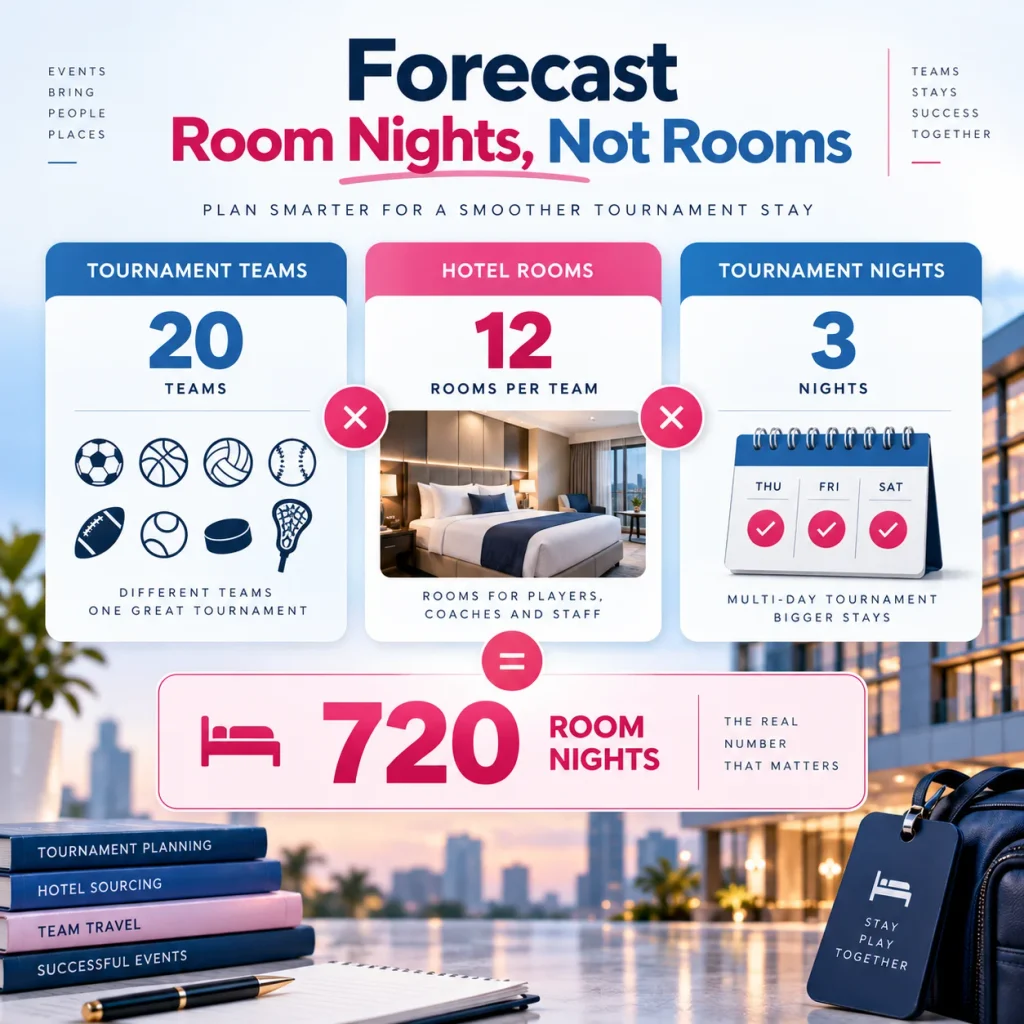
Build it from the bottom up. Take your expected team count, the roster size per team, whether families travel, and the number of competition days. Then hold 10 to 20 percent above the forecast, because a block that runs out sends teams to hotels you have no relationship with and no rate at.
Ten rooms per night is where US hotels start treating a booking as group business. At tournament scale, you are far past that, which is what gives you room to negotiate.
Split the block across hotels
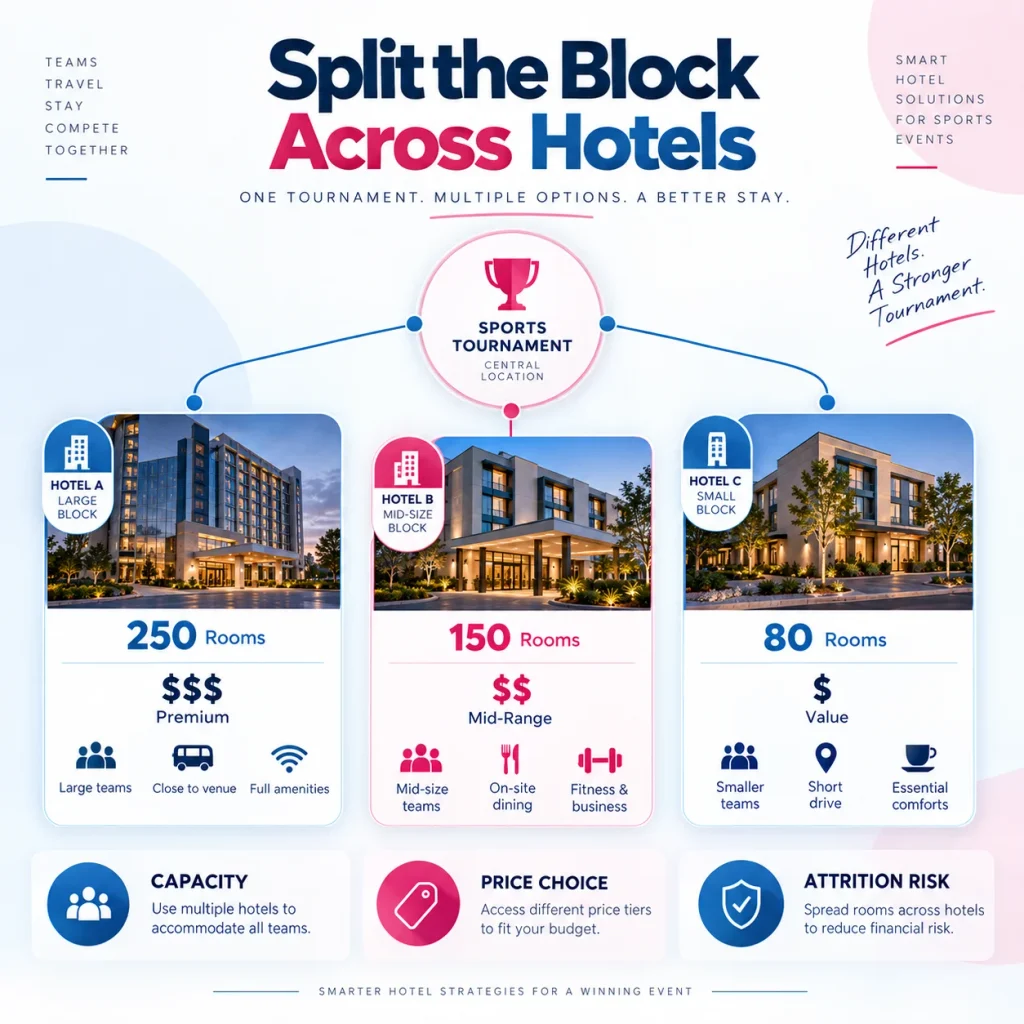
One hotel for a whole tournament is usually the wrong answer, for three separate reasons.
Capacity
Capacity is the obvious one. Few properties can absorb 700 room nights in a weekend alongside their normal business.
For example, when evaluating tournament hotel options, compare properties based on their room inventory, event facilities, location and group-booking flexibility. A property such as Spring House Hotel in Rhode Island can be considered alongside other properties when building a tournament hotel shortlist.
Price choice
Price is the second. Teams travel on very different budgets. Two or three properties at price points roughly $50 apart lets a family choose, and raises total pickup rather than splitting it.
If hotel rooms are being evaluated alongside event facilities, keep the venue cost separate from the hotel block. For broader event budgeting, see this guide to event space costs and party venue pricing.
Attrition risk
Risk is the third and least obvious. A single block carrying your whole event means a single attrition exposure. Three smaller blocks spread that, and each hotel knows it is competing with the other two for pickup.
The RFP, sent five times
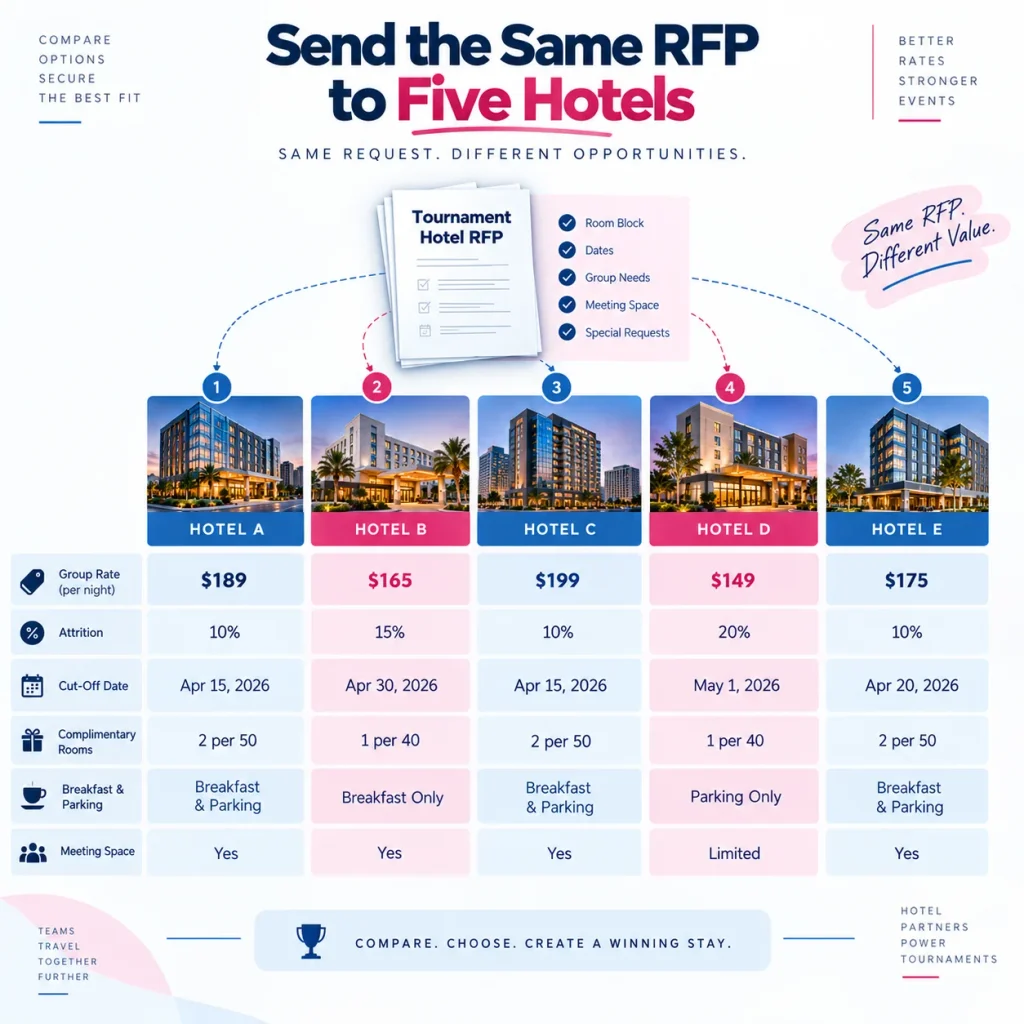
Send the same document to five properties in the same week. Dates, forecast room nights by night, room mix, and the concessions you want. Identical wording matters: quotes you can lay side by side are worth more than five quotes you have to normalise first.
Ask for, in the RFP itself rather than later:
- The group rate, and whether taxes and resort fees sit on top
- Attrition as a percentage of total room nights, not per night
- Cut-off date, and whether it can move
- Complimentary rooms, and at what ratio
- Breakfast, parking and Wi-Fi for every guest in the block
- A meeting room for organiser briefings
- A named contact for the weekend itself
When comparing properties, also look at the cost of event-related spaces separately. If you need meeting or briefing space in addition to hotel rooms, event venue cost per hour can help provide a useful benchmark.
What attrition should you accept?
Attrition is the share of the block you pay for whether it fills or not. Contracts commonly allow 10 to 30 percent, which is the same thing as an 80 to 90 percent pickup commitment.
For a deeper explanation of what happens when a room block falls short, see this guide to room block attrition and shortfalls.
Three things to negotiate, in order of how much they are worth.
Measure it on total room nights, not per night
An 80 percent commitment across 720 room nights gives you room to be short on a quiet Thursday and strong on Saturday. The same commitment applied night by night means Thursday’s shortfall is a penalty even if Saturday oversells.
Require the hotel to resell
If a room you paid attrition on gets sold to someone else, that revenue should credit against your penalty. Hotels agree to this more often than they offer it.
Ask for a block review about a month before cut-off
That is a scheduled conversation to reduce the block without penalty if pickup is behind. It costs the hotel nothing and it is the single most useful clause you can add.
Contract terms at a glance
| Term | What to expect |
|---|---|
| Cut-off date | Commonly 7 to 30 days before arrival. Unsold rooms release to public inventory |
| Attrition | 10 to 30 percent allowed, so 70 to 90 percent pickup required |
| Deposit | Usually one night’s revenue at signing |
| Group rate | 20 to 30 percent below rack, fixed across all block dates |
| Complimentary rooms | Ratios vary widely, from one per 15 rooms to one per 50 room nights |
| Cancellation | Full refund typically needs 30 to 60 days notice. Inside that, the deposit is at risk |
| Force majeure | Should cover weather, travel bans and facility closure, with a right to reschedule |
On complimentary rooms, the ratio is where the published guidance disagrees most: some sources quote one free room per 15 to 20 booked, others one room night per 50 room nights picked up. That spread is real, which means it is negotiable. Ask for the better end and see what comes back.
Should you use a housing company?
At a certain scale the answer becomes yes, and the trade is worth understanding.
A tournament housing company negotiates and contracts on your behalf, which moves the attrition liability off you. That is the main reason organisers use one. It is also how stay-to-play requirements get administered.
Stay-to-play means teams must book inside the official block through the designated portal. It is less common than it was: the Sports Events and Tourism Association reported nearly 40 percent of tournament destinations requiring hotel stays in 2023, down from 60 percent in 2021.
If you go that route, be deliberate about enforcement, because the penalties in circulation are steep.
Published examples include an Alternative Lodging Surcharge of $750 to $1,300 for teams missing their minimum room nights, prorated for partial compliance, and Palmetto Region Volleyball fining $25 per room night short with non-payment meaning removal from the tournament.
Some governing bodies go the other way entirely: USA Volleyball states it will not agree to attrition in any form, and its Florida Region confirms clubs are not required to sign attrition clauses.
Decide which of those worlds your event lives in before you write the policy.
A four night budget, worked
For a mid-sized event with 25 rooms held for organiser and staff use, plus catering and transport.
| Item | Unit | Quantity | Total |
|---|---|---|---|
| Hotel rooms at group rate | $150 per night | 25 rooms × 4 nights | $15,000 |
| Group breakfast | $10 per person per day | 50 people × 4 days | $2,000 |
| Team dinner | $12 per person | 50 people × 4 days | $2,400 |
| Meeting room for briefings | $200 per half day | 2 | $400 |
| Bus transport | $500 per day | 4 days | $2,000 |
| Contingency at 10 percent | — | — | $2,600 |
| Total | $24,400 |
Two notes on using it:
Confirm whether tax sits on top of the group rate, because it usually does, and 15 percent on the room line alone is another $2,250.
Keep the contingency at 10 percent rather than trimming it. Late additions at rack rate are the single most common overrun on a budget like this.
The weeks before cut-off
Pickup is the number to watch, weekly, from the moment the booking link goes out.
Publish the link and the cut-off date together, and repeat both. Most teams book late, and most organisers discover that too close to the deadline to act.
Collect rooming lists rather than trusting the hotel’s report alone. The two disagree more often than you would expect, usually because a family booked outside the block.
At about a month out, use the block review clause. If pickup is behind, reduce. If one hotel is full and another is empty, ask whether rooms can move between them.
Then release unused rooms by the cut-off. That single action is what avoids the attrition charge.
Key takeaways
- Forecast room nights, not rooms. Rooms times nights is what hotels price against.
- Split the block across two or three hotels for capacity, price choice, and to spread attrition risk.
- Negotiate attrition on total room nights rather than per night. It is the most valuable change you can make.
- Ask for a block review a month before cut-off so you can reduce without penalty.
- Comp room ratios range from one per 15 rooms to one per 50 room nights, which means they are negotiable.
- A four night event with 25 rooms, catering and transport lands near $24,400 before tax.
Frequently Asked Questions
How do you book hotels for a sports tournament? ▾
Forecast total room nights across all visiting teams, split the block across two or three hotels, send the same RFP to five properties, then contract with attrition capped at 20 percent of total room nights and a cut-off you can move.
How many hotels should a tournament block cover? ▾
Two or three for most events. It covers capacity, gives families a choice of price point roughly $50 apart, and spreads attrition across separate contracts instead of one.
What attrition should a tournament organiser accept? ▾
Ten to 30 percent is the normal range, meaning a 70 to 90 percent pickup commitment. Insist it is measured on total room nights rather than night by night.
What is a block review clause? ▾
A scheduled conversation about a month before cut-off that lets you reduce the block without penalty if pickup is behind. It costs the hotel nothing and is worth asking for every time.
How many complimentary rooms can you ask for? ▾
Published ratios range from one free room per 15 to 20 booked to one room night per 50 room nights picked up. The spread means it is negotiable, so ask for the better end.
Do tournaments still require stay-to-play? ▾
Less than they did. The Sports Events and Tourism Association reported nearly 40 percent of tournament destinations requiring hotel stays in 2023, down from 60 percent in 2021.
What happens to teams that book outside the block? ▾
It depends on the policy. Published penalties include an Alternative Lodging Surcharge of $750 to $1,300 prorated for partial compliance, and one region fining $25 per room night short with removal from the tournament for non-payment.
How much does a tournament hotel program cost? ▾
For a four-night event with 25 rooms at $150, group breakfast, a team dinner, briefing space and four days of transport, the estimated total is roughly $24,400, including a 10 percent contingency and before tax.
Compare vendors for your next event
Search caterers, photographers, florists, planners, and rentals — then send one request to several vendors at once.