Quick answer: Yes. Universities routinely negotiate group hotel blocks for athletic travel at roughly 15–30% below published rack rates, and one industry analysis found 3-star group rates averaging about 24.6% below online retail. The savings come with conditions: NCAA championship housing must be at “reasonable rates,” public schools often have to bid the contract competitively, and most blocks carry a pickup requirement near 90%.
If you handle team travel for a college program, the discount is not the hard part. Hotels want the volume. The hard part is everything wrapped around the rate: the procurement rules that decide whether you can even pick your own hotel, the commission and rebate built into the number you were quoted, and the attrition clause that can hand back your entire discount after a bad weekend.
How big is the discount, really?
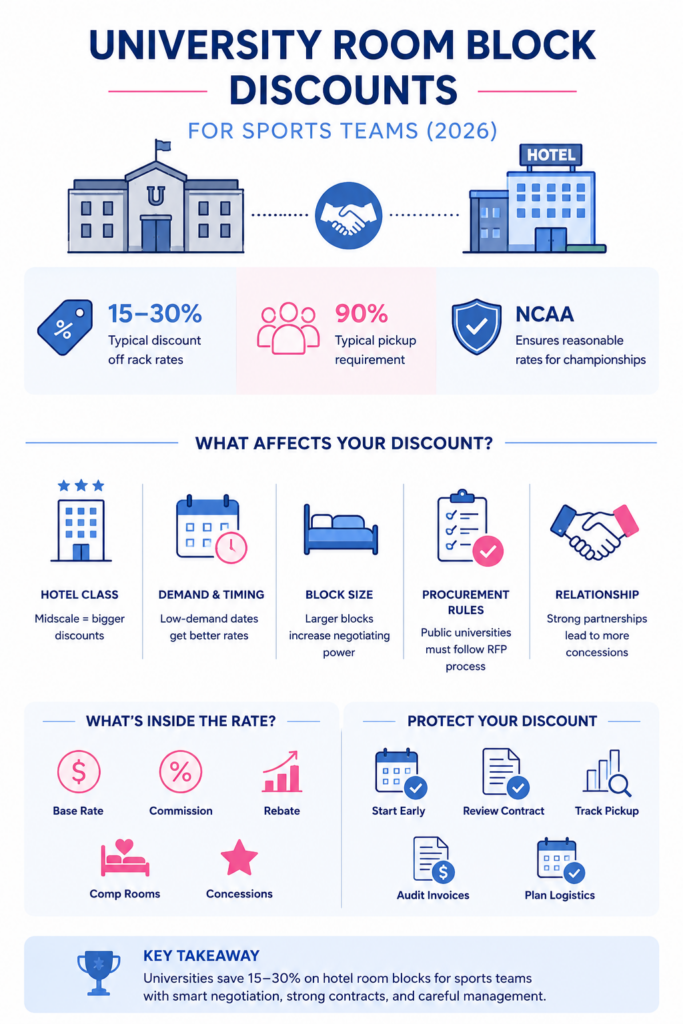
Group rates are a negotiated per-room, per-night price, not the public rack rate. Here is what the available data shows.
| Benchmark | Discount vs. retail | Context |
| Group contracts for sports teams, general range | 15–30% below rack | Typical negotiated outcome across markets |
| 3-star hotel group rates | ~24.6% below online retail on average | Industry analysis; outliers reached ~78% |
| Third-party team booking platforms | 20–30% below published pricing | Platform-advertised range; hotel pays their commission |
| University of Illinois competitive bid | 26% below the runner-up bid | Executive program lodging, awarded to Club Quarters |
Two things shape where you land in that range. Hotel class comes first: midscale and select-service properties cut deeper, luxury properties barely move. Demand comes second. A block on a slow Tuesday in a soft month prices very differently from the same block during a city-wide event, where you may see almost no discount at all.
What do NCAA rules guarantee, and what don’t they?
For NCAA championships, lodging is tightly controlled. Hosts have to secure team hotels “at reasonable rates” as a condition of the bid, and the NCAA contracts those blocks through a travel agency (Anthony Travel). Teams stay in the designated hotels during postseason play. You do not shop around.
What NCAA policy does not do is promise a discount beyond the negotiated rate. It enforces block booking in specified hotels at agreed rates. That is the whole mechanism.
Championship contracts do add protections you rarely get in regular-season deals:
- Eliminated teams may check out early with no early-departure fee, and prepayments are returned.
- If the event is cancelled, postponed, or relocated, the NCAA, host university, and individual guests are not liable for penalties.
- A rate parity clause: the hotel agrees not to offer a lower rate than the contracted group rate, so the block can’t be undercut on a public channel.
- Reservations are made by rooming list once a team qualifies, with a cut-off 7 days before arrival in the tournament template.
Outside championships, conferences may set per-diems or lodging caps but generally defer to NCAA rules and to each school’s own travel policy. For scale on how cost-conscious the association is, NCAA committee travel policy caps association-meeting lodging at a flat maximum of about $185 per night. That figure governs meetings, not team blocks, but it tells you the posture.
Why public universities can’t just call their favorite hotel
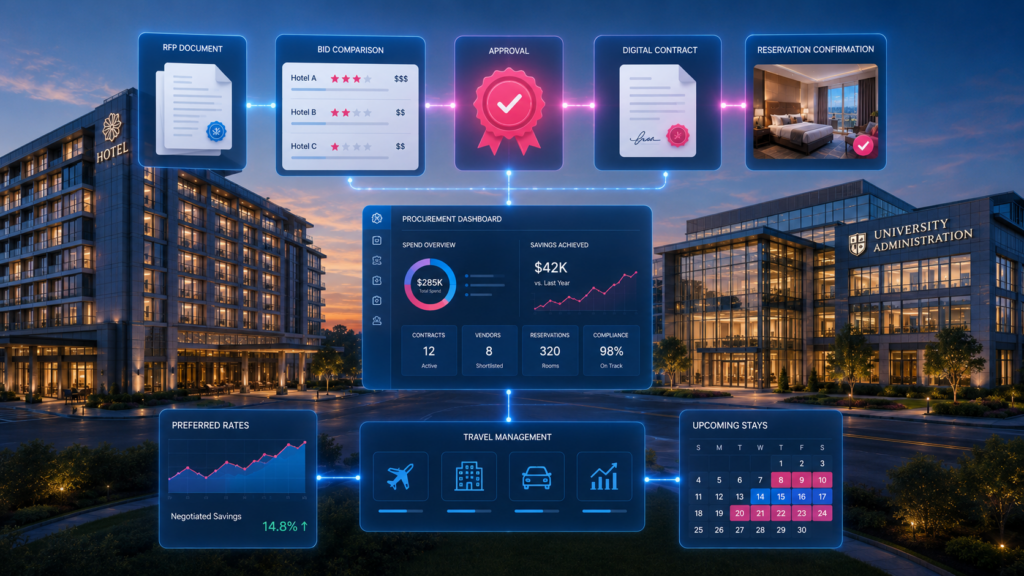
Public institutions treat a team room block like any other service contract. Once the lodging commitment clears a bid threshold, you need a formal RFP or competitive bids.
Two audits make the point:
- Rutgers University (NJ): a state audit found the university had improperly sole-sourced its football team hotel contracts. It was then required to competitively bid team travel lodging.
- University of Illinois: the Board of Trustees approved a competitive bid under the Illinois Procurement Code. The winning hotel came in 26% below the next competitor.
Private universities have no state bidding mandate, but most run internal controls that land in a similar place. Either way, rates and contracts need sign-off from an authorized official (athletics director or travel office) before anyone books.
Many schools solve this once by competitively bidding a travel management company and routing everything through it. Ohio University’s procurement site, for example, names ALTOUR as its preferred travel partner via competitive RFP, handling group and team travel along with hotels and car rentals. Smaller schools often keep a travel clerk inside athletics instead.
One more compliance line worth knowing: NCAA rules forbid boosters from paying for extra lodging or amenities for athletes. Any lodging support runs through the school’s official program. A contract with a booster-owned hotel invites extra scrutiny from your compliance office.
What’s actually inside the rate
The number a hotel quotes an agency-managed block is not a clean net price. It carries payments back out.
| Component | Typical figure | Who it goes to |
| Travel agent commission | 7–10% of room revenue | The travel agency handling the block |
| Rebate to the organizing body | ~10–13% | Event organizer or association |
| Comp rooms, small groups | 1 free per 10 room-nights | The group (often the head coach) |
| Comp rooms, large events | 1 per ~40–50 room-nights | Officials, VIPs, staff |
| Comp rooms, NCAA templates | 1 per ~40–80 room-nights | Per letter-of-agreement terms |
Room-nights, not rooms, drive the comp math. Five rooms for two nights is ten room-nights, which earns one free night at the small-group ratio. Work that out before you accept a “we’ll throw in a comp” offer, because the ratio decides whether that’s generous or standard.
Concessions that move the real cost
Price is one lever. The rest of the package often matters more to a travel budget:
- Free meeting space for film and briefings
- Breakfast vouchers
- Upgraded suites for staff (one sample contract granted a single junior-suite upgrade)
- Complimentary Wi-Fi and parking
- No-charge use of hotel meeting equipment such as easels and podiums
Concessions scale with the size of your commitment. Ask for them as a written list, not a verbal promise, and bring your own priorities in order: rate, comps, amenities, attrition. Sports-event planning guidance recommends exactly that, drafting a wish list of concessions and awarding the business to the hotel that meets it.
Attrition: where the discount can disappear
Hotels protect their inventory with attrition clauses. You commit to picking up a high share of the contracted block or you pay for the gap. A typical term binds the group to about 90% usage, with thresholds in contracts commonly falling in the 80–90% range before penalties kick in.
The math is blunt. Contract 10 rooms, fill 8, and you are financially responsible for the two you didn’t use. Large full-service hotels enforce this most strictly; smaller properties are often looser.
Sports schedules make this genuinely risky, which is why NCAA tournament contracts explicitly waive attrition and early-departure fees for eliminated teams. For everything else, negotiate the clause down. Where attendance is unpredictable because results decide who travels, industry advice is to treat a low or waived attrition threshold as one of the concessions you ask for outright.
Other clauses to read twice before signing:
- Cut-off date for making or cancelling reservations without penalty, often a week to a few weeks out.
- Deposit, commonly a percentage such as one night’s stay in advance.
- Cancellation window for regular-season travel, typically 30–60 days out, past which the school owes a fee (commonly one night).
- Force majeure, spelling out what happens if the event is cancelled, postponed, or moved.
- Liability and indemnification, since the group is responsible for room damage.
- Rooming list deadline and how payment settles, usually to an athletic department master account.
When to start, so the discount is still available
Lead time is bargaining power. Book early and you get both availability and a hotel willing to compete.
| Milestone | Typical timing |
| Host hotel bids for major events | A year or more ahead |
| Blocks for major tournaments | 2–4 months before travel |
| RFP or first hotel conversations, season road games | 2–3 months out |
| Signed block contract | ~1–2 months out |
| Regular away-game blocks | 1–2 months before travel |
| Final rooming list submitted | ~1–2 weeks before the trip |
| Post-stay bill audit against contract | After checkout, once the hotel files its pickup report |
Volume is the second lever. Bigger blocks and multi-team events earn steeper discounts and more comps than a single 8-room away trip ever will. Survey several hotels near the venue and compare rate plus perks side by side rather than rate alone.
Season matters too. Lodging is cheaper in low-demand months and expensive around holidays or big local events, so shift travel dates when the schedule gives you room.
Multi-trip and master rates
Chains rarely allow points redemption on group bookings, but they will extend preferred pricing to accounts that come back. Some conferences and universities negotiate master agreements so teams book a locked-in rate for every road game of a season. Recurring college teams can lock consistent pricing across multiple trips by building the relationship rather than re-bidding every week. Youth and club sports have done this for years around tournament venues; college club programs have started copying it.
How hotels look at your team block
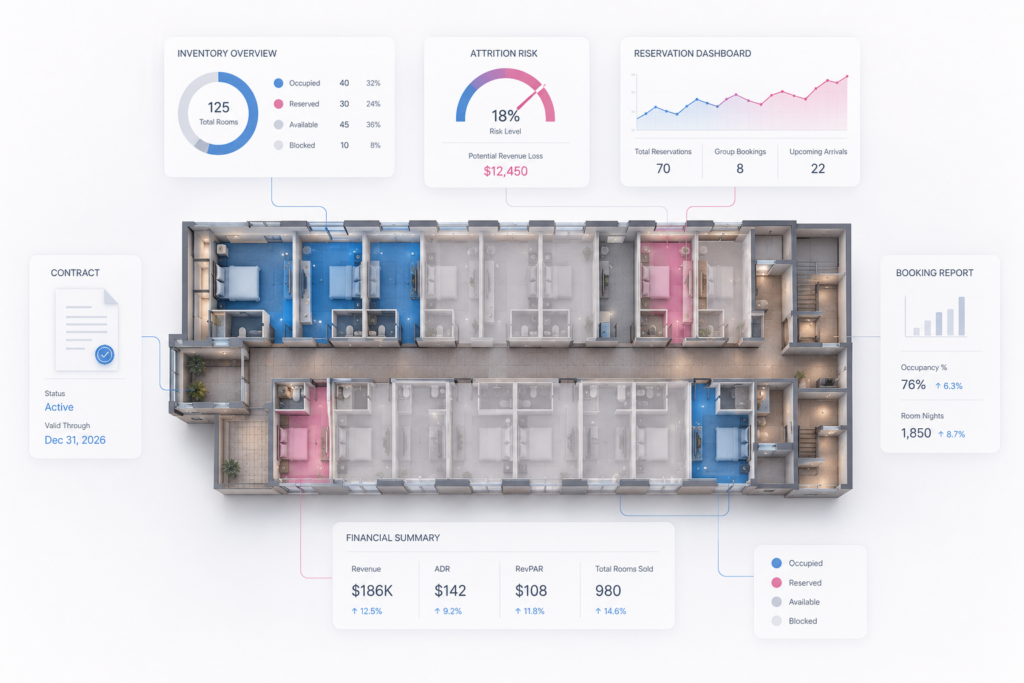
Understanding the other side of the table helps. Chain hotels (Marriott, Hilton, IHG) run dedicated group-sales desks and treat sports like any other group: block the inventory, adjust rates to attract volume, track pickup. Independents can be more flexible on terms but more volatile on price.
From a revenue-management seat, a team block fills rooms that might otherwise sit empty, so a slow night prices low and a compressed night prices high. Hotels also know an athletic block can bring coaches, media, and officials, so amenities get extended to protect repeat business. What they care most about is pickup certainty. Give them a credible number and you have something to trade against attrition.
Third-party team-travel platforms sit in the middle of this, managing blocks at no cost to the team because the hotel pays their commission. Brokered or direct, hotels generally expect one or two complimentary stays per dozens of paid room-nights.
What went wrong at other schools
| Case | What happened | Lesson |
| Rutgers University | Sole-source football team hotel contracts flagged by state audit; competitive bidding required afterward | Check bid thresholds before you commit |
| University of Illinois | Competitive bid produced a rate 26% under the runner-up | Bidding is a discount tool, not just paperwork |
| Missouri State University | 2018 internal audit found hotel charges above contracted rates; a travel agent invoice showed $660 extra for basketball housing | Reconcile every invoice against the contract |
| Home-game hotels (FBS) | 93 FBS programs spent a median of about $44,000 per season housing their own teams before home games | Lodging spend isn’t limited to away travel |
The audit findings all point the same direction. Contracted rate and billed rate are two different numbers until someone checks. Hotels file a room pickup report after the stay showing final occupancy, amenity usage, and comp credits. That report is what you audit the bill against before you approve payment. Missing rebates or comps get resolved through the contract terms.
Key takeaways
- University team blocks typically price 15–30% below rack rates; one analysis put 3-star group rates about 24.6% below retail.
- NCAA championship housing must be at “reasonable rates” in assigned hotels, but the rules don’t promise a discount beyond the negotiated one.
- Public schools often have to bid lodging competitively; Illinois’s bid came in 26% under the next offer, and Rutgers was forced into bidding after an audit.
- Agency-managed rates commonly carry a 7–10% commission and a ~10–13% rebate, plus comp rooms at 1 per 10 to 1 per 80 room-nights depending on event size.
- Attrition near 90% pickup is standard. Negotiate it down when results decide who travels.
- Audit the final bill against the contract. Overbilling has been documented.
Frequently Asked Questions
Do universities get discounts on hotel room blocks for sports teams?▾
Yes. Group contracts for college team travel typically produce rates roughly 15–30% below published rack rates. One industry analysis found 3-star hotel group rates averaged about 24.6% below online retail, with outliers reaching around 78%. The exact discount depends on hotel class, location, and how much demand the hotel already has for those dates.
Does the NCAA negotiate the discount for you?▾
For championships, largely yes. Hosts must secure team hotels at “reasonable rates” as a bid condition, and the NCAA contracts the blocks through a travel agency, with teams required to stay in designated hotels during postseason play. NCAA policy enforces the block and the agreed rate, but it does not promise additional savings beyond what was negotiated.
Do public universities have to bid out team hotel contracts?▾
Often, yes. When lodging commitments exceed state bid thresholds, formal RFPs or competitive bids are required. A New Jersey audit found Rutgers had improperly sole-sourced its football team hotel contracts and required competitive bidding afterward. The University of Illinois ran a bid under the Illinois Procurement Code and secured a rate 26% below the runner-up.
What is a normal attrition requirement on a team room block?▾
A typical clause binds the group to roughly 90% pickup of the contracted block, with contract thresholds commonly set between 80% and 90% before penalties apply. If you contract 10 rooms and fill only 8, you are financially responsible for the unused rooms. NCAA tournament contracts waive attrition and early-departure fees for teams eliminated from play.
How many complimentary rooms should a team block earn?▾
It depends on total room-nights. Small groups often get one comp room per 10 room-nights, so five rooms over two nights earns one free night. Larger event contracts commonly run one comp per about 40–50 room-nights, and NCAA letter-of-agreement templates show roughly one free room per 40–80 room-nights.
Are commissions and rebates built into the quoted rate?▾
In agency-handled and championship contracts, yes. Rates frequently include a 7–10% commission paid to the travel agent plus a rebate of roughly 10–13% back to the organizing body. Those payments are part of the negotiated package, so the number you see quoted is not a clean net cost.
How far ahead should a college team book a hotel block?▾
Blocks for major tournaments generally go 2–4 months ahead, and regular away-game blocks 1–2 months ahead. Host hotel bids for large events can start a year or more in advance. Programs commonly issue an RFP 2–3 months out, sign 1–2 months out, and submit final rooming lists 1–2 weeks before travel.
What perks besides rate can a team negotiate?▾
Free meeting space, breakfast vouchers, upgraded suites for staff, complimentary Wi-Fi and parking, and no-charge use of hotel meeting equipment. One sample contract included a junior-suite upgrade plus free use of easels and podiums alongside comp rooms. Concessions scale with the size of your room commitment, so ask as a prioritized list.
Compare vendors for your next event
Search caterers, photographers, florists, planners, and rentals — then send one request to several vendors at once.