Quick answer: A room block pickup report shows, night by night and usually by room type, how many rooms in your contracted block have actually been reserved. Read the blocked or committed figure against rooms already picked up, then look at what is still available and at the weekly pace you need before the cutoff. Keep your own tracker so you can see new reservations, changes, and cancellations, and so you can catch rooms that booked outside your rate codes.
Example scenario (fictional): Maya is planning a sales kickoff for a mid-size software company. The group arrives Monday, April 12, 2027, and stays through Thursday, April 15. The contracted block is 40 rooms Monday, 80 Tuesday, 80 Wednesday, and 40 Thursday, or 240 room nights in all. The cutoff is Friday, March 12, 2027, 31 days before the first arrival. On Friday, February 19, three weeks before the cutoff, the hotel sends a pickup report: 140 room nights are reserved, which is 58 percent of the block. The contract in this example requires the group to pick up 80 percent of contracted room nights, or 192. Maya needs 52 more room nights in three weeks, about 17 a week. Thursday is lagging at 45 percent. The company, the dates, the counts, and the 80 percent floor are invented to show the method. The same numbers are used in the sample, the weekly tracker, and the infographic.
This is for US professional planners and agencies who already hold a hotel room block for a client and need to read the hotel’s weekly report. It covers the columns, a labeled sample, and a tracker you can keep yourself. The broader process of managing room blocks for a conference stays in that guide. Cutoff extensions and missed-cutoff recovery stay in our guide to the room block cutoff date. Attrition formulas, and how to audit rooms that never appear on the report, are covered later in this post with a link to the shortfall guide. Contract terms vary. This is planning information, not legal advice. Your proposal and contract control.
What a room block pickup report is
The Events Industry Council glossary defines pick-up as the “Number of facility guest rooms actually used out of a room block.” In practice, the report you get during the booking window is usually a count of reservations already made against your group rate code or booking link, by night and often by room type. After the event, the final figure may reflect rooms actually stayed, once cancellations, no-shows, and late departures have been applied. Those two snapshots can differ, so note the date and time on every report the hotel sends.
Hotels and housing desks use several names for the same file: pickup report, pick-up report, block and pickup report, or a housing report that includes pickup. The Events Industry Council defines a housing report as a document detailing housing utilization, including reservations and pickup. Ask for the report in writing, on a set weekday, from a named person, once the booking channel is live. If you are self-managing, put that schedule in the contract rather than hoping sales will remember.
What the columns mean
Column labels vary by hotel system. One widely used group sales report lists agreed rooms (what the customer requested), blocked rooms (what the hotel is holding), pickup (rooms reserved on the block), and a variance percentage of blocked minus pickup, divided by blocked. Your hotel may say committed, sold, reserved, or available instead. The job is the same: compare what you contracted with what is reserved, night by night.
| Column you may see | What it usually means | What to check |
|---|---|---|
| Blocked, agreed, or committed | Rooms the hotel is holding for the group that night, from the contract or a later adjustment | Does this still match the contract, including any reduction you already agreed? |
| Pickup, sold, or reserved | Rooms already reserved against the block, usually on your rate code or booking link | Is this a reservation count, or occupied rooms after arrival? Note the report date. |
| Available or remaining | Blocked rooms minus pickup, in most systems | A zero here on a peak night can mean the block is full, or that the hotel already released rooms. |
| Variance or pickup percent | The gap, or pickup divided by blocked, for that night | A healthy total can hide one weak night. Read each row, not only the total. |
| Room type | Kings, doubles, suites, or other types held in the block | A mismatch here (kings gone, doubles sitting) is a guest problem before it is a bill problem. |
| Sub-block | A slice of the event-contracted block held for speakers, staff, exhibitors, or another group | Unclaimed sub-block rooms should go back into the general block before the cutoff. |
Some reports also show average rate and room revenue. Those figures are useful when you are comparing properties or checking billed room revenue. They are not a substitute for the night-by-night room count, which is what attrition and cutoff decisions are based on.

A sample pickup report, and how to read it
Here is Maya’s report as of Friday, February 19, 2027. The numbers are fictional. Available rooms equal blocked minus pickup in this sample, and pickup percent is pickup divided by blocked, rounded to a whole number.
| Night | Blocked | Picked up | Available | Pickup percent |
|---|---|---|---|---|
| Monday, April 12 | 40 | 22 | 18 | 55% |
| Tuesday, April 13 (peak) | 80 | 52 | 28 | 65% |
| Wednesday, April 14 (peak) | 80 | 48 | 32 | 60% |
| Thursday, April 15 | 40 | 18 | 22 | 45% |
| Total room nights | 240 | 140 | 100 | 58% |
The 58 percent total looks acceptable at first glance, three weeks before the cutoff. It is not, under this contract. The 80 percent floor is 192 room nights, so 52 room nights are still needed. Spread over the three weeks left to March 12, that is about 17 room nights a week. If the next two weeks come in below that pace, the gap gets harder to close in the last week, when many attendees have already made other plans.
Thursday is the row that should jump out. Eighteen of 40 rooms, or 45 percent, is well behind the peak nights. That can mean people are flying out Wednesday night, booking only three nights, or staying Thursday at another hotel. It can also mean the Thursday block was oversized from the start. Maya should confirm the agenda: if the closing session ends Thursday afternoon, a 40-room departure night may be realistic, and the extra rooms are the risk. If people are supposed to stay Thursday, the report is an early warning to send a reminder and to ask the hotel whether Thursday rooms are already being sold around the block.
The two peak nights are also not identical. Tuesday is at 65 percent and Wednesday at 60 percent. A four-room gap at this date is small, and it is still worth watching week to week. If Wednesday stalls while Tuesday fills, check whether the agenda or a dinner is causing people to leave a night early.
Text version of the infographic
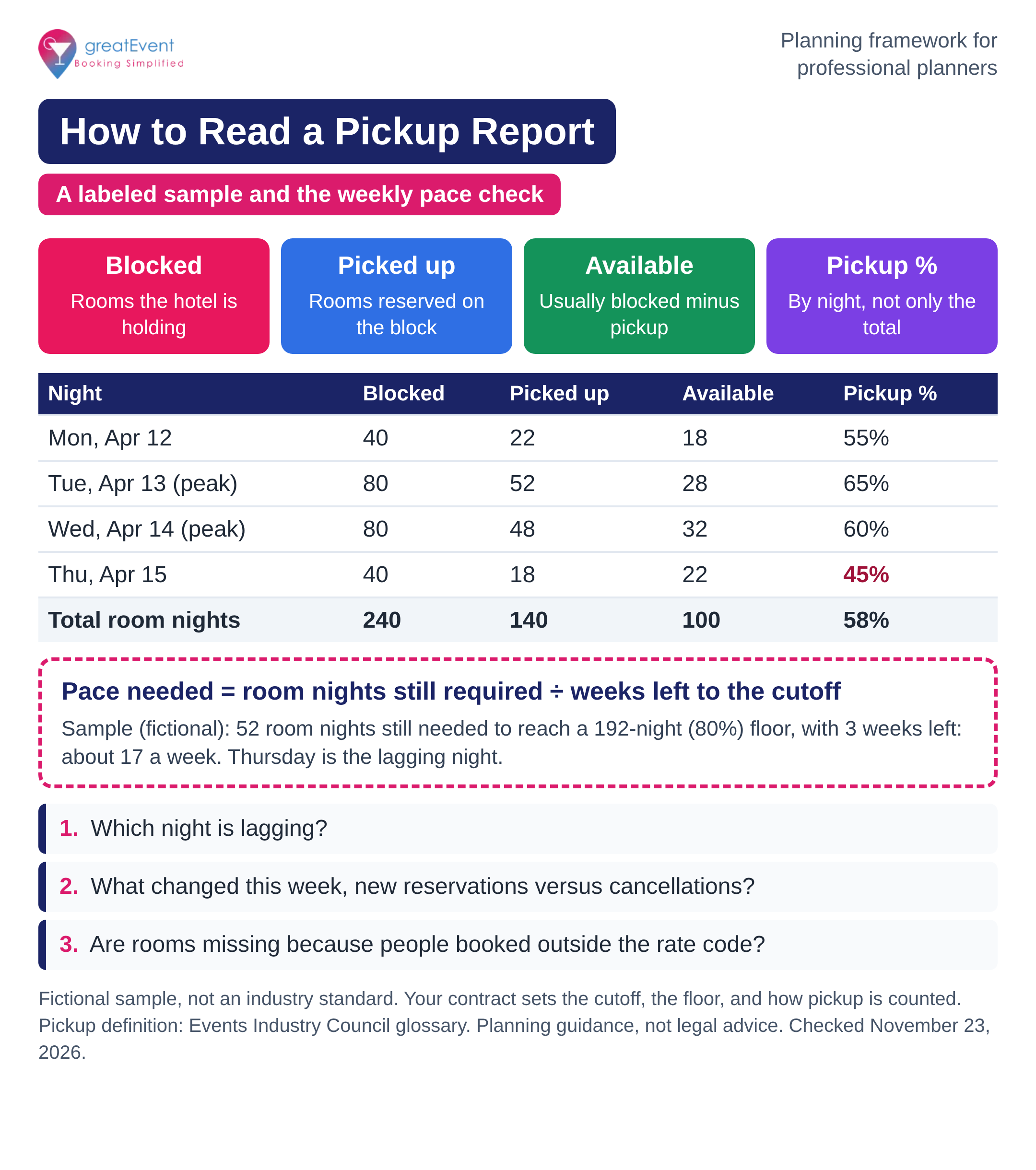
How to read a room block pickup report. A labeled sample and the weekly pace check. The figures are fictional and match the sample in this post.
Four columns: blocked (rooms the hotel is holding), picked up (rooms already reserved on the block), available (usually blocked minus pickup), and pickup percent (pickup divided by blocked, night by night).
Sample as of Friday, February 19, 2027, three weeks before a Friday, March 12 cutoff: Monday 22 of 40 (55 percent), Tuesday 52 of 80 (65 percent), Wednesday 48 of 80 (60 percent), Thursday 18 of 40 (45 percent). Total: 140 of 240 room nights, or 58 percent. An 80 percent floor in this example is 192 room nights, so 52 more are needed in three weeks, about 17 a week. Thursday is the lagging night.
Three questions for every weekly report: Which night is lagging? What changed this week, in new reservations versus cancellations? Are rooms missing because people booked outside the group rate code? A planning framework, not an industry standard. Pickup definition: Events Industry Council glossary. Planning guidance, not legal advice. Checked November 23, 2026.
Why the total can hide a problem
A single pickup percent for the whole block averages strong nights with weak ones. Shoulder nights, the nights on either side of your peak, are where this shows up most often. A conference that is sold out Tuesday and Wednesday can still be short on Sunday or Thursday, and some contracts measure attrition by night rather than across the stay. Read the report the way the contract counts, then look at each night anyway, because a guest who cannot book the night they need may book the whole stay somewhere else.
Room type is the other place a total misleads. If the Tuesday block is 50 kings and 30 doubles, and pickup is 40 kings and 12 doubles, the night can look fine as a room count while pairs who wanted two beds have already left the official block. Ask the hotel to send pickup by room type, not only by night, and to flag sold-out types before they sit on a waitlist you never see.
Sub-blocks need their own line. Ten rooms held for speakers, with only four names in, means six rooms that look “available” in a total but are not actually on sale to attendees. Recycle unclaimed sub-block rooms into the general block while the hotel will still do it.
Why the report can understate your real pickup
Hotels run pickup against your rate codes. An attendee who books the same hotel as a regular guest, through a third-party site, or with a corporate negotiated rate that is not your group code, often will not appear on the report. That gap is a frequent source of surprise attrition bills, and our guide to why a pickup report can understate your real pickup covers how to audit it and what to ask the hotel to credit. The short version for weekly reading: if registration or your own list says more people have rooms than the report shows, do not assume the report is complete. Ask for a list of group-rate reservations, compare it with your list, and raise no-credit stays before the cutoff, not after.
A pickup report is also not a rooming list. The report is a snapshot of how much of the block is reserved. A corporate meeting rooming list is the list of individual reservations you send the hotel, with names, dates, sharing, and billing. Reconcile them by date and room type, and expect the two to disagree while reservations are pending, shared, changed, or canceled.
A weekly tracker you can keep yourself
The hotel’s report is the official count. Your tracker is how you see pace. Keep one row per week, and record new reservations and cancellations separately. A flat week can be a stall, or it can be a week in which 36 rooms booked and 8 canceled. The Events Industry Council defines wash as the difference between the number of reservations at the cut-off date and the number of final reservations at the end of an event, as a count or a percentage, and it can be positive or negative. You will not have a true wash figure until after the event, but watching cancellations each week is how you see the same risk early.
Maya’s weekly totals, also fictional, leading up to the February 19 report:
| Week ending | Cumulative pickup | New this week | Canceled this week | Net change | Pickup percent |
|---|---|---|---|---|---|
| Friday, January 8 | 24 | – | – | – | 10% |
| Friday, January 15 | 36 | 14 | 2 | +12 | 15% |
| Friday, January 22 | 48 | 15 | 3 | +12 | 20% |
| Friday, January 29 | 62 | 18 | 4 | +14 | 26% |
| Friday, February 5 | 84 | 26 | 4 | +22 | 35% |
| Friday, February 12 | 112 | 32 | 4 | +28 | 47% |
| Friday, February 19 | 140 | 36 | 8 | +28 | 58% |
Net change on February 12 and February 19 is the same, plus 28. The underlying week is not. Cancellations doubled in the latest week, from 4 to 8, while new reservations only rose from 32 to 36. If that cancellation rate continues, Maya needs more than 17 new reservations a week to net 17. The tracker is what makes that visible. A hotel report that shows only cumulative pickup would have looked like a steady climb.
Copy this and replace the figures with yours. The dates and counts below are the fictional sample, included so the layout is obvious.
ROOM BLOCK PICKUP TRACKER
Event: ________________________    Hotel: ________________________
Cutoff date: ___________________    Report weekday: _______________
Contracted room nights: _________    Attrition floor (if any): ______
Named hotel contact: ____________    Booking channel / rate code: ____

Week ending | Cum. pickup | New | Canceled | Net | Pickup % | Notes / action
Jan 8       | 24          |  -  |  -       |  -  | 10%      | Link tested, reminders not yet sent
Jan 15      | 36          | 14  |  2       | +12 | 15%      |
Jan 22      | 48          | 15  |  3       | +12 | 20%      |
Jan 29      | 62          | 18  |  4       | +14 | 26%      | Speaker sub-block: 4 of 10 named
Feb 5       | 84          | 26  |  4       | +22 | 35%      |
Feb 12      | 112         | 32  |  4       | +28 | 47%      |
Feb 19      | 140         | 36  |  8       | +28 | 58%      | Thursday at 45%. Need ~17 net RN/week to 192.
Feb 26      |             |     |          |     |          |
Mar 5       |             |     |          |     |          |
Mar 12 (cutoff) |         |     |          |     |          | Request written pickup by night and type as of cutoff

Each week, also record pickup by night (and by room type if the hotel sends it):
Night       | Blocked | Jan 29 | Feb 5 | Feb 12 | Feb 19 | Feb 26 | Mar 5 | Cutoff
Mon Apr 12  | 40      |        |       |        | 22     |        |       |
Tue Apr 13  | 80      |        |       |        | 52     |        |       |
Wed Apr 14  | 80      |        |       |        | 48     |        |       |
Thu Apr 15  | 40      |        |       |        | 18     |        |       |
Total RN    | 240     |        |       |        | 140    |        |       |

Weekly questions:
[ ] Which night is lagging, and is that night how the contract counts attrition?
[ ] What changed this week in new reservations versus cancellations?
[ ] Does my own list or registration count exceed the report? If yes, start an audit of stays booked outside the code.
[ ] Are unclaimed sub-block rooms still sitting off sale?
[ ] If the pace I need is rising, have I raised it with the hotel before the cutoff?
What to do when the pace slips

First, confirm the math with the hotel. Ask whether any block reduction has already been applied, whether the report includes every rate code on the contract, and whether any nights have already been released. Then decide, before the cutoff, among the options you actually have: a reminder to people who registered but have not booked, a release of unclaimed sub-block rooms, a negotiated reduction of weak nights, or an extension of the cutoff if the hotel will grant one.
The weekly pace you need is the room nights still required, divided by the weeks left to the cutoff. If that number keeps rising, raise it with the hotel while the rooms are still in your block. After the cutoff, the work changes: get the pickup report as of the cutoff in writing, and follow the recovery steps in the cutoff guide linked above. Do not wait for a final bill to start that conversation.
Notes by event type
For a company-paid sales kickoff, pickup often follows invitations and travel approvals more than a public registration curve. If the list of attendees is already known, a lagging report usually means people have not booked yet, or they booked the hotel outside the code. Chase the names. A kickoff also tends to have a sharp peak and a thin departure night; size those nights separately, as the sample Thursday shows.
For an association annual meeting, attendees usually book themselves over a long window, and registration may be back-loaded. Pickup will be too. Compare the report with registration each week, keep one official booking channel so the report can be matched to the contract, and watch overflow hotels as their own lines, not as a single total. Last year’s actual pickup by night is the starting forecast, when you have it.
Wedding blocks and sports team blocks use the same report. The difference is who is booking and how short the window is. A wedding pickup check belongs on the planner’s timeline once invitations go out. A team or tournament block may be names on a rooming list rather than a public link, so you will reconcile the list against the hotel’s pickup rather than watching a booking curve. The columns do not change.
Room block pickup checklist
- Put the cutoff, any review dates, and the rooming list deadline on the calendar, and count weeks back from the cutoff.
- Ask the hotel, in writing, for a weekly pickup report by night and room type, from a named contact, once the booking channel is live.
- Record blocked, pickup, available, and pickup percent each week, including each night, not only the total.
- Record new reservations and cancellations separately so a flat week cannot hide wash.
- Compare the report with your own list or registration, and audit stays that may have booked outside the group rate code.
- Release unclaimed sub-block rooms into the general block while the hotel will still move them.
- Work out the weekly pace you still need to reach any attrition floor, and talk to the hotel if that pace is rising.
- On cutoff day, request written pickup by night and room type, and confirmation of what was released.
- After the event, get the final pickup, reconcile it with your tracker, and save the history for the next program.
Compare hotels, venues, and vendors on greatEvent
On greatEvent, start a venue search with the meeting type, location, dates, and attendee count. You can compare hotels and venues side by side, check real-time availability where a venue shows it, or send one inquiry to several venues and get quotes back, as described in our guide to how long it takes to book an event venue. When you request a hotel room block, ask each hotel how it will send pickup reports (by night, by room type, how often, and from whom), and how it handles reservations after the cutoff, so the terms compare cleanly before you sign. For sleeping rooms, we book hotel room blocks. You can also find your vendors and suppliers on greatEvent, from caterers for a welcome reception to transportation for arrival day.
There are no fees for planners. We pay you commission on any qualifying booking you make on greatEvent.
Register as a professional planner
Frequently asked questions
What is a room block pickup report?
▾
A room block pickup report shows how many rooms in your contracted block have been reserved, usually by night and by room type. You read the blocked or committed figure against rooms already picked up, then look at what is still available.
How often should I ask for a pickup report?
▾
Ask for it every week, from a named contact, once the booking link or rooming list is live. Weekly is frequent enough to see pace and cancellations. Closer to the cutoff, you may want a midweek update if a night is lagging.
What is the difference between a pickup report and a rooming list?
▾
A pickup report is a snapshot of how much of the block is reserved at a point in time. A rooming list is the list of individual reservations you send the hotel, with names, dates, and billing. Reconcile them by date and room type, and allow for pending, shared, changed, and canceled reservations.
Why doesn’t the pickup report match the number of people I think have booked?
▾
Hotels usually count only reservations that used your group rate code or booking link. People who book the hotel as a regular guest, or through another channel, often will not appear. Shared rooms, pending reservations, and sub-blocks listed separately also throw the numbers off.
What is wash on a room block?
▾
Wash is the difference between the number of reservations at the cutoff date and the number of final reservations at the end of the event. It can go up or down, and it can be stated as a count or a percentage. That is why a cutoff-day snapshot is not the same as the final pickup the hotel uses after departure.
What should I do if pickup is tracking short of my attrition floor?
▾
Work out the weekly pace you still need, then act before the cutoff: remind attendees, release unclaimed sub-block rooms into the general block, and talk to the hotel about a reduction or an extension while there is still time. After the cutoff, get the report as of that date in writing and follow your recovery options under the contract.
Research and sources
Sources were checked on November 23, 2026. The opening scenario, the sample report, the weekly tracker, and the pace math are fictional: the company, the dates, the room counts, and the 80 percent attrition floor are invented to show the method. Hotel report column names vary by system; the agreed, blocked, pickup, and variance labels described above follow a published group sales report used as an example, not a universal standard. Contract terms vary. This post is planning information, not legal advice.
- Events Industry Council industry glossary, “Pick-Up”: “Number of facility guest rooms actually used out of a room block.” Read November 23, 2026.
- Events Industry Council industry glossary, “Wash”: “The difference between number of reservations at cut-off date and the number of final reservations at the end of an event. Can be positive or negative and be expressed as a number or percentage.” Read November 23, 2026.
- Events Industry Council industry glossary, “Housing Report”: “Document detailing housing utilisation (reservations, pickup, etc.).” Spelling as in the glossary. Read November 23, 2026.
- Events Industry Council industry glossary, plain text only: “Cut-Off Date,” “Release Date,” “Reservation Review Date,” “Attrition,” “Slippage,” “Room Block,” “Room Nights,” “Peak Night,” “Sub-Block,” “Rooming List,” “No-Show,” “Complimentary Ratio,” and “Post-Event Report (PER).” Read November 23, 2026.
- Published block/pickup comparison report documentation of a group sales and event management system, guestroom fields (agreed, blocked at definite, blocked, pickup, and variance percent), read November 20, 2026, and rechecked November 23, 2026.
- Published room grid documentation of a hotel property management system, describing blocked rooms and reservations already picked up from a block, read November 20, 2026, and rechecked November 23, 2026.
Compare vendors for your next event
Search caterers, photographers, florists, planners, and rentals — then send one request to several vendors at once.