Quick answer: A sales kickoff (SKO) is a company’s annual meeting for its sales team, usually held at the start of the fiscal year to launch the new plan. To plan one for a client, set the dates around the fiscal-year start, the quarter close, and holidays. Build a two-day agenda with a general session, breakouts by role and by region, a working lunch, and a recognition dinner. Choose a venue whose general session room seats the full group and can stay set for both days. Then size the hotel room block night by night from when people arrive and leave, and track pickup until the cut-off date.
Example scenario (fictional): In mid-November, a software client asks its agency for a kickoff for about 220 sellers. Its fiscal year starts February 1, comp plans are final in late January, and the sales leader wants everyone in one room in the first week of February. The hotel the client used last year already has another group in its ballroom that week. The planner has to find dates, a general session room, eight breakout rooms, and a hotel room block in about 11 weeks.
This is for professional planners and agencies who run a client’s annual sales kickoff, and for in-house corporate meeting planners who own it. It covers what is specific to a sales kickoff meeting: picking the dates, the agenda, the venue type by headcount, and the hotel room block. For the general steps every corporate event shares, such as approvals, budgets, procurement, and the final month, use our guide on how to plan a corporate event. Comp plans, quota letters, and anything that touches employment terms belong to the client’s sales operations, HR, and legal teams.
In this guide:
- What a sales kickoff is, and what makes it different to plan
- Pick the dates
- A two-day sales kickoff agenda template
- Choose the venue by headcount
- Size the hotel room block: a worked example
- When to start booking
- One-page sales kickoff checklist
- FAQ
What a sales kickoff is, and what makes it different to plan
A Salesforce guide to SKO planning describes a sales kickoff as a meeting for a company’s sales teams, typically held in January or February at the beginning of the fiscal year, where leaders set out how the team will grow the business in the new year. It lists celebrating the previous year’s wins, sharing goals, and getting reps working from the same plan as its purpose. If the client’s fiscal year starts in another month, the kickoff may follow it, so ask before you assume January.
On the planning side, a sales kickoff differs from other company meetings in a few ways:
- Most attendees carry a quota. Each day at the kickoff is a day away from customers, so sales leaders push for a short program and dislike dates near a quarter close.
- The content is often confidential. Territories, comp plans, pricing, and product roadmaps get presented, so the general session and the regional breakouts need rooms that can be closed to other hotel guests.
- People fly in from every region at once. Arrival and departure times drive the room block, the first session’s start time, and when the last session can end.
- Recognition is part of the program. The Salesforce guide lists awards celebrations among common kickoff agenda items, and an awards dinner needs its own space and its own timing.
- Other teams may join. Salesforce says it invites solution engineering managers and select customer success, industry, and partner team managers along with its sales teams. Each added group changes the headcount and the breakout plan.
Pick the dates
The client usually wants the kickoff as early in the fiscal year as possible, but it can’t happen before the plan, territories, and comp plans are final. Get these answers in the first call:
Date-picking checklist
- ☐ When does the client’s fiscal year start, and when does the prior year’s last quarter close?
- ☐ When will the plan, territories, quotas, and comp plans be final enough to present?
- ☐ Which weeks are month-end or quarter-close weeks that sales leaders will refuse?
- ☐ Which federal holidays and long weekends fall in the window, and does the client want to avoid travel on them?
- ☐ Are there religious or cultural observances that matter to this sales team?
- ☐ Does the kickoff clash with an earnings call, a product launch, a board meeting, or another company event?
- ☐ Can the CEO and the sales leader both attend the general session dates?
- ☐ If the destination has winter weather, is there time in the agenda for late arrivals?
- ☐ Is there a backup date range if the first choice has no space?
For a January or February 2027 kickoff, the U.S. Office of Personnel Management’s federal holiday schedule lists New Year’s Day on Friday, January 1, 2027, the Birthday of Martin Luther King, Jr. on Monday, January 18, 2027, and Washington’s Birthday on Monday, February 15, 2027. The two Mondays create three-day weekends. Some client teams take those days off, and some attendees won’t want to travel over a holiday weekend, so check the client’s own holiday calendar before you offer dates that touch them.
Offer the client two date ranges. Hotels with space for a full general session, breakouts, and a dinner on the same nights are easier to find when the client can move by a week.
A two-day sales kickoff agenda template
This template uses two meeting days plus an arrival evening. That fits a general session, role and regional breakouts, and a recognition dinner, and it keeps sellers away from customers for three nights at most. Use the template below as a starting point and adjust it to the client’s content. The times are an example. The room column is what you send to the venue.
| When | Session | Who attends | Room you need |
|---|---|---|---|
| Day 0, afternoon | Arrivals, hotel check-in, registration desk opens | Everyone as they arrive | Registration space near the hotel lobby |
| Day 0, 6:00 p.m. | Welcome reception | Everyone | Reception space separate from the general session room |
| Day 1, 7:00 a.m. | Breakfast | Everyone | Breakfast space outside the general session room |
| Day 1, 8:00 a.m. | Opening general session: last year’s results and this year’s plan, from the CEO and sales leader | Everyone | General session room set for the full group, held for both days |
| Day 1, 10:00 a.m. | Product and go-to-market session | Everyone | General session room |
| Day 1, 11:15 a.m. | Customer panel or partner session | Everyone | General session room |
| Day 1, 12:15 p.m. | Working lunch, seated by region | Everyone | Lunch space with assigned tables |
| Day 1, 1:30 p.m. | Breakouts by role: account executives, sales engineers, sales development reps, customer success | Each role group | One breakout room per role group |
| Day 1, 6:30 p.m. | Recognition dinner and awards | Everyone, plus invited executives | Banquet space with a stage, or a turned general session room |
| Day 2, 8:00 a.m. | Breakouts by region or segment: territory and account planning | Each region | One private room per region |
| Day 2, 10:30 a.m. | Skills workshops, such as discovery, negotiation, or the new pricing | Mixed groups | Breakout rooms, reused or reset |
| Day 2, 12:00 p.m. | Lunch | Everyone | Lunch space |
| Day 2, 1:00 p.m. | Closing general session: first-quarter priorities and Q&A with leadership | Everyone | General session room |
| Day 2, 2:30 p.m. | Close and departures | Everyone | Luggage storage; late checkout list for the hotel |
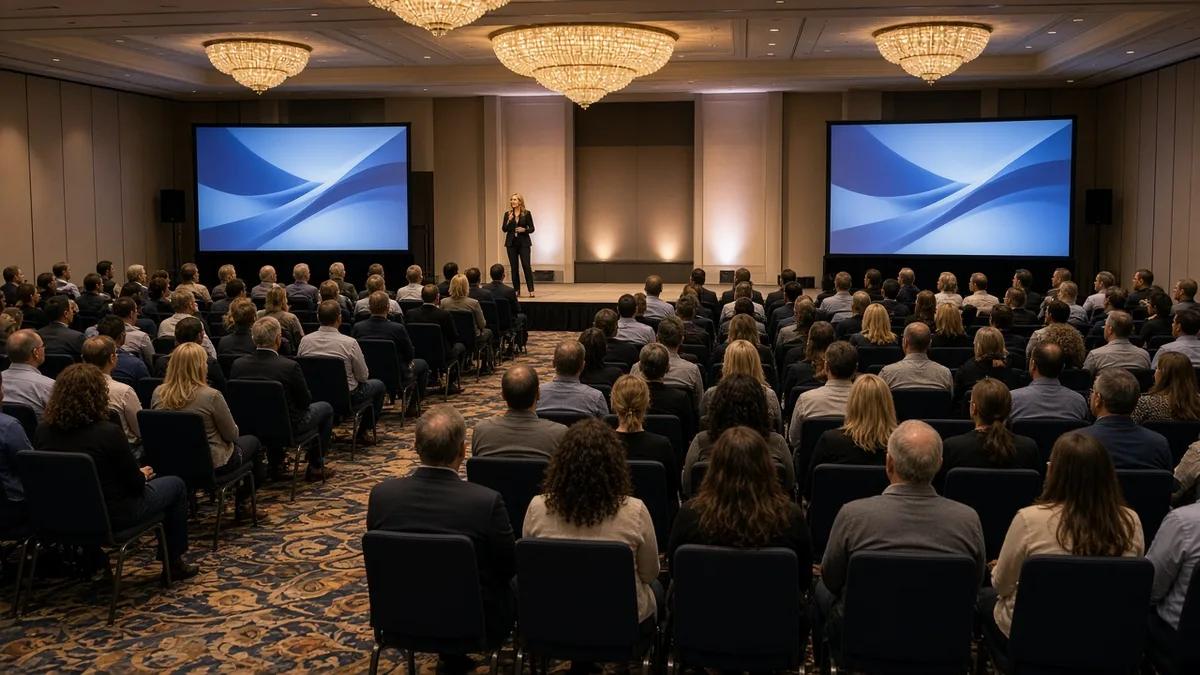
Count breakout rooms from the busiest time slot, not from the number of sessions. In this template, Day 1 at 1:30 p.m. needs four rooms (one per role) and Day 2 at 8:00 a.m. needs one room per region, so a client with eight regions needs eight rooms at once. Our guide to how many breakout rooms a conference needs walks through that calculation, including setup and reset time.
Three agenda choices save trouble later:
- Keep the general session room set for both days. If the same room has to become the dinner space on Day 1, the reset adds labor and needs time between the last afternoon session and the dinner. Ask the venue how long the turn takes.
- Schedule comp plan and territory content in closed rooms. Regional breakouts are where reps ask about their own numbers, and those questions shouldn’t carry into a hotel corridor.
- End Day 2 early enough for people flying home that day. A 2:30 p.m. close gives attendees on shorter routes time for an evening flight, which reduces the third hotel night in the room block below.
Choosing a sales meeting theme
If the client wants a theme for the kickoff, it is usually a short line that appears on the stage screens, the agenda, and the awards. A useful theme comes from the year’s plan itself, such as a new product, a new market, or one sales motion the leader wants everyone to adopt. Ask the sales leader for the one sentence they want reps to repeat after the event, and build the theme from it. Settle the theme before you order anything printed or branded, and ask your vendors and suppliers how late they can accept the final artwork.
Choose the venue by headcount
A hotel keeps the room block and the meeting space under one contract, and attendees walk from their rooms to the sessions. As the group grows, the general session room and the peak-night room count decide where it can go. These ranges are rough planning guidance. The real limit is how many people the room seats in your layout, which you can check with our meeting room capacity chart.
| Attendees | Venue type that usually fits | What to check first |
|---|---|---|
| Up to about 100 | Hotel with a divisible ballroom, or a conference center | A ballroom section that seats everyone in your layout; breakout rooms on the same floor; whether the whole room block fits in one hotel |
| About 100 to 500 | Full-service or convention hotel | Ballroom held for both days; enough breakout rooms at the busiest slot; a second space for the dinner, or the time to turn the ballroom |
| About 500 to 1,500 | Large convention hotel or conference center, sometimes with a second hotel | Whether one hotel can hold the peak night; an overflow hotel within walking distance; registration space for the arrival rush |
| More than 1,500 | Convention center with nearby hotels | Hotel room blocks across several hotels; move-in and move-out days; walking or shuttle times between hotels and the hall |
Whatever the size, ask each venue the same questions:
- Can the general session room stay set from the first session to the last without being released to another group overnight?
- How many breakout rooms are free at the same time, and are they close to the general session room?
- Can the general session room and the regional breakouts be closed to other hotel guests?
- Where would the welcome reception, the lunches, and the recognition dinner go, and does any of them require a room reset?
- Which other groups are in the hotel on your dates, and will they share the foyer or prefunction space?
- How much setup time do your vendors and suppliers get before the opening session, and when must they be out?
The recognition dinner can stay in the main hotel or go to an outside venue such as a restaurant buyout or a private event space. An outside dinner adds a group movement and a separate contract. Expect to confirm a private dinner space for a large group with that venue’s events team after an inquiry, and start the conversation as soon as the dates are held.
Size the hotel room block: a worked example
Size the block one night at a time. The arrival, peak, and departure nights are different numbers, and a block with the same count every night can leave the client paying for empty rooms. For the contract side, including who pays, direct billing, attrition, and the cut-off date, see our guide to booking a corporate event hotel room block.
Illustrative example. These are assumptions for a fictional two-day kickoff, not averages. Replace each one with the client’s own numbers and last year’s pickup if the client has it.
- 220 people register.
- 25 of them live within driving distance and won’t stay at the hotel, so 195 people need a room.
- Each person gets a single room under the client’s travel policy.
- 15 of the 195 drive in on the morning of Day 1, so they don’t need the arrival night.
- After the 2:30 p.m. close on Day 2, 120 people can’t get home that evening and stay a third night.
- One variation: the client’s 40 sales development reps share rooms, two to a room, and all of them leave on Day 2.
| Night | Who stays | Rooms, single occupancy | Rooms if 40 SDRs share |
|---|---|---|---|
| Day 0 (arrival) | 195 people, minus 15 who drive in on Day 1 | 180 | 160 |
| Day 1 (peak) | All 195 | 195 | 175 |
| Day 2 (departure) | Those who can’t fly home that evening | 120 | 120 |
| Total | 495 room nights | 455 room nights |
Check the math before it goes into the hotel RFP: 180 plus 195 plus 120 is 495 room nights. If the 40 SDRs share, they need 20 rooms instead of 40, which removes 20 rooms on each of the first two nights: 160 plus 175 plus 120 is 455 room nights, or 40 fewer. The SDRs don’t change the third night because they have already left.
From there, a few decisions belong to the client:
- Whether to contract the full forecast or a lower number. A lower block reduces what the client owes if fewer people book, but the hotel may not hold extra rooms at the group rate later. Your contract’s attrition terms set the actual exposure.
- Who books: attendees through a booking link, or you through a rooming list. Agree on who sends name changes to the hotel, and by when.
- The cut-off date. Put it on the calendar the day the contract is signed, and send a pickup reminder to the client’s sales operations team well before it.
- Whether a 195-room peak night fits in one hotel. If it doesn’t, you need an overflow hotel. Our guide to managing room blocks across several hotels covers sub-blocks, pickup reports, and attrition when each hotel has its own contract.

When to start booking
The earlier the dates are fixed, the more hotels can offer a full ballroom and a room block on the same nights. For booking windows by event size, see our guide on how far in advance to book a conference venue. If the kickoff is only weeks away, as in the scenario above, widen the search: offer two date ranges, consider a second city, accept a split between a main hotel and a nearby one, and ask venues which of their dates have the general session room free for two full days.
Whatever the lead time, hold the space in writing and track when each hold expires. If the sales leader confirms the dates late, a hold that lapses in the meantime can cost the client the venue.
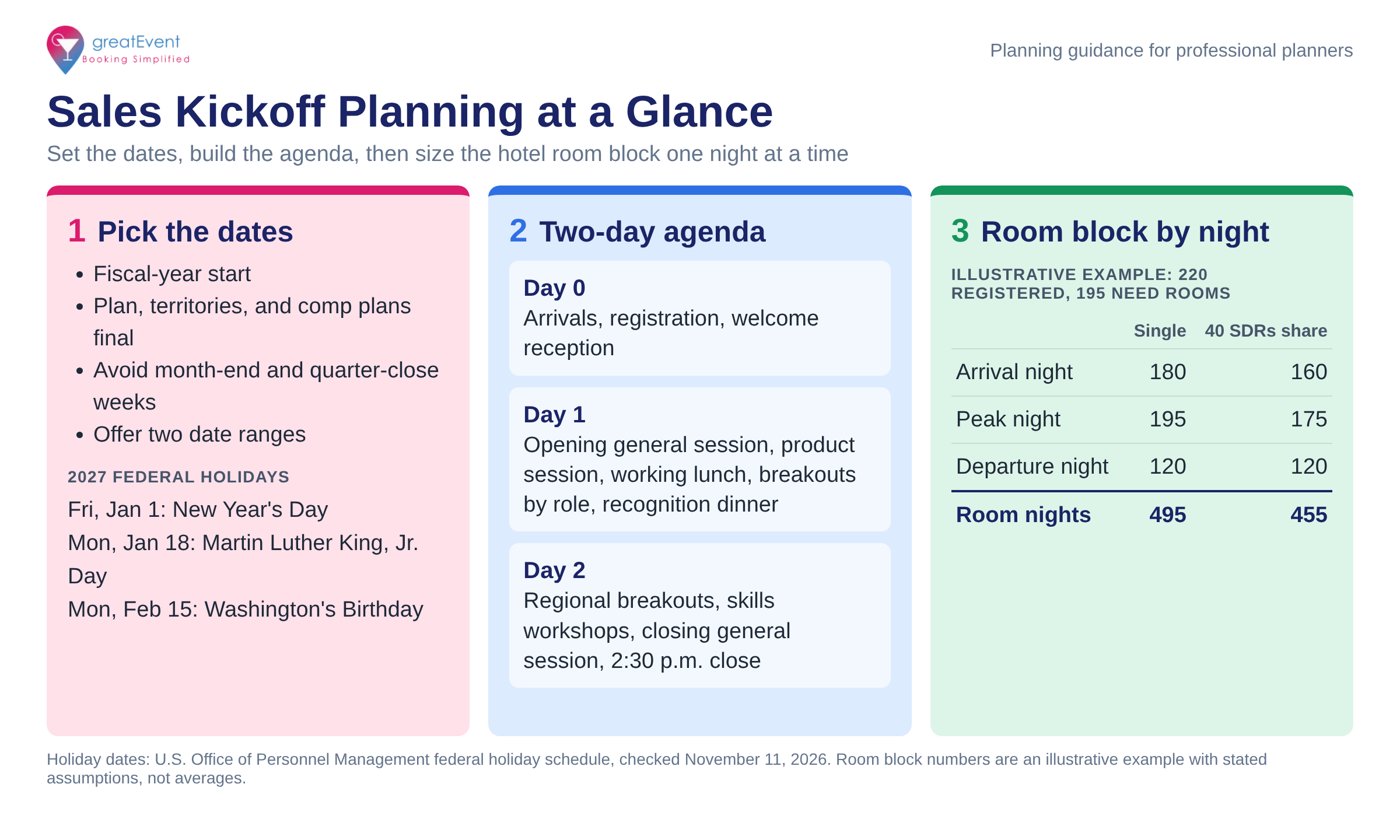
Text version of the infographic: Sales kickoff planning at a glance. Step 1, pick the dates: fiscal-year start; plan, territories, and comp plans final; avoid month-end and quarter-close weeks; check 2027 federal holidays (New Year’s Day, Friday, January 1; Martin Luther King, Jr. Day, Monday, January 18; Washington’s Birthday, Monday, February 15); offer two date ranges. Step 2, a two-day agenda: Day 0, arrivals, registration, and a welcome reception; Day 1, opening general session, product session, working lunch, breakouts by role, and a recognition dinner; Day 2, regional breakouts, skills workshops, closing general session, and a 2:30 p.m. close. Step 3, size the hotel room block night by night (illustrative example): 220 registered, 195 need rooms; arrival night 180, peak night 195, departure night 120, total 495 room nights; with 40 SDRs sharing, 160, 175, and 120, total 455. Holiday dates from the U.S. Office of Personnel Management; room block numbers are an illustrative example with stated assumptions.
One-page sales kickoff checklist
Copy this into your planning document and add an owner and a date to each line.
SALES KICKOFF CHECKLIST
Client: ______________  Fiscal year starts: ______  Sales leader: ______________
Planner: ______________  Client approver: ______________  Version: ___

1. DATES
[ ] Plan, territories, and comp plans final by: ______
[ ] Month-end / quarter-close weeks to avoid: ______
[ ] Holidays and long weekends checked (federal + client calendar)
[ ] CEO and sales leader confirmed for the general session
[ ] Date range 1: ______  Date range 2: ______

2. HEADCOUNT
[ ] Invite list from sales operations (roles + regions)
[ ] Other teams attending (SE, CS, marketing, partners): ___
[ ] Expected attendance: ___  Local / not staying: ___

3. AGENDA
[ ] Arrival day plan + welcome reception
[ ] General session sessions and speakers
[ ] Breakouts by role: ___ rooms  |  by region: ___ rooms
[ ] Busiest slot: ___ rooms at once
[ ] Confidential sessions in closed rooms
[ ] Recognition dinner: location ___  time ___
[ ] Close time on the last day: ___
[ ] Theme line approved by: ______

4. VENUE
[ ] General session room seats ___ in ___ layout, held both days
[ ] Breakout rooms near the general session room
[ ] Space for reception, lunches, and dinner (or turn time: ___)
[ ] Other groups in house on our dates: ___
[ ] Setup and teardown times for our vendors and suppliers
[ ] Hold expiry dates: ______

5. HOTEL ROOM BLOCK
[ ] Rooms per night: Day 0 ___  Day 1 ___  Day 2 ___  Total ___
[ ] Single vs shared room policy confirmed
[ ] Booking link or rooming list; who sends changes: ___
[ ] Cut-off date: ______  Pickup reminder sent: ______
[ ] Attrition terms reviewed  |  Overflow hotel needed? Y / N

6. AFTER THE KICKOFF
[ ] Final invoice checked against the contract
[ ] Room pickup checked against the block
[ ] Survey sent  |  Notes for next year's dates and block
Plan the sales kickoff venue and vendors on greatEvent
Start the venue search once you have the date ranges, the headcount, and the busiest breakout slot. Those three numbers decide which hotels and conference centers can host the kickoff.
On greatEvent, start a venue search with the meeting type, location, date, and attendee count. You can compare hotels and venues side by side, check real-time availability, or send one inquiry to several venues and get quotes back. Set up the hotel room block with the hotel at the same time as the meeting space, so the general session room and the peak night are confirmed for the same dates. You can also find your vendors and suppliers for the kickoff on greatEvent, from caterers for the recognition dinner to transportation for arrival day.
There are no fees for planners. We pay you commission on any qualifying booking you make on greatEvent.
Register as a professional planner
Frequently asked questions
What is a sales kickoff?
▾
A sales kickoff, or SKO, is a company’s annual meeting for its sales team, usually held at the start of the fiscal year. Leaders review the previous year, present the new plan and goals, and train the team on what changes.
When do companies hold their sales kickoff?
▾
Usually early in the fiscal year, so January or February for companies whose fiscal year follows the calendar. Pick the dates after the plan and comp plans are final, and avoid month-end, quarter-close weeks, and holidays.
How long should a sales kickoff be?
▾
There is no standard length. Two meeting days plus an arrival evening fits a general session, role and regional breakouts, and a recognition dinner without keeping sellers away from customers for most of a week.
What should a sales kickoff agenda include?
▾
An opening general session on results and the new plan, product and customer sessions, breakouts by role and by region, a working lunch, a recognition dinner, and a closing session with the next quarter’s priorities.
What kind of venue works for a sales kickoff?
▾
Usually a hotel with a ballroom for the general session, enough breakout rooms for the busiest time slot, and a room block under the same contract. Very large kickoffs may need a convention center and several hotels.
How do you calculate the hotel room block for a sales kickoff?
▾
Count rooms night by night. Start with attendees who need a room, remove anyone arriving on the first meeting morning, add only those staying after the last session, and adjust for any shared rooms.
Research and sources
Sources were checked on November 11, 2026. The opening scenario is fictional. The agenda template, the venue ranges by headcount, the venue questions, and the checklist are planning guidance. The room block numbers are an illustrative example based on the stated assumptions, not averages, and no prices are given.
- Federal Holidays, U.S. Office of Personnel Management, 2027 holiday schedule, https://www.opm.gov/policy-data-oversight/pay-leave/federal-holidays/, read November 11, 2026.
- How To Plan the Ultimate Sales Kickoff: 5 Things You Need To Do, Lynne Zaledonis, Salesforce blog, January 15, 2020, read November 11, 2026.
Compare vendors for your next event
Search caterers, photographers, florists, planners, and rentals — then send one request to several vendors at once.